Whisper — Architecture & Fine-Tuning
Whisper is a 30-second-window transformer encoder-decoder, trained on 680k hours of multilingual weakly-supervised audio-text pairs. One architecture, multiple tasks, robust across 99 languages. The 2026 reference ASR.
Lesson 5 of 17Build~75 minutesPython
Before this: Lesson 4 of Phase 6 (ASR), lesson 10 of Phase 5 (Attention), lesson 5 of Phase 7 (Full Transformer)
On this page
The Problem
Whisper, released by OpenAI in September 2022, was the first ASR model to ship as a commodity: paste audio, get text, 99 languages, robust to noise, runs on a laptop. By 2024 OpenAI had shipped Large-v3 and Turbo variants; by 2026, Whisper is the default baseline for everything from podcast transcription to voice assistants to YouTube subtitles.
But Whisper is not a pipeline you can treat as a black box forever. Domain shift kills it — technical jargon, speaker accents, proper nouns, short clips, silence. You need to know:
- What it actually is inside.
- How to give it chunked, streaming, or long-form audio correctly.
- When to fine-tune and how.
The Concept
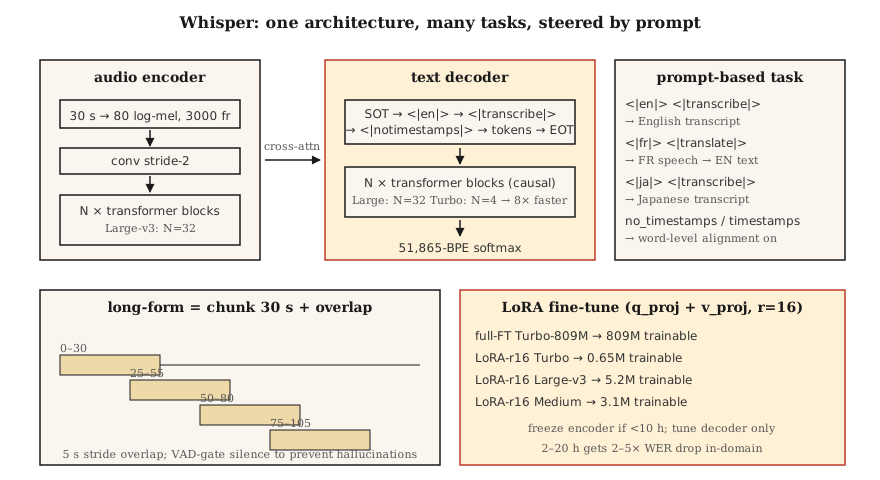
Architecture. Standard transformer encoder-decoder.
- Input: 30-second log-mel spectrogram, 80 mels, 10 ms hop → 3000 frames. Clips shorter are zero-padded, clips longer are chunked.
- Encoder: conv-downsample (stride 2) +
Ntransformer blocks. For Large-v3: 32 layers, 1280-dim, 20 heads. - Decoder:
Ntransformer blocks with causal self-attn + cross-attn to encoder output. Same size as encoder. - Output: BPE tokens over a 51,865-token vocab.
Large-v3 has 1.55B params. Turbo uses a 4-layer decoder (from 32), cutting latency 8× with a <1% WER hit.
The prompt format. Whisper is a multitask model steered by special tokens in the decoder prompt:
<|startoftranscript|><|en|><|transcribe|><|notimestamps|> Hello world.<|endoftext|><|en|>: language tag; names the language spoken in the audio. Leave it out and Whisper detects the language first.<|transcribe|>or<|translate|>: task tag; transcribe the speech in its source language, or translate it to English text.<|notimestamps|>: skip word-level timestamps (faster).
The prompt is what lets one model do many tasks. Change <|en|> to <|fr|> and it transcribes French.
30-second window. Everything is pinned to 30 seconds. Longer clips need chunking; shorter clips are padded. Windows are not streamed natively — this is why WhisperX, Whisper-Streaming, and faster-whisper exist.
Log-mel normalization. (log_mel - mean) / std where the stats come from Whisper's own training corpus. You must use Whisper's preprocessing (whisper.audio.log_mel_spectrogram), not librosa.feature.melspectrogram.
Variants in 2026
| Variant | Params | Latency (A100) | WER (LibriSpeech-clean) |
|---|---|---|---|
| Tiny | 39M | 1× realtime | 5.4% |
| Base | 74M | 1× | 4.1% |
| Small | 244M | 1× | 3.0% |
| Medium | 769M | 1× | 2.7% |
| Large-v3 | 1.55B | 2× | 1.8% |
| Large-v3-turbo | 809M | 8× | 1.58% |
| Whisper-Streaming (2024) | 1.55B | streaming | 2.0% |
Fine-tuning
Canonical workflow in 2026:
- Collect 10–100 hours of target-domain audio with aligned transcripts.
- Run
transformers.Seq2SeqTrainerwithgenerate_with_losscallback. - Parameter-efficient: LoRA on
q_proj,k_proj,v_projof attention layers reduces GPU memory 4× with <0.3 WER cost. - Freeze the encoder if you have <10 hours. Only tune the decoder.
- Use Whisper's own tokenizer and prompt format; never swap tokenizers.
Community results: fine-tuning Medium on 20 hours of medical dictation drops WER from 12% to 4.5% on medical vocabulary. Fine-tuning Turbo on 4 hours of Icelandic drops WER from 18% to 6%.
sp-asr-attentionBuild It
Step 1: run Whisper out of the box
import whisper
model = whisper.load_model("large-v3-turbo")
result = model.transcribe(
    "clip.wav",
    language="en",
    task="transcribe",
    temperature=0.0,
    condition_on_previous_text=False,  # prevents runaway repetition
)
print(result["text"])
for seg in result["segments"]:
    print(f"[{seg['start']:.2f}–{seg['end']:.2f}] {seg['text']}")
Key defaults you should always override: temperature=0.0 (sampling defaults to 0.0 → 0.2 → 0.4 … fallback chain), condition_on_previous_text=False (prevents the cascading hallucination problem), and no_speech_threshold=0.6 (silence detection).
Step 2: chunked long-form
# whisperx is the 2026 reference for long-form with word-level timestamps
import whisperx
model = whisperx.load_model("large-v3-turbo", device="cuda", compute_type="float16")
segments = model.transcribe("1hour.mp3", batch_size=16, chunk_size=30)
WhisperX adds (1) Silero VAD gating, (2) word-level alignment via wav2vec 2.0, (3) diarization via pyannote.audio. The 2026 workhorse for production transcription.
Step 3: fine-tune with LoRA
from transformers import WhisperForConditionalGeneration, WhisperProcessor
from peft import LoraConfig, get_peft_model

model = WhisperForConditionalGeneration.from_pretrained("openai/whisper-large-v3-turbo")
lora = LoraConfig(
    r=16, lora_alpha=32, target_modules=["q_proj", "v_proj"],
    lora_dropout=0.1, bias="none", task_type="SEQ_2_SEQ_LM",
)
model = get_peft_model(model, lora)
# model.print_trainable_parameters()  -> ~3M trainable / 809M total
Then standard Trainer loop. Checkpoint every 1000 steps. Evaluate with WER on held-out.
Step 4: inspect what each layer learns
# Grab cross-attention weights during decode to see what the decoder attends to.
with torch.inference_mode():
    out = model.generate(
        input_features=features,
        return_dict_in_generate=True,
        output_attentions=True,
    )
# out.cross_attentions: layer × head × step × src_len
Visualize with a heatmap — you will see diagonal alignment as decoder steps scan through encoder frames. That diagonal is Whisper's notion of word timestamps.
Use It
The 2026 stack:
| Situation | Pick |
|---|---|
| General English, offline | Large-v3-turbo via whisperx |
| Mobile / edge | Whisper-Tiny quantized (int8) or Moonshine |
| Multilingual long-form | Large-v3 via whisperx + diarization |
| Low-resource language | Fine-tune Medium or Turbo with LoRA |
| Streaming (2 s latency) | Whisper-Streaming or Parakeet-TDT |
| Word-level timestamps | WhisperX (forced alignment via wav2vec 2.0) |
faster-whisper (CTranslate2 backend) is the fastest CPU+GPU inference runtime in 2026 — 4× faster than vanilla with identical output.
Pitfalls that still ship in 2026
- Hallucinated text on silence. Whisper trained on captions includes "Thanks for watching!", "Subscribe!", song lyrics. Always VAD-gate before calling.
condition_on_previous_textcascade. One hallucination pollutes subsequent windows. SetFalseunless you need fluency across chunks.- Short-clip padding. A 2-second clip padded to 30 seconds can hallucinate in the trailing silence. Use
pad=Falseor VAD-gate. - Wrong mel stats. Using librosa's mels instead of Whisper's produces near-random output. Use
whisper.audio.log_mel_spectrogram.
Ship It
Save as outputs/skill-whisper-tuner.md. Design a Whisper fine-tune or inference pipeline for a given domain.
Exercises
- Easy. Run
code/main.py. It tokenizes a Whisper-style prompt, computes decoded shape budgets, and prints the chunk schedule for a 10-minute clip. - Medium. Install
faster-whisper, transcribe a 10-minute podcast, compare WER against a human transcript. Trylanguage="auto"vs forcedlanguage="en". - Hard. Using HF
datasets, pick a language Whisper struggles with (e.g., Urdu), fine-tune Medium with LoRA for 2 epochs on 2 hours, and report WER delta.
Key Terms
| Term | What people say | What it actually means |
|---|---|---|
| 30-sec window | Whisper's limit | Hard input cap; chunk longer audio. |
| SOT | Start-of-transcript | <|startoftranscript|> kicks off the decoder prompt. |
| Timestamps token | Temporal alignment | Every 0.02 s offset is a special token in the 51k vocab. |
| Turbo | The fast variant | 4-decoder layers, 8× faster, <1% WER regression. |
| WhisperX | The long-form wrapper | VAD + Whisper + wav2vec alignment + diarization. |
| LoRA fine-tune | Efficient tuning | Add low-rank adapters to attention; train ~0.3% of params. |
| Hallucination | The silent failure | Whisper produces fluent English from noise/silence. |
Further Reading
- Radford et al. (2022). Whisper paper — the original architecture and training recipe.
- OpenAI (2024). Whisper Large-v3-turbo release — 4-layer decoder, 8× speedup.
- Bain et al. (2023). WhisperX — long-form, word-aligned, diarized.
- Systran — faster-whisper repo — CTranslate2-backed, 4× faster.
- HuggingFace — Whisper fine-tune tutorial — canonical LoRA / full-FT walkthrough.
Questions people ask
Can Whisper be fine-tuned on custom data?
Yes. You can fine-tune Whisper on pairs of audio and correct transcripts from your own domain, such as product names or local accents. Libraries like Hugging Face Transformers support this, and smaller Whisper sizes can be tuned on a single GPU.
Why does Whisper sometimes hallucinate text?
Whisper predicts text like a language model, so on silence, music or noisy audio it can produce words that were never spoken or repeat phrases. Trimming silence with voice activity detection and checking confidence scores reduces the problem.
Lessons from AI Engineering from Scratch by Rohit Ghumare and contributors, MIT license. Notes for owners by Lozo. License