Attention Mechanism — The Breakthrough
The decoder stops squinting at a compressed summary and starts looking at the whole source. Everything after this is attention plus engineering.
Lesson 10 of 29Build~45 minutesPython
Before this: Lesson 9 of Phase 5 (Sequence-to-Sequence Models)
On this page
The Problem
Lesson 09 ended on a measured failure. A GRU encoder-decoder trained on a toy copy task goes from 89% accuracy at length 5 to near-chance at length 80. The reason is structural, not a training bug: every bit of information the encoder gleaned has to fit in one fixed-size hidden state, and the decoder never sees anything else.
Bahdanau, Cho, and Bengio published a three-line fix in 2014. Instead of giving the decoder only the final encoder state, keep every encoder state. At each decoder step, compute a weighted average of encoder states where the weights say "how much does the decoder need to look at encoder position i right now?" That weighted average is the context, and it changes every decoder step.
That is the whole idea. Transformers extended it. Self-attention applied it to a single sequence. Multi-head attention ran it in parallel. But the 2014 version already broke the bottleneck, and once you have it, the pivot to transformers is engineering, not conceptual.
The Concept
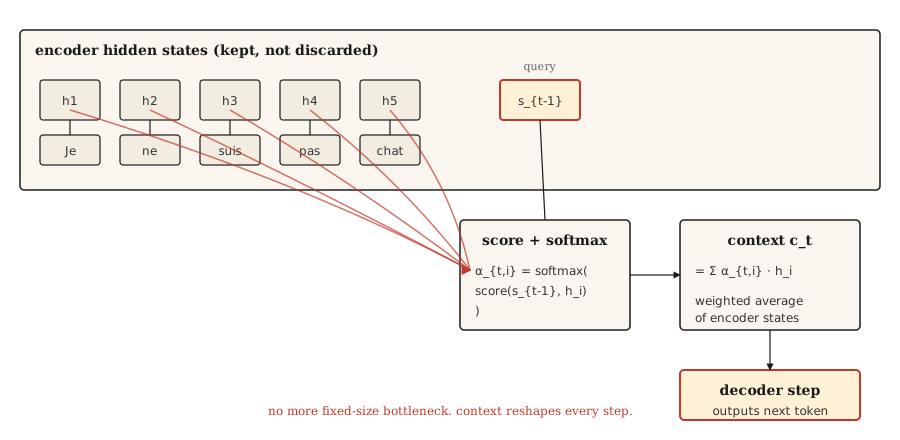
At each decoder step t:
- Use the previous decoder hidden state
s_{t-1}as a query. - Score it against every encoder hidden state
h_1, ..., h_T. One scalar per encoder position. - Softmax the scores to get attention weights
α_{t,1}, ..., α_{t,T}that sum to 1. - Context vector
c_t = Σ α_{t,i} * h_i. Weighted average of encoder states. - Decoder takes
c_tplus the previous output token, produces the next token.
The weighted average is the point. When the decoder needs to translate "Je" to "I", it weights the encoder state over "Je" high and the others low. When it needs "not", it weights "pas" high. The context vector reshapes each step.
Shapes (the thing that bites everyone)
This is where every attention implementation goes wrong the first time. Read slowly.
| Thing | Shape | Notes |
|---|---|---|
Encoder hidden states H |
(T_enc, d_h) |
If BiLSTM, d_h = 2 * d_hidden |
Decoder hidden state s_{t-1} |
(d_s,) |
One vector |
Attention score e_{t,i} |
scalar | One per encoder position |
Attention weight α_{t,i} |
scalar | After softmax over all i |
Context vector c_t |
(d_h,) |
Same shape as an encoder state |
Bahdanau (additive) score. e_{t,i} = v_α^T * tanh(W_a * s_{t-1} + U_a * h_i).
s_{t-1}has shape(d_s,),h_ihas shape(d_h,).W_ahas shape(d_attn, d_s).U_ahas shape(d_attn, d_h).- Their sum inside the tanh has shape
(d_attn,). v_αhas shape(d_attn,). The inner product withv_αcollapses to a scalar. This is whatv_αdoes. It is not magic. It is the projection that turns an attention-dim vector into a scalar score.
Luong (multiplicative) score. Three variants:
dot:e_{t,i} = s_t^T * h_i. Requiresd_s == d_h. Hard constraint. Skip if your encoder is bidirectional.general:e_{t,i} = s_t^T * W * h_iwithWshape(d_s, d_h). Removes the equal-dim constraint.concat: essentially the Bahdanau form. Rarely used since the first two are cheaper.
One Bahdanau / Luong gotcha worth naming. Bahdanau uses s_{t-1} (the decoder state before generating the current word). Luong uses s_t (the state after). Mixing them up produces subtly wrong gradients that are extremely hard to debug. Pick one paper and stick to its convention.
attention-heatmapBuild It
Step 1: additive (Bahdanau) attention
import numpy as np


def additive_attention(decoder_state, encoder_states, W_a, U_a, v_a):
    projected_dec = W_a @ decoder_state
    projected_enc = encoder_states @ U_a.T
    combined = np.tanh(projected_enc + projected_dec)
    scores = combined @ v_a
    weights = softmax(scores)
    context = weights @ encoder_states
    return context, weights


def softmax(x):
    x = x - np.max(x)
    e = np.exp(x)
    return e / e.sum()
Check your shapes against the table above. encoder_states has shape (T_enc, d_h). projected_enc has shape (T_enc, d_attn). projected_dec has shape (d_attn,) and broadcasts. combined has shape (T_enc, d_attn). scores has shape (T_enc,). weights has shape (T_enc,). context has shape (d_h,). Ship it.
Step 2: Luong dot and general
def dot_attention(decoder_state, encoder_states):
    scores = encoder_states @ decoder_state
    weights = softmax(scores)
    return weights @ encoder_states, weights


def general_attention(decoder_state, encoder_states, W):
    projected = W.T @ decoder_state
    scores = encoder_states @ projected
    weights = softmax(scores)
    return weights @ encoder_states, weights
Three lines each. This is why Luong's paper landed. Same accuracy on most tasks, a lot less code.
Step 3: a worked numerical example
Given three encoder states (roughly "cat", "sat", "mat") and a decoder state that aligns most with the first, the attention distribution concentrates on position 0. If the decoder state shifts to align with the last, attention moves to position 2. The context vector tracks.
H = np.array([
    [1.0, 0.0, 0.2],
    [0.5, 0.5, 0.1],
    [0.1, 0.9, 0.3],
])

s_close_to_cat = np.array([0.9, 0.1, 0.2])
ctx, w = dot_attention(s_close_to_cat, H)
print("weights:", w.round(3))
weights: [0.464 0.305 0.231]First row wins. Then move the decoder state closer to the third encoder state and watch the weights shift. That is it. Attention is explicit alignment.
Step 4: why this is the bridge to transformers
Translate the language above into Q/K/V:
- Query = decoder state
s_{t-1} - Key = encoder states (what we score against)
- Value = encoder states (what we weight and sum)
In classical attention, keys and values are the same thing. Self-attention separates them: you can query a sequence against itself, with different learned projections for K and V. Multi-head attention runs it in parallel with different learned projections. Transformers stack the whole stage many times and drop RNNs.
The math is the same. The shapes are the same. The pedagogical jump from Bahdanau attention to scaled dot-product attention is mostly notation.
Use It
PyTorch and TensorFlow ship attention directly.
import torch
import torch.nn as nn

mha = nn.MultiheadAttention(embed_dim=128, num_heads=8, batch_first=True)
query = torch.randn(2, 5, 128)
key = torch.randn(2, 10, 128)
value = torch.randn(2, 10, 128)

output, weights = mha(query, key, value)
print(output.shape, weights.shape)
torch.Size([2, 5, 128]) torch.Size([2, 5, 10])That is a transformer attention layer. Query batch of 5 positions, key/value batch of 10 positions, 128-dim each, 8 heads. output is the new context-augmented queries. weights is the 5x10 alignment matrix you can visualize.
When classical attention still matters
- Pedagogy. The single-head, single-layer, RNN-based version makes every concept visible.
- On-device sequence tasks where transformers do not fit.
- Any paper from 2014-2017. You will misread it without knowing Bahdanau's convention.
- Fine-grained alignment analysis in MT. Raw attention weights are an interpretability tool even on transformer models, and reading them requires knowing what they are.
The attention-weight-as-explanation trap
Attention weights look interpretable. They are weights that sum to one across positions; you can plot them; high means "looked at this." Reviewers love them.
They are not as interpretable as they look. Jain and Wallace (2019) showed that attention distributions can be permuted and replaced by arbitrary alternatives without changing model predictions for some tasks. Never report attention weights as evidence of reasoning without an ablation or counterfactual check.
Ship It
Save as outputs/prompt-attention-shapes.md:
---
name: attention-shapes
description: Debug shape bugs in attention implementations.
phase: 5
lesson: 10
---

Given a broken attention implementation, you identify the shape mismatch. Output:

1. Which matrix has the wrong shape. Name the tensor.
2. What its shape should be, derived from (d_s, d_h, d_attn, T_enc, T_dec, batch_size).
3. One-line fix. Transpose, reshape, or project.
4. A test to catch regressions. Typically: assert `output.shape == (batch, T_dec, d_h)` and `weights.shape == (batch, T_dec, T_enc)` and `weights.sum(dim=-1) close to 1`.

Refuse to recommend fixes that silently broadcast. Broadcast-hiding bugs surface later as silent accuracy degradation, the worst kind of attention bug.

For Bahdanau confusion, insist the decoder input is `s_{t-1}` (pre-step state). For Luong, `s_t` (post-step state). For dot-product, flag dimension mismatch between query and key as the most common first-time error.
Exercises
- Easy. Implement
softmaxmasking so padding tokens in the encoder get attention weight zero. Test on a batch with variable-length sequences. - Medium. Add multi-head attention to the Luong
generalform. Splitd_hinton_headsgroups, run attention per head, concatenate. Verify the single-head case matches your earlier implementation. - Hard. Train a GRU encoder-decoder with Bahdanau attention on the toy copy task from lesson 09. Plot accuracy vs sequence length. Compare against the no-attention baseline. You should see the gap widen as length grows, confirming attention lifts the bottleneck.
Key Terms
| Term | What people say | What it actually means |
|---|---|---|
| Attention | Looking at things | Weighted average of a value sequence, weights computed from a query-key similarity. |
| Query, Key, Value | QKV | Three projections: Q asks, K is what to match, V is what to return. |
| Additive attention | Bahdanau | Feed-forward score: v^T tanh(W q + U k). |
| Multiplicative attention | Luong dot / general | Score is q^T k or q^T W k. Cheaper, same accuracy on most tasks. |
| Alignment matrix | The pretty picture | Attention weights as a (T_dec, T_enc) grid. Read it to see what the model attended to. |
Further Reading
- Bahdanau, Cho, Bengio (2014). Neural Machine Translation by Jointly Learning to Align and Translate — the paper.
- Luong, Pham, Manning (2015). Effective Approaches to Attention-based Neural Machine Translation — the three score variants and their comparison.
- Jain and Wallace (2019). Attention is not Explanation — the interpretability caveat.
- Dive into Deep Learning — Bahdanau Attention — runnable walkthrough with PyTorch.
Check yourself
Quick quiz
What problem in seq2seq did Bahdanau attention solve?
- Tokenization mismatch
- Beam search latency
- The fixed-size context-vector bottleneck where the decoder only saw the encoder's final state
- Vanishing gradients in encoders
Show the answer
C. The fixed-size context-vector bottleneck where the decoder only saw the encoder's final state Attention lets the decoder consult every encoder state, not just the last one.
What is the attention context vector at decoder step t?
- The encoder's final hidden state
- The decoder's input embedding
- A random projection
- A weighted average of encoder hidden states where the weights come from a query-key score
Show the answer
D. A weighted average of encoder hidden states where the weights come from a query-key score Context = sum of alpha_i * h_i, a step-dependent weighted average of encoder states.
In Bahdanau (additive) attention, what role does the vector v_a play?
- It encodes positions
- It biases the softmax
- It controls dropout
- It is the projection that turns the attention-dim hidden combination into a scalar score per encoder position
Show the answer
D. It is the projection that turns the attention-dim hidden combination into a scalar score per encoder position v_a dot-products with tanh(W_a s + U_a h) to collapse a d_attn vector into a scalar score.
In Luong's 'dot' attention variant, what constraint must hold?
- Beam search is required
- Decoder state and encoder state must share the same dimensionality (d_s == d_h)
- Softmax must be log-space
- The encoder must be bidirectional
Show the answer
B. Decoder state and encoder state must share the same dimensionality (d_s == d_h) dot uses s^T h with no projection, so dimensions must match exactly.
Which Q/K/V mapping describes classical (Bahdanau/Luong) attention?
- Q from encoder, K and V from decoder
- Q, K, V are three independent learned projections of the source
- Q = decoder state; K and V = encoder states (same tensor)
- Q is random, K and V are learned
Show the answer
C. Q = decoder state; K and V = encoder states (same tensor) In classical attention, keys and values are both encoder states; transformers split K and V via learned projections.
Why is reporting raw attention weights as 'explanation' considered fragile?
- Research (e.g. Jain and Wallace, 2019) showed attention distributions can be permuted without changing predictions on some tasks
- Attention weights are not differentiable
- Attention weights leak labels
- They are too small to plot
Show the answer
A. Research (e.g. Jain and Wallace, 2019) showed attention distributions can be permuted without changing predictions on some tasks Attention weights are correlated with predictions but not faithful explanations without ablation/counterfactual checks.
Which step bridges Bahdanau attention to transformer self-attention?
- Querying a sequence against itself with separately learned Q, K, and V projections, run in parallel heads
- Dropping beam search
- Replacing softmax with sigmoid
- Adding more RNN layers
Show the answer
A. Querying a sequence against itself with separately learned Q, K, and V projections, run in parallel heads Self-attention queries the same sequence, with split K and V projections, parallelized across heads.
What is one practical use case for masking in attention?
- Replacing dropout
- Encoding positions
- Setting attention weight for padding tokens to zero so they do not contribute to the context vector
- Reducing model size
Show the answer
C. Setting attention weight for padding tokens to zero so they do not contribute to the context vector Masking padding (or future tokens in a decoder) prevents the softmax from spreading weight onto invalid positions.
Questions people ask
What problem does the attention mechanism solve?
It removes the need to compress a whole input into one fixed summary. At each output step, the model scores every input position for relevance and blends them by those scores. This keeps detail from long inputs and made translation and later language models much better.
Is attention the same thing as a transformer?
No. Attention is a technique. A transformer is a full model design built mostly from attention layers, plus other parts like feed-forward layers and normalization. Attention was first added to RNN models before transformers dropped the RNN part entirely.
Lessons from AI Engineering from Scratch by Rohit Ghumare and contributors, MIT license. Notes for owners by Lozo. License