Voice Anti-Spoofing & Audio Watermarking — ASVspoof 5, AudioSeal, WaveVerify
Voice cloning shipped faster than defenses. 2026 production voice systems need two things: a detector (AASIST, RawNet2) that classifies real vs fake speech, and a watermark (AudioSeal) that survives compression and editing. Ship both or do not ship voice cloning.
Lesson 16 of 17Build~75 minutesPython
Before this: Lesson 6 of Phase 6 (Speaker Recognition), lesson 8 of Phase 6 (Voice Cloning)
On this page
The Problem
Three related defenses:
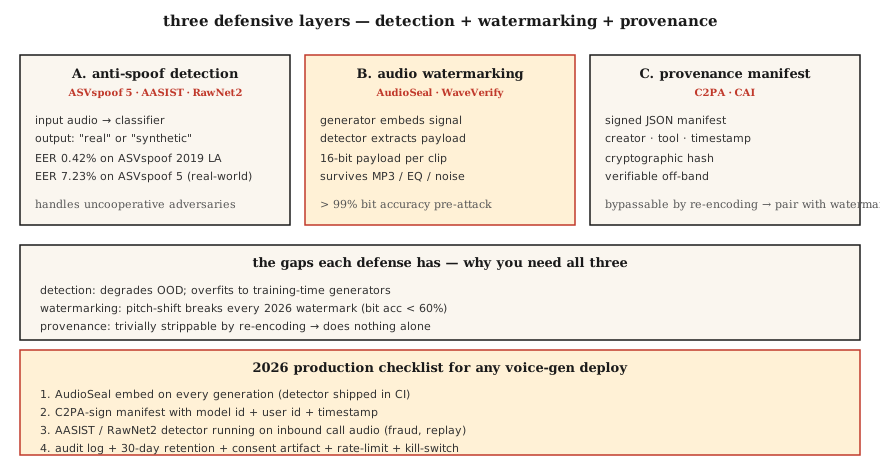
- Anti-spoofing / deepfake detection. Given an audio clip, is it synthetic or real? ASVspoof benchmarks (ASVspoof 2019 → 2021 → 5) are the gold standard.
- Audio watermarking. Embed an imperceptible signal in generated audio that a detector can extract later. AudioSeal (Meta) and WavMark are the open options.
- Authenticated provenance. Cryptographic signing of audio files + metadata. C2PA / Content Authenticity Initiative.
Detection handles adversaries who don't cooperate. Watermarking handles compliance — AI-generated audio should be identifiable as such. Both are required in 2026.
The Concept
ASVspoof 5 — the 2024-2025 benchmark
Biggest change from prior editions:
- Crowdsourced data (not studio clean) — realistic conditions.
- ~2000 speakers (vs ~100 before).
- 32 attack algorithms. TTS + voice conversion + adversarial perturbation.
- Two tracks. Countermeasure (CM) standalone detection; Spoofing-robust ASV (SASV) for biometric systems.
State-of-the-art on ASVspoof 5: ~7.23% EER. On the older ASVspoof 2019 LA: 0.42% EER. Real-world deployment: expect 5-10% EER on in-the-wild clips.
AASIST and RawNet2 — detection model families
AASIST (2021, updated through 2026). Graph-attention on spectral features. Current SOTA on ASVspoof 5 countermeasure task.
RawNet2. Convolutional front-end over raw waveform + TDNN backbone. Simpler baseline; still competitive with fine-tuning.
NeXt-TDNN + SSL features. 2025 variant: ECAPA-style + WavLM features + focal loss. Achieves the 0.42% EER on ASVspoof 2019 LA.
AudioSeal — the 2024 watermark default
Meta's AudioSeal (Jan 2024, v0.2 Dec 2024). Key design:
- Localized. Detects the watermark per-frame at 16 kHz sample resolution (1/16000 s).
- Generator + detector jointly trained. Generator learns to embed inaudible signal; detector learns to find it through augmentations.
- Robust. Survives MP3 / AAC compression, EQ, speed-shift ±10%, noise mix +10 dB SNR.
- Fast. Detector runs at 485× realtime; 1000× faster than WavMark.
- Capacity. 16-bit payload (can encode model ID, generation timestamp, user ID) embeddable in each utterance.
WavMark
The pre-AudioSeal open baseline. Invertible neural network, 32 bits/sec. Problems:
- Synchronization brute-force is slow.
- Can be removed by Gaussian noise or MP3 compression.
- Not real-time friendly.
WaveVerify (July 2025)
Addresses AudioSeal's weaknesses — specifically temporal manipulations (reversal, speed). Uses FiLM-based generator + Mixture-of-Experts detector. Competitive with AudioSeal on standard attacks; handles temporal edits.
The gap adversaries exploit
From AudioMarkBench: "under pitch shift, all watermarks show Bit Recovery Accuracy below 0.6, indicating near-complete removal." Pitch-shift is the universal attack. No 2026 watermark is fully robust to aggressive pitch modification. This is why you need detection (AASIST) alongside watermarking.
C2PA / Content Authenticity Initiative
Not an ML technique — a manifest format. Audio files carry cryptographically signed metadata about creation tool, author, date. Audobox / Seamless use it. Good for provenance; does nothing if a bad actor re-encodes and strips metadata.
v4-audio-watermarkBuild It
Step 1: a simple spectral-feature detector (toy)
def spectral_rolloff(spec, percentile=0.85):
    cum = 0
    total = sum(spec)
    if total == 0:
        return 0
    threshold = total * percentile
    for k, v in enumerate(spec):
        cum += v
        if cum >= threshold:
            return k
    return len(spec) - 1

def is_suspicious(audio):
    spec = magnitude_spectrum(audio)
    rolloff = spectral_rolloff(spec)
    return rolloff / len(spec) > 0.92
Synthetic speech often has unusually flat high-frequency energy. Production detectors use AASIST, not this. But the intuition holds.
Step 2: AudioSeal embed + detect
from audioseal import AudioSeal
import torch

generator = AudioSeal.load_generator("audioseal_wm_16bits")
detector = AudioSeal.load_detector("audioseal_detector_16bits")

audio = load_wav("generated.wav", sr=16000)[None, None, :]
payload = torch.tensor([[1, 0, 1, 1, 0, 1, 0, 0, 1, 1, 0, 1, 0, 1, 1, 0]])
watermark = generator.get_watermark(audio, sample_rate=16000, message=payload)
watermarked = audio + watermark

result, decoded_payload = detector.detect_watermark(watermarked, sample_rate=16000)
# result: float in [0, 1] — probability of watermark presence
# decoded_payload: 16 bits; match against embedded payload
Step 3: evaluation — EER
def eer(real_scores, fake_scores):
    thresholds = sorted(set(real_scores + fake_scores))
    best = (1.0, 0.0)
    for t in thresholds:
        far = sum(1 for s in fake_scores if s >= t) / len(fake_scores)
        frr = sum(1 for s in real_scores if s < t) / len(real_scores)
        if abs(far - frr) < best[0]:
            best = (abs(far - frr), (far + frr) / 2)
    return best[1]
Step 4: the production integration
def safe_tts(text, voice, clone_reference=None):
    if clone_reference is not None:
        verify_consent(user_id, clone_reference)
    audio = tts_model.synthesize(text, voice)
    audio_with_wm = audioseal_embed(audio, payload=build_payload(user_id, model_id))
    manifest = c2pa_sign(audio_with_wm, user_id, timestamp=now())
    return audio_with_wm, manifest
Every generation ships: (1) watermark, (2) signed manifest, (3) retention-policy-compliant audit log.
Use It
| Use case | Defense |
|---|---|
| Shipping TTS / voice cloning | AudioSeal embed on every output (non-negotiable) |
| Biometric voice unlock | AASIST + ECAPA ensemble; liveness challenge |
| Call-center fraud detection | AASIST on 20% sample of incoming calls |
| Podcast authenticity | C2PA signing on upload, AudioSeal if AI-generated |
| Research / training detectors | ASVspoof 5 train/dev/eval sets |
Pitfalls
- Watermark without detector ever running. Pointless. Ship the detector in your CI.
- Detection without calibration. AASIST trained on ASVspoof LA overfits; real-world accuracy drops. Calibrate on your domain.
- Pitch-shift gap. Aggressive pitch shift removes most watermarks. Have a detection fallback.
- Metadata strip-and-rehost. C2PA is trivially bypassable by re-encoding. Always add cryptographic + perceptual (watermark) defense together.
- Liveness as detection. Ask user to say a random phrase. Prevents replay attacks but not real-time cloning.
Ship It
Save as outputs/skill-spoof-defender.md. Pick detection model, watermark, provenance manifest, and operational playbook for a voice-gen deployment.
Exercises
- Easy. Run
code/main.py. Toy detector + toy watermark embed/detect on synthetic audio. - Medium. Install
audioseal, embed a 16-bit payload in a TTS output, re-decode. Corrupt the audio with noise and measure Bit Recovery Accuracy. - Hard. Fine-tune a RawNet2 or AASIST on ASVspoof 2019 LA. Measure EER. Test on a held-out set of F5-TTS-generated clips — see how OOD detection degrades.
Key Terms
| Term | What people say | What it actually means |
|---|---|---|
| ASVspoof | The benchmark | Biennial challenge; 2024 = ASVspoof 5. |
| CM (countermeasure) | Detector | Classifier: real speech vs synthetic / converted. |
| SASV | Speaker verif + CM | Integrated biometric + spoof detection. |
| AudioSeal | Meta watermark | Localized, 16-bit payload, 485× faster than WavMark. |
| Bit Recovery Accuracy | Watermark survival | Fraction of payload bits recovered after attack. |
| C2PA | Provenance manifest | Cryptographic metadata about creation / authorship. |
| AASIST | Detector family | Graph-attention-based anti-spoofing SOTA. |
Further Reading
- Todisco et al. (2024). ASVspoof 5 — the current benchmark.
- Defossez et al. (2024). AudioSeal — the watermark default.
- Chen et al. (2025). WaveVerify — MoE detector for temporal attacks.
- Jung et al. (2022). AASIST — the SOTA detection backbone.
- AudioMarkBench (2024) — robustness evaluation.
- C2PA specification — provenance manifest format.
Questions people ask
Can AI detect deepfake voices?
Detection models trained on real and fake speech can catch many synthetic voices, but they are not perfect and can be fooled by new generators or heavy audio compression. Detection works best combined with process checks, like calling back on a known number.
What is audio watermarking?
Audio watermarking embeds a hidden signal in a recording that people cannot hear but software can detect. Tools like AudioSeal mark AI-generated speech so platforms can later identify it, even after common edits like compression or trimming.
Lessons from AI Engineering from Scratch by Rohit Ghumare and contributors, MIT license. Notes for owners by Lozo. License