Text-to-Speech (TTS) — From Tacotron to F5 and Kokoro
ASR inverts speech to text; TTS inverts text to speech. The 2026 stack is three parts: text → tokens, tokens → mel, mel → waveform. Each part has a default model that fits in a laptop.
Lesson 7 of 17Build~75 minutesPython
Before this: Lesson 2 of Phase 6 (Spectrograms & Mel), lesson 9 of Phase 5 (Seq2Seq), lesson 5 of Phase 7 (Full Transformer)
On this page
The Problem
You have a string: "Please remind me to water the plants at 6 pm." You need a 3-second audio clip that sounds natural, has correct prosody (pauses, stress), pronounces "plants" with the right vowel, and runs in under 300 ms on a CPU for a live voice assistant. You also need to swap voices, handle code-switched input ("remind me at 6 pm, daijoubu?"), and not embarrass yourself on names.
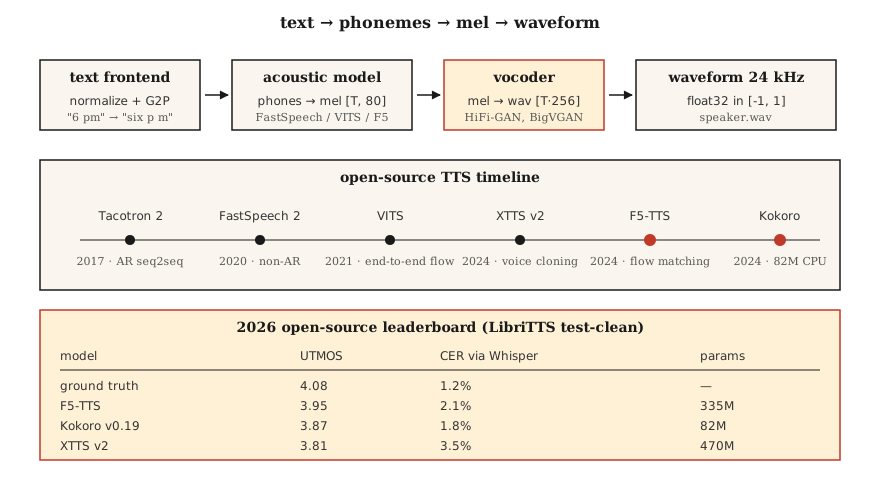
Modern TTS pipelines look like this:
- Text frontend. Normalize text (dates, numbers, emails), convert to phonemes or subword tokens, predict prosody features.
- Acoustic model. Text → mel spectrogram. Tacotron 2 (2017), FastSpeech 2 (2020), VITS (2021), F5-TTS (2024), Kokoro (2024).
- Vocoder. Mel → waveform. WaveNet (2016), WaveRNN, HiFi-GAN (2020), BigVGAN (2022), neural codec vocoders in 2024+.
In 2026 the acoustic + vocoder split blurs with end-to-end diffusion and flow-matching models. But the mental model of three parts still holds for debugging.
The Concept
Tacotron 2 (2017). Seq2seq: char-embedding → BiLSTM encoder → location-sensitive attention → autoregressive LSTM decoder emits mel frames. Slow (AR), wobbly on long text. Still cited as a baseline.
FastSpeech 2 (2020). Non-autoregressive. Duration predictor outputs how many mel frames each phoneme gets. 1-pass, 10× faster than Tacotron. Loses some naturalness (monotonic alignment) but ships everywhere.
VITS (2021). Jointly trains encoder + flow-based duration + HiFi-GAN vocoder end-to-end with variational inference. High quality, single model. Dominant open-source TTS 2022–2024. Variants: YourTTS (multi-speaker zero-shot), XTTS v2 (2024, Coqui).
F5-TTS (2024). Diffusion transformer over flow matching. Natural prosody, zero-shot voice cloning with 5 seconds of reference audio. Top of the 2026 open-source TTS leaderboards. 335M params.
Kokoro (2024). Small (82M), CPU-runnable, best-in-class English TTS for real-time use. Closed-vocabulary English-only, apache-2.0.
OpenAI TTS-1-HD, ElevenLabs v2.5, Google Chirp-3. Commercial state of the art. ElevenLabs v2.5 emotion tags ("[whispered]", "[laughing]") and character voices dominate audiobook production in 2026.
Vocoder evolution
| Era | Vocoder | Latency | Quality |
|---|---|---|---|
| 2016 | WaveNet | offline only | SOTA at release |
| 2018 | WaveRNN | ~realtime | good |
| 2020 | HiFi-GAN | 100× realtime | near-human |
| 2022 | BigVGAN | 50× realtime | generalizes across speakers/langs |
| 2024 | SNAC, DAC (neural codecs) | integrated with AR models | discrete tokens, bit-efficient |
By 2026 most "TTS" models are end-to-end from text to waveform; the mel spectrogram is an internal representation.
Evaluation
- MOS (Mean Opinion Score). 1–5 scale, crowd-sourced. Still the gold standard; painfully slow.
- CMOS (Comparative MOS). A-vs-B preference. Tighter confidence intervals per annotation.
- UTMOS, DNSMOS. Reference-free neural MOS predictors. Used for leaderboards.
- CER (Character Error Rate) via ASR. Run TTS output through Whisper, compute CER against the input text. Proxy for intelligibility.
- SECS (Speaker Embedding Cosine Similarity). Voice-cloning quality.
2026 numbers on LibriTTS test-clean:
| Model | UTMOS | CER (via Whisper) | Size |
|---|---|---|---|
| Ground truth | 4.08 | 1.2% | — |
| F5-TTS | 3.95 | 2.1% | 335M |
| XTTS v2 | 3.81 | 3.5% | 470M |
| VITS | 3.62 | 3.1% | 25M |
| Kokoro v0.19 | 3.87 | 1.8% | 82M |
| Parler-TTS Large | 3.76 | 2.8% | 2.3B |
sp-tts-stackBuild It
Step 1: phonemize input
from phonemizer import phonemize
ph = phonemize("Hello world", language="en-us", backend="espeak")
# 'həloʊ wɜːld'
Phonemes are the universal bridge. Avoid feeding raw text to anything below VITS-level quality.
Step 2: run Kokoro (2026 CPU default)
from kokoro import KPipeline
tts = KPipeline(lang_code="a")  # "a" = American English
audio, sr = tts("Please remind me to water the plants at 6 pm.", voice="af_bella")
# audio: float32 tensor, sr=24000
Runs offline, single file, 82M params.
Step 3: run F5-TTS with voice cloning
from f5_tts.api import F5TTS
tts = F5TTS()
wav = tts.infer(
    ref_file="my_voice_5s.wav",
    ref_text="The quick brown fox jumps over the lazy dog.",
    gen_text="Please remind me to water the plants.",
)
Pass a 5-second reference clip + its transcript; F5 clones prosody and timbre.
Step 4: HiFi-GAN vocoder from scratch
Too big to fit in a tutorial script, but the shape is:
class HiFiGAN(nn.Module):
    def __init__(self, mel_channels=80, upsample_rates=[8, 8, 2, 2]):
        super().__init__()
        # 4 upsample blocks, total 256x to go from mel-rate to audio-rate
        ...
    def forward(self, mel):
        return self.blocks(mel)  # -> waveform
Training: adversarial (discriminator on short windows) + mel-spectrogram reconstruction loss + feature-matching loss. Commoditized — use pretrained checkpoints from hifi-gan repo or nvidia-NeMo.
Step 5: the full pipeline (pseudocode)
text = "Please remind me at 6 pm."
phones = phonemize(text)
mel = acoustic_model(phones, speaker=alice)      # [T, 80]
wav = vocoder(mel)                                # [T * 256]
soundfile.write("out.wav", wav, 24000)
Use It
The 2026 stack:
| Situation | Pick |
|---|---|
| Real-time English voice assistant | Kokoro (CPU) or XTTS v2 (GPU) |
| Voice cloning from 5 s reference | F5-TTS |
| Commercial character voices | ElevenLabs v2.5 |
| Audiobook narration | ElevenLabs v2.5 or XTTS v2 + fine-tune |
| Low-resource language | Train VITS on 5–20 h target-lang data |
| Expressive / emotion tags | ElevenLabs v2.5 or StyleTTS 2 fine-tune |
Open-source leader as of 2026: F5-TTS for quality, Kokoro for efficiency. Don't reach for Tacotron unless you are a historian.
Pitfalls
- No text normalizer. "Dr. Smith" reads as "Doctor" or "Drive"? "2026" as "twenty twenty six" or "two zero two six"? Normalize BEFORE phonemizer.
- OOV proper nouns. "Ghumare" → "ghyu-mair"? Ship a fallback grapheme-to-phoneme model for unknown tokens.
- Clipping. Vocoder output rarely clips, but mel scaling mismatch at inference can overshoot ±1.0. Always
np.clip(wav, -1, 1). - Sample-rate mismatch. Kokoro outputs 24 kHz; your downstream pipeline expects 16 kHz → resample or get aliasing.
Ship It
Save as outputs/skill-tts-designer.md. Design a TTS pipeline for a given voice, latency, and language target.
Exercises
- Easy. Run
code/main.py. Builds a phoneme dictionary from a toy vocab, estimates duration per phoneme, and prints a fake "mel" schedule. - Medium. Install Kokoro, synthesize the same sentence at voice
af_bellaandam_adam. Compare audio durations and subjective quality. - Hard. Record a 5-second reference clip of yourself. Use F5-TTS to clone it. Report SECS between reference and cloned output.
Key Terms
| Term | What people say | What it actually means |
|---|---|---|
| Phoneme | Sound unit | Abstract sound class; 39 in English (ARPABet). |
| Duration predictor | How long each phoneme lasts | Non-AR model output; integer frames per phoneme. |
| Vocoder | Mel → waveform | Neural net mapping mel-spec to raw samples. |
| HiFi-GAN | Standard vocoder | GAN-based; dominant 2020–2024. |
| MOS | Subjective quality | 1–5 mean opinion score from human raters. |
| SECS | Voice-clone metric | Cosine similarity between target and output speaker embedding. |
| F5-TTS | 2024 open-source SOTA | Flow-matching diffusion; zero-shot cloning. |
| Kokoro | CPU English leader | 82M-param model, Apache 2.0. |
Further Reading
- Shen et al. (2017). Tacotron 2 — the seq2seq baseline.
- Kim, Kong, Son (2021). VITS — end-to-end flow-based.
- Chen et al. (2024). F5-TTS — current open-source SOTA.
- Kong, Kim, Bae (2020). HiFi-GAN — the vocoder that still ships in 2026.
- Kokoro-82M on HuggingFace — 2024 CPU-friendly English TTS.
Questions people ask
How does text-to-speech AI work?
Text is first cleaned up and turned into phonemes or tokens. An acoustic model predicts a mel spectrogram from them, setting timing, pitch and tone. A vocoder then turns that spectrogram into the final audio wave. Some newer models merge these steps.
What is a vocoder in speech synthesis?
A vocoder converts a spectrogram, which describes frequencies over time, back into an actual sound wave you can play. Neural vocoders like HiFi-GAN produce much more natural audio than older methods and run fast enough for real time.
Lessons from AI Engineering from Scratch by Rohit Ghumare and contributors, MIT license. Notes for owners by Lozo. License