Audio Evaluation — WER, MOS, UTMOS, MMAU, FAD, and the Open Leaderboards
You cannot ship what you cannot measure. This lesson names the 2026 metrics for every audio task: ASR (WER, CER, RTFx), TTS (MOS, UTMOS, SECS, WER-on-ASR-round-trip), audio-language (MMAU, LongAudioBench), music (FAD, CLAP), and speaker (EER). Plus the leaderboards where you compare.
Lesson 17 of 17Learn~60 minutesPython
Before this: Lesson 4 of Phase 6, 06, 07, 09, 10; lesson 9 of Phase 2 (Model Evaluation)
On this page
The Problem
Every audio task has multiple metrics, each measuring a different axis. Using the wrong metric is how you ship a model that looks great on your dashboard and terribly in production. The 2026 canonical list:
| Task | Primary | Secondary |
|---|---|---|
| ASR | WER | CER · RTFx · first-token latency |
| TTS | MOS / UTMOS | SECS · WER-on-ASR-round-trip · CER · TTFA |
| Voice cloning | SECS (ECAPA cosine) | MOS · CER |
| Speaker verification | EER | minDCF · FAR / FRR at operating point |
| Diarization | DER | JER · speaker confusion |
| Audio classification | top-1 · mAP | macro F1 · per-class recall |
| Music generation | FAD | CLAP · listening panel MOS |
| Audio language model | MMAU-Pro | LongAudioBench · AudioCaps FENSE |
| Streaming S2S | latency P50/P95 | WER · MOS |
The Concept
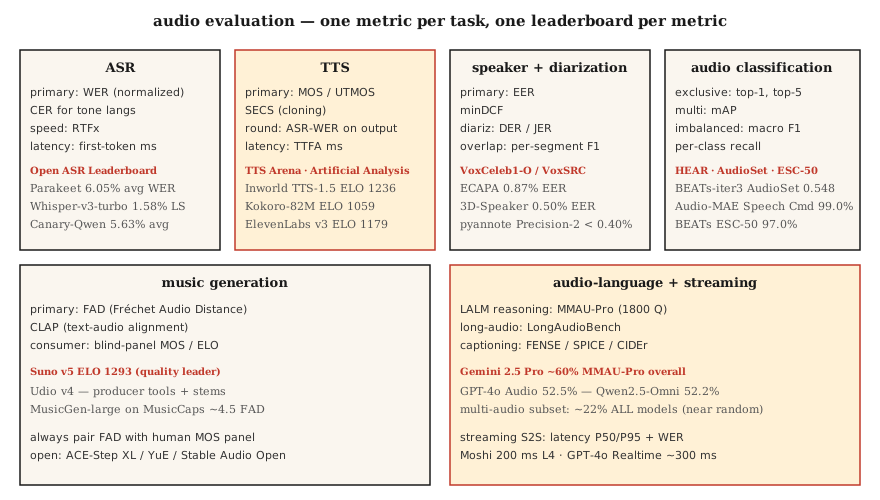
ASR metrics
WER (Word Error Rate). (S + D + I) / N. Lowercase, strip punctuation, normalize numbers before scoring. Use jiwer or OpenAI's whisper_normalizer. < 5% = human-parity read speech.
CER (Character Error Rate). Same formula, character-level. Used for tone languages (Mandarin, Cantonese) where word segmentation is ambiguous.
RTFx (inverse real-time factor). Audio seconds processed per wall-clock second. Higher is better. Parakeet-TDT hits 3380×. Whisper-large-v3 is ~30×.
First-token latency. Wall-clock from audio input to first transcript token. Critical for streaming. Deepgram Nova-3: ~150 ms.
TTS metrics
MOS (Mean Opinion Score). 1-5 human rating. Gold standard but slow. Collect 20+ listeners per sample, 100+ samples per model.
UTMOS (2022-2026). Learned MOS predictor. Correlates ~0.9 with human MOS on standard benchmarks. F5-TTS: UTMOS 3.95; ground truth: 4.08.
SECS (Speaker Encoder Cosine Similarity). For voice cloning. ECAPA embedding cosine between reference and cloned output. > 0.75 = recognizable clone.
WER-on-ASR-round-trip. Run Whisper over TTS output, compute WER against the input text. Catches intelligibility regressions. 2026 SOTA: < 2% WER on English test sets (Mandarin sets report CER instead).
TTFA (time-to-first-audio). Wall-clock latency. Kokoro-82M: ~100 ms; F5-TTS: ~1 s.
Voice-cloning-specific
SECS + MOS + CER as a triple. Cloning that scores high SECS but low MOS means timbre-right-but-unnatural; the opposite means natural voice but wrong speaker.
Speaker verification
EER (Equal Error Rate). The threshold where False Accept Rate equals False Reject Rate. ECAPA on VoxCeleb1-O: 0.87%.
minDCF (min Detection Cost). Weighted cost at a chosen operating point (often FAR=0.01). More production-relevant than EER.
Diarization
DER (Diarization Error Rate). (FA + Miss + Confusion) / total_speaker_time. Missed speech + false-alarm speech + speaker-confusion, each as a fraction. AMI meetings: DER ~10-20% is realistic. pyannote 3.1 + Precision-2 commercial: <10% DER on well-recorded audio.
JER (Jaccard Error Rate). Alternative to DER, robust to short-segment bias.
Audio classification
Multi-label: mAP (mean Average Precision) over all classes. AudioSet: 0.548 mAP for BEATs-iter3.
Multi-class exclusive: top-1, top-5 accuracy. Speech Commands v2: 99.0% top-1 (Audio-MAE).
Imbalanced: macro F1 + per-class recall. Report per-class — aggregate accuracy hides which classes fail.
Music generation
FAD (Fréchet Audio Distance). Distance between VGGish-embedding distributions of real vs generated audio. MusicGen-small on MusicCaps: 4.5. MusicLM: 4.0. Lower better.
CLAP Score. Text-audio alignment score using CLAP embeddings. > 0.3 = reasonable alignment.
Listening panel MOS. Still the final word for consumer-grade music. Suno v5 scored ELO 1293 on Suno's own paired-preference benchmark. That is a vendor number; TTS Arena ranks speech, not music.
Audio-language benchmarks
MMAU (Massive Multi-Audio Understanding). 10k audio-QA pairs.
MMAU-Pro. 1800 hard items, four categories: speech / sound / music / multi-audio. Random chance 25% on 4-way. Gemini 2.5 Pro overall ~60%; multi-audio ~22% across all models.
LongAudioBench. Multi-minute clips with semantic queries. Audio Flamingo Next beats Gemini 2.5 Pro.
AudioCaps / Clotho. Captioning benchmarks. SPICE, CIDEr, FENSE metrics.
Streaming speech-to-speech
Latency P50 / P95 / P99. Wall-clock from end-of-user-speech to first audible response. Moshi: 200 ms; GPT-4o Realtime: 300 ms.
WER / MOS on the output.
Barge-in responsiveness. Time from user interrupt to assistant mute. Target < 150 ms.
The 2026 leaderboards
| Leaderboard | Tracks | URL |
|---|---|---|
| Open ASR Leaderboard (HF) | English + multilingual + long-form | huggingface.co/spaces/hf-audio/open_asr_leaderboard |
| TTS Arena (HF) | English TTS | huggingface.co/spaces/TTS-AGI/TTS-Arena |
| Artificial Analysis Speech | TTS + STT, ELO from paired votes | artificialanalysis.ai/speech |
| MMAU-Pro | LALM reasoning | sonalkum.github.io/mmau-pro |
| SpeakerBench / VoxSRC | Speaker recognition | voxsrc.github.io |
| MMAU music subset | Music LALM | (within MMAU) |
| HEAR benchmark | Self-supervised audio | hearbenchmark.com |
sp-wer-alignBuild It
Step 1: WER with normalization
from jiwer import wer, Compose, ToLowerCase, RemovePunctuation, Strip

transform = Compose([ToLowerCase(), RemovePunctuation(), Strip()])
score = wer(
    truth="Please turn on the lights.",
    hypothesis="please turn on the light",
    truth_transform=transform,
    hypothesis_transform=transform,
)
# ~0.17
Step 2: TTS round-trip WER
def ttr_wer(tts_model, asr_model, texts):
    errors = []
    for txt in texts:
        audio = tts_model.synthesize(txt)
        recog = asr_model.transcribe(audio)
        errors.append(wer(truth=txt, hypothesis=recog))
    return sum(errors) / len(errors)
Step 3: SECS for voice cloning
from speechbrain.inference.speaker import EncoderClassifier
sv = EncoderClassifier.from_hparams("speechbrain/spkrec-ecapa-voxceleb")

emb_ref = sv.encode_batch(load_wav("reference.wav"))
emb_clone = sv.encode_batch(load_wav("cloned.wav"))
secs = torch.nn.functional.cosine_similarity(emb_ref, emb_clone, dim=-1).item()
Step 4: FAD for music generation
from frechet_audio_distance import FrechetAudioDistance
fad = FrechetAudioDistance()
score = fad.get_fad_score("generated_folder/", "reference_folder/")
Step 5: EER for speaker verification (same code as Lesson 6)
def eer(same_scores, diff_scores):
    thresholds = sorted(set(same_scores + diff_scores))
    best = (1.0, 0.0)
    for t in thresholds:
        far = sum(1 for s in diff_scores if s >= t) / len(diff_scores)
        frr = sum(1 for s in same_scores if s < t) / len(same_scores)
        if abs(far - frr) < best[0]:
            best = (abs(far - frr), (far + frr) / 2)
    return best[1]
Use It
Pair every deploy with a fixed eval harness that runs on every model update. Three cardinal rules:
- Normalize before scoring. Lowercase, punctuation-strip, number-expand. Report the normalization rule.
- Report distributions, not averages. P50/P95/P99 for latency. Per-class recall for classification. Per-category for MMAU.
- Run one canonical public benchmark. Even if your production data differs, reporting on Open ASR / TTS Arena / MMAU lets reviewers compare apples-to-apples.
Pitfalls
- UTMOS extrapolation. Trained on VCTK-style clean speech; scores noisy / cloned / emotional audio poorly.
- MOS panel bias. 20 Amazon Mechanical Turk workers ≠ 20 target users. Pay for a domain panel if stakes are high.
- FAD depends on reference set. Compare against the same reference distribution across models.
- Aggregate WER. A 5% WER overall can hide 30% WER on accented speech. Report by demographic slice.
- Public benchmark saturation. Most frontier models are near the ceiling on standard benchmarks. Build an in-house held-out set that reflects your traffic.
Ship It
Save as outputs/skill-audio-evaluator.md. Pick metrics, benchmarks, and reporting format for any audio model release.
Exercises
- Easy. Run
code/main.py. Compute WER / CER / EER / SECS / FAD-ish / MMAU-ish on toy inputs. - Medium. Build a TTS round-trip WER harness. Run your Kokoro or F5-TTS output through Whisper. Compute WER over 50 prompts. Flag prompts with WER > 10%.
- Hard. Score your Lesson 10 LALM choice on MMAU-Pro speech + multi-audio subsets (50 items each). Report per-category accuracy and compare with the published number.
Key Terms
| Term | What people say | What it actually means |
|---|---|---|
| WER | ASR score | (S+D+I)/N at word level after normalization. |
| CER | Character WER | For tone languages or char-level systems. |
| MOS | Human opinion | 1-5 rating; 20+ listeners × 100 samples. |
| UTMOS | ML MOS predictor | Learned model; correlates ~0.9 with human MOS. |
| SECS | Voice-clone similarity | ECAPA cosine between reference and clone. |
| EER | Speaker verif score | Threshold where FAR = FRR. |
| DER | Diarization score | (FA + Miss + Confusion) / total. |
| FAD | Music-gen quality | Fréchet distance on VGGish embeddings. |
| RTFx | Throughput | Audio seconds per wall-clock second. |
Further Reading
- jiwer — WER/CER library with normalization utilities.
- UTMOS (Saeki et al. 2022) — learned MOS predictor.
- Fréchet Audio Distance (Kilgour et al. 2019) — the music-gen standard.
- Open ASR Leaderboard — 2026 live rankings.
- TTS Arena — human-vote TTS leaderboard.
- MMAU-Pro benchmark — LALM reasoning leaderboard.
- HEAR benchmark — audio SSL benchmarks.
Questions people ask
What is word error rate in speech recognition?
Word error rate, or WER, counts the words a system substituted, deleted or inserted compared with a correct transcript, divided by the number of words in that transcript. Lower is better. It is the standard way to compare transcription accuracy.
How is text-to-speech quality measured?
The classic method is MOS, where listeners rate how natural clips sound. Automatic predictors like UTMOS estimate those ratings without people. Teams also check speaker similarity for cloned voices and run the audio back through speech recognition to catch mispronounced words.
Lessons from AI Engineering from Scratch by Rohit Ghumare and contributors, MIT license. Notes for owners by Lozo. License