Build a Voice Assistant Pipeline — The Phase 6 Capstone
Everything from lessons 01-11, stitched together. Build a voice assistant that listens, reasons, and talks back. In 2026 that is a solved engineering problem, not a research problem — but the integration details decide whether it ships.
Lesson 12 of 17Build~120 minutesPython
Before this: Lesson 4 of Phase 6, 05, 06, 07, 11; lesson 9 of Phase 11 (Function Calling); lesson 1 of Phase 14 (Agent Loop)
On this page
The Problem
Build an end-to-end assistant:
- Captures mic input (16 kHz mono).
- Detects start/end of user speech.
- Transcribes streaming.
- Passes transcript to an LLM that can call tools (timer, weather, calendar).
- Streams LLM text to a TTS.
- Plays audio back to the user.
- Stops if the user interrupts mid-response.
Latency target: first TTS audio byte within 800 ms of the user finishing their utterance on a laptop CPU. Quality target: no missed words, no hallucinated subtitles on silence, no voice cloning leakage, no prompt injection success.
The Concept
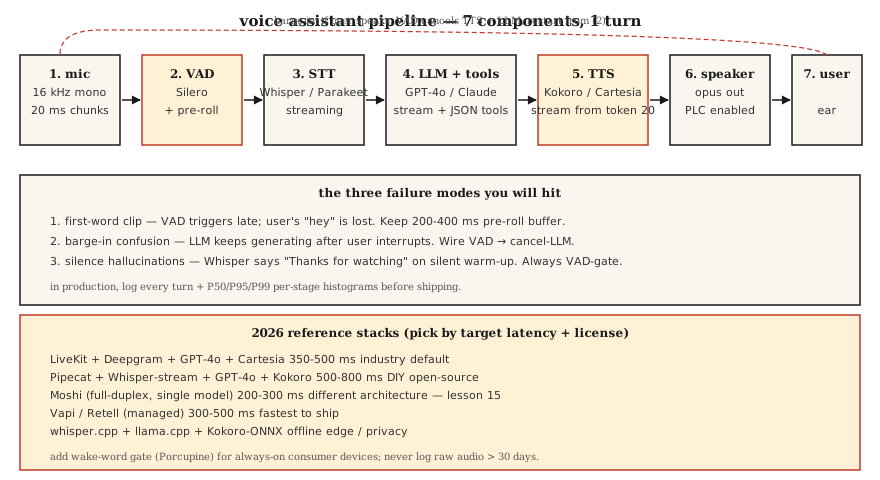
The seven components
- Audio capture. Mic → 16 kHz mono → 20 ms chunks. Usually
sounddevicein Python or native AudioUnit/ALSA/WASAPI in production. - VAD (Lesson 11). Silero VAD @ threshold 0.5, min speech 250 ms, silence hang-over 500 ms. Signals "start" and "end."
- Streaming STT (Lesson 4-5). Whisper-streaming, Parakeet-TDT, or Deepgram Nova-3 (API). Partial + final transcripts.
- LLM with tool calling. GPT-4o / Claude 3.5 / Gemini 2.5 Flash. JSON schema for tools. Stream tokens.
- Streaming TTS (Lesson 7). Kokoro-82M (fastest open) or Cartesia Sonic (commercial). Start TTS after 20 LLM tokens.
- Playback. Speaker out; opus-encode for low-bandwidth networks.
- Interruption handler. If VAD fires during TTS playback, stop playback, cancel LLM, restart STT.
The three failure modes you will hit
- First-word clip. VAD starts a beat too late. User's "hey" is missing. Start threshold at 0.3, not 0.5.
- Mid-response interrupt confusion. LLM keeps generating after user interrupts; assistant talks over user. Wire VAD → cancel-LLM.
- Silence hallucination. Whisper outputs "Thanks for watching" on the silent warm-up frames. Always VAD-gate.
2026 production reference stacks
| Stack | Latency | License | Notes |
|---|---|---|---|
| LiveKit + Deepgram + GPT-4o + Cartesia | 350-500 ms | commercial API | Industry default 2026 |
| Pipecat + Whisper-streaming + GPT-4o + Kokoro | 500-800 ms | mostly open | DIY-friendly |
| Moshi (full-duplex) | 200-300 ms | CC-BY 4.0 | Single-model; different architecture, lesson 15 |
| Vapi / Retell (managed) | 300-500 ms | commercial | Fastest to launch; limited customization |
| Whisper.cpp + llama.cpp + Kokoro-ONNX | offline | open | Privacy / edge |
v4-voice-latencyBuild It
Step 1: mic capture with chunking (pseudocode)
import sounddevice as sd

def mic_stream(chunk_ms=20, sr=16000):
    q = queue.Queue()
    def cb(indata, frames, time, status):
        q.put(indata.copy().flatten())
    with sd.InputStream(channels=1, samplerate=sr, blocksize=int(sr * chunk_ms/1000), callback=cb):
        while True:
            yield q.get()
Step 2: VAD-gated turn capture
def capture_turn(stream, vad, pre_roll_ms=300, silence_ms=500):
    buf, pre, triggered = [], collections.deque(maxlen=pre_roll_ms // 20), False
    silent = 0
    for chunk in stream:
        pre.append(chunk)
        if vad(chunk):
            if not triggered:
                buf = list(pre)
                triggered = True
            buf.append(chunk)
            silent = 0
        elif triggered:
            silent += 20
            buf.append(chunk)
            if silent >= silence_ms:
                return b"".join(buf)
Step 3: streaming STT → LLM → TTS
async def turn(audio_bytes):
    transcript = await stt.transcribe(audio_bytes)
    async for token in llm.stream(transcript):
        async for audio in tts.stream(token):
            await speaker.play(audio)
Step 4: tool calling inside the LLM loop
tools = [
    {"name": "get_weather", "parameters": {"location": "string"}},
    {"name": "set_timer", "parameters": {"seconds": "int"}},
]

async for chunk in llm.stream(user_text, tools=tools):
    if chunk.type == "tool_call":
        result = dispatch(chunk.name, chunk.args)
        continue_streaming(result)
    if chunk.type == "text":
        await tts.stream(chunk.text)
Step 5: interruption handling
tts_task = asyncio.create_task(tts_loop())
while True:
    chunk = await mic.get()
    if vad(chunk):
        tts_task.cancel()
        await speaker.stop()
        await new_turn()
        break
Use It
See code/main.py for a runnable simulation that wires all seven components with stub models, so you can see the pipeline shape even without hardware. For a real implementation, swap stubs with:
silero-vad(pip install silero-vad)deepgram-sdkoropenai-whisperopenai(gpt-4o) oranthropickokoroorcartesiasounddevicefor I/O
Pitfalls
- Logging PII forever. Full-turn audio is PII in most jurisdictions. 30-day retention, encrypted at rest.
- No barge-in. Users will interrupt. Your assistant must stop talking.
- TTS that blocks. Synchronous TTS blocks the event loop. Use async or a separate thread.
- No tool-call error handling. Tools fail. LLM must get back the error + retry once, then gracefully degrade.
- Overzealous hallucination filters. Over-filter and the assistant repeats "I can't help with that." Under-filter and it says anything. Calibrate on a held-out set.
- No wake-word option. Always-listening is a privacy liability. Add a wake-word gate (Porcupine or openWakeWord).
Ship It
Save as outputs/skill-voice-assistant-architect.md. Given budget + scale + language + compliance constraints, produce a full stack spec.
Exercises
- Easy. Run
code/main.py. It simulates one full turn end-to-end with stub modules and prints per-stage latency. - Medium. Replace the STT stub with a real Whisper model on a pre-recorded
.wav. Measure WER and end-to-end latency. - Hard. Add tool calling: implement
get_weather(any API) andset_timer. Route the LLM through the tools and verify that when the user says "set a 5 minute timer" the right function fires and the spoken reply confirms it.
Key Terms
| Term | What people say | What it actually means |
|---|---|---|
| Turn | A user + assistant round-trip | One VAD-bounded user speech + one LLM-TTS response. |
| Barge-in | Interruption | User speaks while assistant talks; assistant stops. |
| Wake word | "Hey assistant" | Short keyword detector; Porcupine, Snowboy, openWakeWord. |
| End-pointing | Turn ending | VAD + min-silence decision that user has finished. |
| Pre-roll | Pre-speech buffer | Keep 200-400 ms of audio before VAD fires to avoid first-word clip. |
| Tool call | Function invocation | LLM emits JSON; runtime dispatches; result feeds back in-loop. |
Further Reading
- LiveKit — voice agent quickstart — production-grade reference.
- Pipecat — voice agent examples — DIY-friendly framework.
- OpenAI Realtime API — the managed voice-native path.
- Kyutai Moshi — full-duplex reference (Lesson 15).
- Porcupine wake-word — wake-word gating.
- Anthropic — tool use guide — LLM function calling.
Questions people ask
How do you build an AI voice assistant?
Combine voice activity detection to know when someone speaks, speech recognition to get text, a language model to decide the reply and call tools, and text-to-speech to answer. Stream each step and handle interruptions so the conversation feels natural.
Can an AI voice agent answer business phone calls?
Yes. Voice agents can greet callers, answer common questions, book appointments and take messages. They work best with a narrow scope, good guardrails, a way to transfer to a person, and disclosure that the caller is talking to AI.
Lessons from AI Engineering from Scratch by Rohit Ghumare and contributors, MIT license. Notes for owners by Lozo. License