Speaker Recognition & Verification
ASR asks "what did they say?" Speaker recognition asks "who said it?" The math looks the same — embeddings plus cosine — but every production decision hinges on a single EER number.
Lesson 6 of 17Build~45 minutesPython
Before this: Lesson 2 of Phase 6 (Spectrograms & Mel), lesson 22 of Phase 5 (Embedding Models)
On this page
The Problem
A user says a passphrase. You want to know: is this the person they claim to be (verification, 1:1), or is it the first person in your enrollment bank (identification, 1:N)? Or neither — is this an unknown speaker (open-set)?
Pre-2018: GMM-UBM + i-vectors. Reasonable EER but fragile to channel shift (phone vs laptop) and emotion. 2018–2022: x-vectors (TDNN backbone trained with angular margin). 2022+: ECAPA-TDNN and WavLM-large embeddings. By 2026 the field is dominated by three models and one metric.
The metric is EER — Equal Error Rate. Set your decision threshold so False Accept Rate = False Reject Rate. The crossover is EER. Used in every paper, every leaderboard, every procurement call.
The Concept
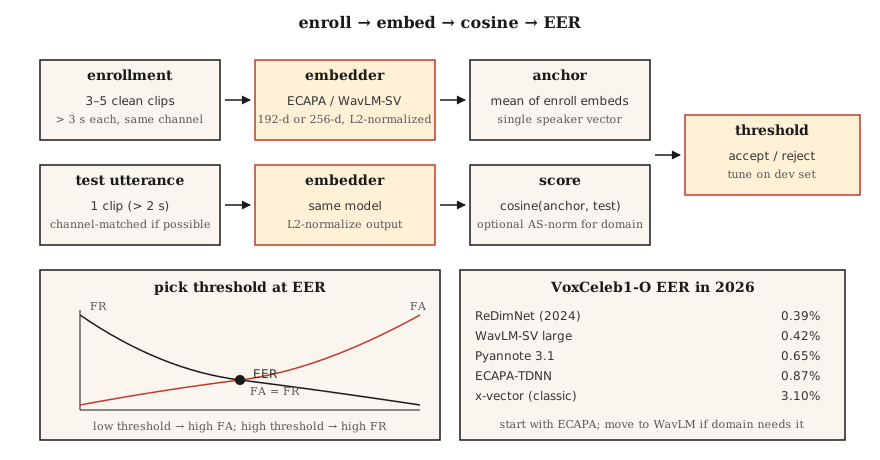
The pipeline. Enrollment: record 5–30 seconds of the target speaker; compute a fixed-dimension embedding (192-d for ECAPA-TDNN, 256-d for WavLM-large). Verification: get the test utterance embedding; compute cosine similarity; compare to a threshold.
ECAPA-TDNN (2020, still dominant 2026). Emphasized Channel Attention, Propagation and Aggregation - Time-Delay Neural Network. 1D conv blocks with squeeze-excitation, multi-head attention pooling, followed by a linear layer to 192-d. Trained on VoxCeleb 1+2 (2,700 speakers, 1.1M utterances) with Additive Angular Margin loss (AAM-softmax).
WavLM-SV (2022+). Fine-tune a pretrained WavLM-large SSL backbone with AAM loss. Higher quality but slower — 300+ MB vs 15 MB.
x-vector (baseline). TDNN + statistics pooling. Classic; still useful on CPU / edge.
AAM-softmax. Standard softmax with added margin m in the angular space: cos(θ + m) for the correct class. Forces inter-class angular separation. Typical m=0.2, scale s=30.
Scoring
- Cosine between enrollment and test embeddings. Threshold-based decision.
- PLDA (Probabilistic LDA). Project embeddings into a latent space where same-speaker vs different-speaker has a closed-form likelihood ratio. Added on top of cosine for +10–20% EER reduction. Standard pre-2020; now used only in closed-set setups.
- Score normalization.
S-normorAS-norm: normalize each score against a cohort of imposter means and stds. Essential for cross-domain eval.
Numbers you should know (2026)
| Model | VoxCeleb1-O EER | Params | Throughput (A100) |
|---|---|---|---|
| x-vector (classic) | 3.10% | 5 M | 400× RT |
| ECAPA-TDNN | 0.87% | 15 M | 200× RT |
| WavLM-SV large | 0.42% | 316 M | 20× RT |
| Pyannote 3.1 segmentation + embedding | 0.65% | 6 M | 100× RT |
| ReDimNet (2024) | 0.39% | 24 M | 100× RT |
Diarization
"Who spoke when" in a multi-speaker clip. Pipeline: VAD → segment → embed each segment → cluster (agglomerative or spectral) → smooth boundaries. Modern stack: pyannote.audio 3.1, which bundles speaker segmentation + embedding + clustering behind one call. 2026 SOTA DER on AMI is ~15% (down from 23% in 2022).
sp-eer-crossoverBuild It
Step 1: toy embedding from MFCC statistics
def embed_mfcc_stats(signal, sr):
    frames = featurize_mfcc(signal, sr, n_mfcc=13)
    mean = [sum(f[i] for f in frames) / len(frames) for i in range(13)]
    std = [
        math.sqrt(sum((f[i] - mean[i]) ** 2 for f in frames) / len(frames))
        for i in range(13)
    ]
    return mean + std  # 26-d
Not SOTA by a mile — for teaching only. code/main.py uses this as a proof-of-concept on synthetic speaker data.
Step 2: cosine similarity + threshold
def cosine(a, b):
    dot = sum(x * y for x, y in zip(a, b))
    na = math.sqrt(sum(x * x for x in a))
    nb = math.sqrt(sum(x * x for x in b))
    return dot / (na * nb) if na and nb else 0.0

def verify(enroll, test, threshold=0.75):
    return cosine(enroll, test) >= threshold
Step 3: EER from similarity pairs
def eer(same_scores, diff_scores):
    thresholds = sorted(set(same_scores + diff_scores))
    best = (1.0, 1.0, 0.0)  # (fa, fr, threshold)
    for t in thresholds:
        fr = sum(1 for s in same_scores if s < t) / len(same_scores)
        fa = sum(1 for s in diff_scores if s >= t) / len(diff_scores)
        if abs(fa - fr) < abs(best[0] - best[1]):
            best = (fa, fr, t)
    return (best[0] + best[1]) / 2, best[2]
Returns (eer, threshold_at_eer). Report both.
Step 4: production with SpeechBrain
from speechbrain.pretrained import EncoderClassifier

clf = EncoderClassifier.from_hparams(source="speechbrain/spkrec-ecapa-voxceleb")

# enroll: average the embeddings of 3-5 clean samples
enroll = torch.stack([clf.encode_batch(load(x)) for x in enrollment_clips]).mean(0)
# verify
score = clf.similarity(enroll, clf.encode_batch(load("test.wav"))).item()
verdict = score > 0.25   # ECAPA typical threshold; tune on your data
Step 5: diarize with pyannote
from pyannote.audio import Pipeline

pipe = Pipeline.from_pretrained("pyannote/speaker-diarization-3.1")
diarization = pipe("meeting.wav", num_speakers=None)
for turn, _, speaker in diarization.itertracks(yield_label=True):
    print(f"{turn.start:.1f}–{turn.end:.1f}  {speaker}")
Use It
The 2026 stack:
| Situation | Pick |
|---|---|
| Closed-set 1:1 verification, edge | ECAPA-TDNN + cosine threshold |
| Open-set verification, cloud | WavLM-SV + AS-norm |
| Diarization (meetings, podcasts) | pyannote/speaker-diarization-3.1 |
| Anti-spoofing (replay / deepfake detection) | AASIST or RawNet2 |
| Tiny embedded (KWS + enrollment) | Titanet-Small (NeMo) |
Pitfalls
- Channel mismatch. Model trained on VoxCeleb (web video) ≠ phone-call audio. Always evaluate on target channel.
- Short utterances. EER degrades sharply below 3 seconds of test audio.
- Enrollment with noise. One noisy enrollment poisons the anchor. Use ≥3 clean samples and average.
- Fixed threshold across conditions. Always tune the threshold on a held-out dev set from the target domain.
- Cosine on non-normalized embeddings. L2-normalize first; otherwise the magnitude dominates.
Ship It
Save as outputs/skill-speaker-verifier.md. Pick model, enrollment protocol, threshold-tuning plan, and fraud safeguards.
Exercises
- Easy. Run
code/main.py. Builds synthetic "speakers" (different tone profiles), enrolls, computes EER on a 100-pair trial list. - Medium. Use SpeechBrain ECAPA on 30 VoxCeleb1 utterances (5 speakers × 6 each). Compute EER with cosine vs PLDA.
- Hard. Build the full enroll → diarize → verify pipeline with
pyannote.audio. Evaluate DER on AMI dev set.
Key Terms
| Term | What people say | What it actually means |
|---|---|---|
| EER | The headline metric | Threshold where False Accept = False Reject. |
| Verification | 1:1 | "Is this Alice?" |
| Identification | 1:N | "Who is speaking?" |
| Open-set | Unknown possible | Test set can contain unenrolled speakers. |
| Enrollment | Registering | Computing a speaker's reference embedding. |
| AAM-softmax | The loss | Softmax with additive angular margin; forces cluster separation. |
| PLDA | Classic scoring | Probabilistic LDA; likelihood-ratio scoring on top of embeddings. |
| DER | Diarization metric | Diarization Error Rate — miss + false alarm + confusion. |
Further Reading
- Snyder et al. (2018). X-Vectors: Robust DNN Embeddings for Speaker Recognition — the classic deep-embedding paper.
- Desplanques et al. (2020). ECAPA-TDNN — dominant architecture 2020–2026.
- Chen et al. (2022). WavLM: Large-Scale Self-Supervised Pre-Training for Full Stack Speech Processing — SSL backbone for SV and diarization.
- Bredin et al. (2023). pyannote.audio 3.1 — production diarization + embedding stack.
- VoxCeleb leaderboard (updated 2026) — current EER standings across models.
Questions people ask
What is the difference between speaker identification and speaker verification?
Identification picks which known person is speaking from a group. Verification checks a yes or no claim, such as whether this voice belongs to the account holder. Both compare voice embeddings, but they use different thresholds and tests.
What is equal error rate in speaker verification?
Equal error rate is the point where the rate of wrongly accepting an impostor equals the rate of wrongly rejecting the real speaker. Lower is better. It gives one number to compare systems, though real deployments tune the threshold to their own risk.
Lessons from AI Engineering from Scratch by Rohit Ghumare and contributors, MIT license. Notes for owners by Lozo. License