Audio-Language Models — Qwen2.5-Omni, Audio Flamingo, GPT-4o Audio
2026 audio-language models reason over speech + environmental sound + music. Qwen2.5-Omni-7B matches GPT-4o Audio on MMAU-Pro. Audio Flamingo Next beats Gemini 2.5 Pro on LongAudioBench. The gap between open and closed is essentially closed — except on multi-audio tasks, where everyone is near random.
Lesson 10 of 17Learn~45 minutesPython
Before this: Lesson 4 of Phase 6 (ASR), lesson 3 of Phase 12 (Vision-Language Models), lesson 10 of Phase 7 (Audio Transformers)
On this page
The Problem
You have 5 seconds of audio: dog barks, someone yells "stop!", then silence. Useful questions span multiple axes:
- Transcription. "What was said?" — ASR territory.
- Semantic reasoning. "Is the person in danger?" — requires joint understanding of the bark + yell + silence.
- Music reasoning. "What instruments play the melody?"
- Long-audio retrieval. "Where in this 90-minute lecture did the instructor explain gradient descent?"
A single model that answers all of these with one prompt is an audio-language model (LALM / ALM). Separate from pure ASR: LALMs produce free-form natural-language answers, not just transcripts.
The Concept
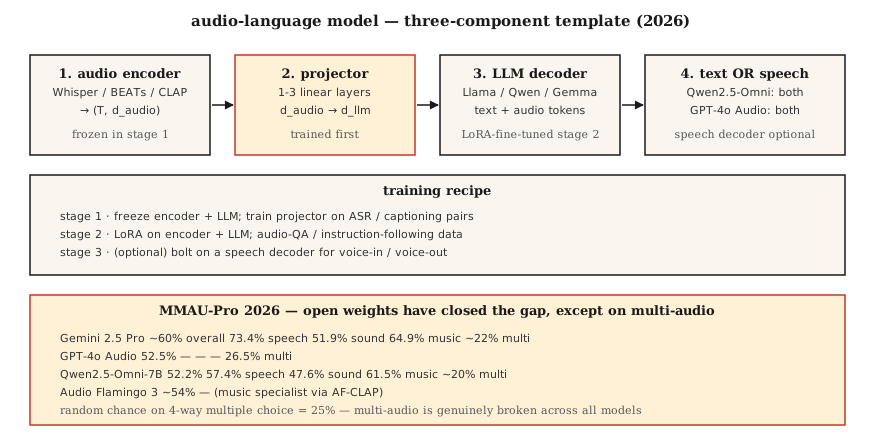
The three-component template
Every 2026 LALM has the same skeleton:
- Audio encoder. Whisper encoder · BEATs · CLAP · WavLM · or a custom encoder per model.
- Projector. Linear or MLP bridging audio-encoder features into the LLM's token embedding space.
- LLM. Llama / Qwen / Gemma-based decoder. Takes interleaved text + audio tokens; generates text.
Training:
- Stage 1. Freeze encoder + LLM; train projector only on ASR / captioning data.
- Stage 2. Full / LoRA fine-tune on instruction-following audio tasks (QA, reasoning, music understanding).
- Stage 3 (optional). Voice-in / voice-out adds a speech decoder. Qwen2.5-Omni and AF3-Chat do this.
The 2026 model map
| Model | Backbone | Audio encoder | Output modality | Access |
|---|---|---|---|---|
| Qwen2.5-Omni-7B | Qwen2.5-7B | Custom + Whisper | text + speech | Apache-2.0 |
| Qwen3-Omni | Qwen3 | Custom | text + speech | Apache-2.0 |
| Audio Flamingo 3 | Qwen2 | AF-CLAP | text | NVIDIA non-commercial |
| Audio Flamingo Next | Qwen2 | AF-CLAP v2 | text | NVIDIA non-commercial |
| SALMONN | Vicuna | Whisper + BEATs | text | Apache-2.0 |
| LTU / LTU-AS | Llama | CAV-MAE | text | Apache-2.0 |
| GAMA | Llama | AST + Q-Former | text | Apache-2.0 |
| Gemini 2.5 Flash/Pro (closed) | Gemini | proprietary | text + speech | API |
| GPT-4o Audio (closed) | GPT-4o | proprietary | text + speech | API |
Benchmark reality check (2026)
MMAU-Pro. 1800 QA pairs covering speech / sound / music / mixed. Multi-audio subset included.
| Model | Overall | Speech | Sound | Music | Multi-audio |
|---|---|---|---|---|---|
| Gemini 2.5 Pro | ~60% | 73.4% | 51.9% | 64.9% | ~22% |
| Gemini 2.5 Flash | ~57% | 73.4% | 50.5% | 64.9% | 21.2% |
| GPT-4o Audio | 52.5% | — | — | — | 26.5% |
| Qwen2.5-Omni-7B | 52.2% | 57.4% | 47.6% | 61.5% | ~20% |
| Audio Flamingo 3 | ~54% | — | — | — | — |
| Audio Flamingo Next | SOTA on LongAudioBench | — | — | — | — |
The multi-audio column is damning for everyone. Random chance on 4-option multiple choice = 25%; most models score around there. LALMs still struggle to compare two clips.
Where LALMs are useful in 2026
- Compliance audit of call-center recordings. "Did the agent mention the required disclosure?"
- Accessibility. Describe sound events to deaf users (not just transcription).
- Content moderation. Detect violent language + threatening tone + background context.
- Podcast / meeting chaptering. Semantic summary, not just speaker turns.
- Music catalog analysis. "Find all tracks with a B-section key change."
Where they are NOT (yet) useful
- Fine-grained music theory (below chord-level).
- Speaker-attributed reasoning over long conversations (degrades past 10 minutes).
- Multi-audio comparison (22-26% is barely above random).
- Real-time streaming reasoning (most are offline batch inference).
v4-alm-tokensBuild It
Step 1: query Qwen2.5-Omni
from transformers import AutoModelForCausalLM, AutoProcessor

processor = AutoProcessor.from_pretrained("Qwen/Qwen2.5-Omni-7B")
model = AutoModelForCausalLM.from_pretrained("Qwen/Qwen2.5-Omni-7B", torch_dtype="auto")

audio, sr = load_wav("clip.wav", sr=16000)
messages = [{
    "role": "user",
    "content": [
        {"type": "audio", "audio": audio},
        {"type": "text", "text": "What sounds do you hear, and what's happening?"},
    ],
}]
inputs = processor.apply_chat_template(messages, tokenize=True, return_tensors="pt")
output = model.generate(**inputs, max_new_tokens=200)
print(processor.decode(output[0], skip_special_tokens=True))
Step 2: the projector pattern
import torch.nn as nn

class AudioProjector(nn.Module):
    def __init__(self, audio_dim=1280, llm_dim=4096):
        super().__init__()
        self.down = nn.Linear(audio_dim, llm_dim)
        self.act = nn.GELU()
        self.up = nn.Linear(llm_dim, llm_dim)

    def forward(self, audio_features):
        return self.up(self.act(self.down(audio_features)))
That's it. The projector is usually 1-3 linear layers. Training it on ASR pairs (audio → transcript) is the Stage-1 pretext task.
Step 3: benchmarking MMAU / LongAudioBench
from datasets import load_dataset
mmau = load_dataset("gamma-lab-umd/MMAU-Pro", split="test")
mcq = mmau.filter(lambda item: len(item["choices"] or []) > 1)

correct = 0
for item in mcq:
    answer = call_model(item["audio_path"], item["question"], item["choices"])
    if answer == item["answer"]:
        correct += 1
print(f"Accuracy: {correct / len(mcq):.3f}")
audio_path points into the dataset repo's data.zip (about 47 GB), so download and unzip it before scoring. This exact-match loop is a sanity check, not the benchmark scorer, so its number is not comparable with published MMAU-Pro results. The official evaluator matches multiple-choice answers by embedding similarity (NV-Embed-v2), grades open-ended answers with an LLM judge, and checks instruction-following answers with regex rules: write predictions to a model_output column and run evaluate_mmau_pro_comprehensive.py from the MMAU-Pro repo. Report each category (speech, sound, music, multi, and the rest) separately. Aggregate numbers hide where the model fails.
Use It
| Task | 2026 pick |
|---|---|
| Free-form audio QA (open) | Qwen2.5-Omni-7B |
| Best open on long audio | Audio Flamingo Next |
| Best closed | Gemini 2.5 Pro |
| Voice-in / voice-out agent | Qwen2.5-Omni or GPT-4o Audio |
| Music reasoning | Audio Flamingo 3 or 2 (music-specialized AF-CLAP) |
| Call-center audit | Gemini 2.5 Pro via API, with RAG over your policy docs |
Pitfalls
- Over-trust on multi-audio. If your task needs "which clip has X," random-chance-level performance is real.
- Long-audio degradation. Past 10 minutes, most models' speaker attribution breaks. Diarize first (Lesson 6), then summarize.
- Hallucinations on silence. Same Whisper-style issue inherited by LALMs that use Whisper encoder. VAD-gate.
- Benchmark cherry-picking. Vendor blog posts highlight best-case categories. Run MMAU-Pro multi-audio subset yourself.
Ship It
Save as outputs/skill-alm-picker.md. Pick LALM + benchmark subset + output-modality (text vs speech) for a given audio-understanding task.
Exercises
- Easy. Run
code/main.pyto see a toy projector pattern + fake LALM routing of (audio-embedding, text-tokens) → output tokens. - Medium. Score Qwen2.5-Omni-7B on 100 MMAU-Pro speech items. Compare to the paper's reported number.
- Hard. Build a minimal audio-captioning baseline: BEATs encoder + 2-layer projector + frozen Llama-3.2-1B. Fine-tune only the projector on AudioCaps. Compare to SALMONN on Clotho-AQA.
Key Terms
| Term | What people say | What it actually means |
|---|---|---|
| LALM | Audio ChatGPT | Audio encoder + projector + LLM decoder. |
| Projector | Adapter | Small MLP mapping audio features into LLM embedding space. |
| MMAU | The benchmark | 10k audio-QA pairs across speech, sound, music. |
| MMAU-Pro | Harder MMAU | 1800 multi-audio / reasoning-heavy questions. |
| LongAudioBench | Long-form eval | Multi-minute clips with semantic queries. |
| Voice-in / voice-out | Speech-native | Model ingests speech and emits speech without text detour. |
Further Reading
- Chu et al. (2024). Qwen2-Audio — reference architecture.
- Alibaba (2025). Qwen2.5-Omni — speech-in-speech-out.
- NVIDIA (2025). Audio Flamingo 3 — the open long-audio leader.
- NVIDIA (2026). Audio Flamingo Next — LongAudioBench SOTA.
- Tang et al. (2023). SALMONN — dual-encoder pioneer.
- MMAU-Pro leaderboard — live 2026 rankings.
Questions people ask
Can AI understand audio without transcribing it first?
Yes. Audio-language models encode the sound directly and feed it to a language model, so they can pick up tone, background sounds and music, not just words. They can still miss details, so important outputs should be checked.
What is the difference between speech recognition and an audio-language model?
Speech recognition only turns spoken words into text. An audio-language model can also reason about the audio, such as describing sounds, judging emotion, answering questions about a recording or following spoken instructions.
Lessons from AI Engineering from Scratch by Rohit Ghumare and contributors, MIT license. Notes for owners by Lozo. License