Embedding Models — The 2026 Deep Dive
Word2Vec gave you a vector per word. Modern embedding models give you a vector per passage, cross-lingual, with sparse, dense, and multi-vector views, sized to fit your index. Pick wrong and your RAG retrieves the wrong thing.
Lesson 22 of 29Learn~60 minutesPython
Before this: Lesson 3 of Phase 5 (Word2Vec), lesson 14 of Phase 5 (Information Retrieval)
On this page
The Problem
Your RAG system retrieves the wrong passage 40% of the time. The culprit is rarely the vector database or the prompt. It is the embedding model.
Choosing an embedding in 2026 means picking across five axes:
- Dense vs sparse vs multi-vector. One vector per passage, or one per token, or a sparse weighted bag of words.
- Language coverage. Monolingual English models still win on English-only tasks. Multilingual models win when corpora are mixed.
- Context length. 512 tokens vs 8,192 vs 32,768 — and real effective capacity is often 60-70% of the advertised max.
- Dimension budget. 3,072 floats at full precision = 12 KB per vector. At 100M vectors, storage is $1,300/month. Matryoshka truncation cuts this 4×.
- Open vs hosted. Open-weight means you control the stack and data. Hosted means you trade control for always-latest.
This lesson names the tradeoffs so you can pick on evidence, not on whatever was popular last quarter.
The Concept
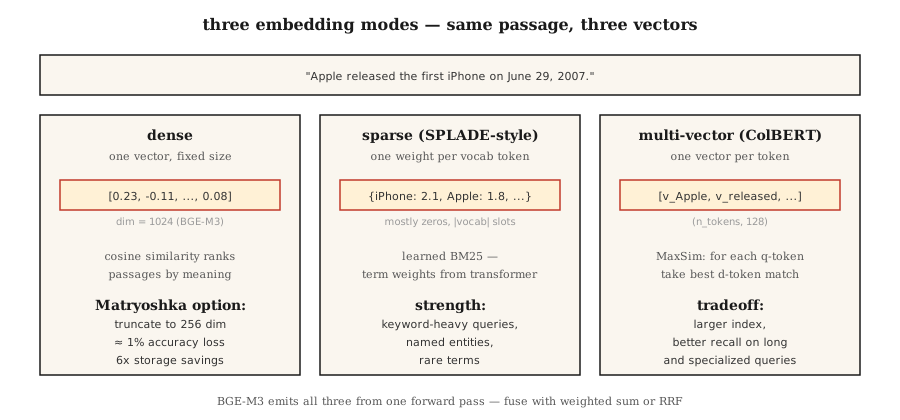
Dense embeddings. One vector per passage (usually 384-3,072 dimensions). Cosine similarity ranks passages by semantic proximity. OpenAI text-embedding-3-large, BGE-M3 dense mode, Voyage-3. Default choice.
Sparse embeddings. SPLADE-style. A transformer predicts a weight for every vocab token, then zeros out most of them. Result is a sparse vector of size |vocab|. Captures lexical matching (like BM25) but with learned term weights. Strong on keyword-heavy queries.
Multi-vector (late interaction). ColBERTv2, Jina-ColBERT. One vector per token. Scoring with MaxSim: for each query token, find the most similar document token, sum the scores. More expensive to store and score, but wins on long queries and domain-specific corpora.
BGE-M3: all three at once. Single model outputs dense, sparse, and multi-vector representations simultaneously. Each can be queried independently; scores fuse via weighted sum. The 2026 default when you want flexibility from one checkpoint.
Matryoshka Representation Learning. Trained so the first N dimensions of the vector form a useful standalone embedding. Truncate a 1,536-dim vector to 256 dim and pay ~1% accuracy for 6× storage savings. Supported by OpenAI text-3, Cohere v4, Voyage-4, Jina v5, Gemini Embedding 2, Nomic v1.5+.
The MTEB leaderboard tells a partial story
Massive Text Embedding Benchmark — 56 tasks across 8 task types at launch (2022), expanded to 100+ tasks in MTEB v2. In early 2026, Gemini Embedding 2 tops retrieval (67.71 MTEB-R). Cohere embed-v4 leads general (65.2 MTEB). BGE-M3 leads open-weight multilingual (63.0). The leaderboard is necessary but not sufficient — always benchmark on your domain.
The three-tier pattern
| Use case | Pattern |
|---|---|
| Fast first-pass | Dense bi-encoder (BGE-M3, text-3-small) |
| Recall boost | Sparse (SPLADE, BGE-M3 sparse) + RRF fuse |
| Precision on top-50 | Multi-vector (ColBERTv2) or cross-encoder reranker |
Most production stacks use all three.
gx-matryoshkaBuild It
Step 1: baseline — dense embeddings with Sentence-BERT
from sentence_transformers import SentenceTransformer
import numpy as np

encoder = SentenceTransformer("BAAI/bge-small-en-v1.5")
corpus = [
    "The first iPhone launched in 2007.",
    "Apple released the iPod in 2001.",
    "Android is an operating system from Google.",
]
emb = encoder.encode(corpus, normalize_embeddings=True)

query = "When was the iPhone released?"
q_emb = encoder.encode([query], normalize_embeddings=True)[0]
scores = emb @ q_emb
print(sorted(enumerate(scores), key=lambda x: -x[1]))
normalize_embeddings=True makes the dot product equal cosine similarity. Always set it.
Step 2: Matryoshka truncation
def truncate(vectors, dim):
    out = vectors[:, :dim]
    return out / np.linalg.norm(out, axis=1, keepdims=True)

emb_256 = truncate(emb, 256)
emb_128 = truncate(emb, 128)
Re-normalize after truncation. Nomic v1.5, OpenAI text-3, and Voyage-4 are trained so this is lossless for the first few levels. Non-Matryoshka models (original Sentence-BERT) degrade sharply when truncated.
Step 3: BGE-M3 multi-functionality
from FlagEmbedding import BGEM3FlagModel

model = BGEM3FlagModel("BAAI/bge-m3", use_fp16=True)

output = model.encode(
    corpus,
    return_dense=True,
    return_sparse=True,
    return_colbert_vecs=True,
)
# output["dense_vecs"]:    (n_docs, 1024)
# output["lexical_weights"]: list of dict {token_id: weight}
# output["colbert_vecs"]:  list of (n_tokens, 1024) arrays
Three indexes, one inference call. Score fusion:
dense_score = ... # cosine over dense_vecs
sparse_score = model.compute_lexical_matching_score(q_lex, d_lex)
colbert_score = model.colbert_score(q_col, d_col)
final = 0.4 * dense_score + 0.2 * sparse_score + 0.4 * colbert_score
Tune the weights on your domain.
Step 4: MTEB eval on a custom task
from mteb import MTEB

tasks = ["ArguAna", "SciFact", "NFCorpus"]
evaluation = MTEB(tasks=tasks)
results = evaluation.run(encoder, output_folder="./mteb-results")
Run your candidate models on a representative subset. Do not trust leaderboard rank alone — your domain matters.
Step 5: hand-rolled cosine from scratch
See code/main.py. Averaged Hashing Trick embeddings (stdlib-only). Not competitive with transformer embeddings, but shows the shape: tokenize → vector → normalize → dot product.
Pitfalls
- Same model for query and doc. Some models (Voyage, Jina-ColBERT) use asymmetric encoding — query and document pass through different paths. Always check the model card.
- Missing prefix.
bge-*models need"Represent this sentence for searching relevant passages: "prepended to queries. 3-5 point recall gap if you forget. - Over-trimming Matryoshka. 1,536 → 256 is usually safe. 1,536 → 64 is not. Validate on your eval set.
- Context truncation. Most models silently truncate inputs over their max length. Long docs need chunking (see lesson 23).
- Ignoring latency tail. MTEB scores hide p99 latency. A 600M model might beat a 335M model by 2 points but cost 3× more per query.
Use It
The 2026 stack:
| Situation | Pick |
|---|---|
| English-only, fast, API | text-embedding-3-large or voyage-3-large |
| Open-weight, English | BAAI/bge-large-en-v1.5 |
| Open-weight, multilingual | BAAI/bge-m3 or Qwen3-Embedding-8B |
| Long context (32k+) | Voyage-3-large, Cohere embed-v4, Qwen3-Embedding-8B |
| CPU-only deployment | Nomic Embed v2 (137M params, MoE) |
| Storage-constrained | Matryoshka-truncated + int8 quantization |
| Keyword-heavy queries | Add SPLADE sparse, RRF-fuse with dense |
2026 pattern: start with BGE-M3 or text-3-large, evaluate on your domain with MTEB, swap if a domain-specific model wins by more than 3 points.
Ship It
Save as outputs/skill-embedding-picker.md:
---
name: embedding-picker
description: Pick embedding model, dimension, and retrieval mode for a given corpus and deployment.
version: 1.0.0
phase: 5
lesson: 22
tags: [nlp, embeddings, retrieval]
---

Given a corpus (size, languages, domain, avg length), deployment target (cloud / edge / on-prem), latency budget, and storage budget, output:

1. Model. Named checkpoint or API. One-sentence reason.
2. Dimension. Full / Matryoshka-truncated / int8-quantized. Reason tied to storage budget.
3. Mode. Dense / sparse / multi-vector / hybrid. Reason.
4. Query prefix / template if required by the model card.
5. Evaluation plan. MTEB tasks relevant to domain + held-out domain eval with nDCG@10.

Refuse recommendations that truncate Matryoshka to <64 dims without domain validation. Refuse ColBERTv2 for corpora under 10k passages (overhead not justified). Flag long-document corpora (>8k tokens) routed to models with 512-token windows.
Exercises
- Easy. Encode 100 sentences with
bge-small-en-v1.5at full dim (384), then at Matryoshka 128. Measure MRR drop on 10 queries. - Medium. Compare BGE-M3 dense, sparse, and colbert on 500 passages from your domain. Which wins on recall@10? Does RRF fusion beat the best single mode?
- Hard. Run MTEB on three candidate models across your top-2 domain tasks. Report MTEB score, p99 latency on a 100-query batch, and $/1M queries. Pick the Pareto-optimal one.
Key Terms
| Term | What people say | What it actually means |
|---|---|---|
| Dense embedding | The vector | One fixed-size vector per text. Cosine similarity for ranking. |
| Sparse embedding | Learned BM25 | One weight per vocab token; mostly zeros; trained end-to-end. |
| Multi-vector | ColBERT-style | One vector per token; MaxSim scoring; bigger index, better recall. |
| Matryoshka | Russian doll trick | First N dims are a valid smaller embedding on their own. |
| MTEB | The benchmark | Massive Text Embedding Benchmark — 56 tasks at launch, 100+ in v2. |
| BEIR | The retrieval benchmark | 18 zero-shot retrieval tasks; often cited for cross-domain robustness. |
| Asymmetric encoding | Query ≠ doc path | Model uses different projections for queries and documents. |
Further Reading
- Reimers, Gurevych (2019). Sentence-BERT — the bi-encoder paper.
- Muennighoff et al. (2022). MTEB: Massive Text Embedding Benchmark — the leaderboard paper.
- Chen et al. (2024). BGE-M3: Multi-lingual, Multi-functionality, Multi-granularity — the unified three-mode model.
- Kusupati et al. (2022). Matryoshka Representation Learning — the dimension-ladder training objective.
- Santhanam et al. (2022). ColBERTv2: Effective and Efficient Retrieval via Lightweight Late Interaction — late interaction in production.
- MTEB leaderboard on Hugging Face — live rankings.
Check yourself
Quick quiz
What is a dense embedding?
- One fixed-size vector per text where cosine similarity ranks passages by semantic proximity
- A token-level alignment matrix
- A sparse weight per vocab token
- A graph over documents
Show the answer
A. One fixed-size vector per text where cosine similarity ranks passages by semantic proximity Dense embeddings give one vector per text (typically 384-3072 dim); cosine ranks similarity.
What does Matryoshka Representation Learning enable?
- Faster softmax
- Multilingual training
- Cross-encoder rescoring
- Truncating a trained embedding to its first N dimensions and getting a still-useful smaller embedding
Show the answer
D. Truncating a trained embedding to its first N dimensions and getting a still-useful smaller embedding Matryoshka training makes the first N dims of the vector standalone-useful, enabling cheap truncation.
How do multi-vector (ColBERT) embeddings score query-doc pairs?
- Cosine of mean-pooled token vectors
- Cross-entropy
- MaxSim: for each query token find the most similar document token, then sum the maxima
- Earth-mover's distance
Show the answer
C. MaxSim: for each query token find the most similar document token, then sum the maxima ColBERT-style late interaction uses MaxSim across per-token vectors.
What does BGE-M3 output simultaneously?
- Only a sparse vector
- Only a dense vector
- Dense, sparse, and multi-vector (colbert) representations from one model in a single inference
- Only a colbert vector
Show the answer
C. Dense, sparse, and multi-vector (colbert) representations from one model in a single inference BGE-M3 emits three retrieval modes from one model, useful for fused hybrid scoring.
Why must you re-normalize a Matryoshka-truncated vector before cosine similarity?
- Truncation changes the vector norm; without re-normalizing, dot product no longer equals cosine
- Cosine ignores normalization
- Truncation breaks training
- Required by FAISS only
Show the answer
A. Truncation changes the vector norm; without re-normalizing, dot product no longer equals cosine Re-normalizing after truncation restores unit norm so dot product equals cosine again.
Why do BGE models often need a query-side prefix string?
- To compress queries
- Prefixes change tokenizer behavior
- Required by FAISS
- BGE was trained with an explicit query prompt; omitting it costs 3-5 points recall
Show the answer
D. BGE was trained with an explicit query prompt; omitting it costs 3-5 points recall BGE models expect a 'Represent this sentence for searching...' prefix on queries.
Why is MTEB necessary but not sufficient for picking an embedding model?
- MTEB only covers English
- MTEB rewards bigger models
- MTEB ignores latency
- Leaderboard ranks are average across many tasks; your specific domain may differ, so always benchmark on your data
Show the answer
D. Leaderboard ranks are average across many tasks; your specific domain may differ, so always benchmark on your data MTEB averages across tasks; domain-specific eval can flip the ranking.
When should you add SPLADE sparse retrieval alongside dense embeddings?
- On small corpora only
- Whenever the encoder is multilingual
- When queries are keyword-heavy or contain identifiers/codes that dense embeddings blur
- Whenever Matryoshka is used
Show the answer
C. When queries are keyword-heavy or contain identifiers/codes that dense embeddings blur SPLADE captures lexical/keyword matches that dense models can miss; fuse with dense via RRF.
Questions people ask
How do I choose an embedding model for RAG?
Start with public leaderboards like MTEB for a shortlist, then test on your own documents and real questions. Weigh retrieval quality, languages supported, vector size, speed, price and whether it can run on your own servers. Your own test set matters more than any leaderboard.
What is the difference between dense and sparse embeddings?
Dense embeddings are short lists of numbers where every value carries some meaning, good for matching ideas worded differently. Sparse embeddings are long lists that are mostly zero and act like weighted keyword lists, good for exact terms. Many systems use both.
Lessons from AI Engineering from Scratch by Rohit Ghumare and contributors, MIT license. Notes for owners by Lozo. License