Topic Modeling — LDA and BERTopic
LDA: documents are mixtures of topics, topics are distributions over words. BERTopic: documents cluster in embedding space, clusters are topics. Same goal, different decompositions.
Lesson 15 of 29Learn~45 minutesPython
Before this: Lesson 2 of Phase 5 (BoW + TF-IDF), lesson 3 of Phase 5 (Word2Vec)
On this page
The Problem
You have 10,000 customer support tickets, 50,000 news articles, or 200,000 tweets. You need to know what the collection is about without reading it. You do not have labeled categories. You do not even know how many categories exist.
Topic modeling answers that without supervision. Give it a corpus, get back a small set of coherent topics and, for each document, a distribution over those topics.
Two algorithmic families dominate. LDA (2003) treats each document as a mixture of latent topics and each topic as a distribution over words. Inference is Bayesian. It still ships in production where you need mixed-membership topic assignments and explainable word-level probability distributions.
BERTopic (2020) encodes documents with BERT, reduces dimensionality with UMAP, clusters with HDBSCAN, and extracts topic words via class-based TF-IDF. It wins on short text, social media, and anything where semantic similarity matters more than word overlap. One document gets one topic, which is a limitation for long-form content.
This lesson builds intuition for both and names which one to pick for a given corpus.
The Concept
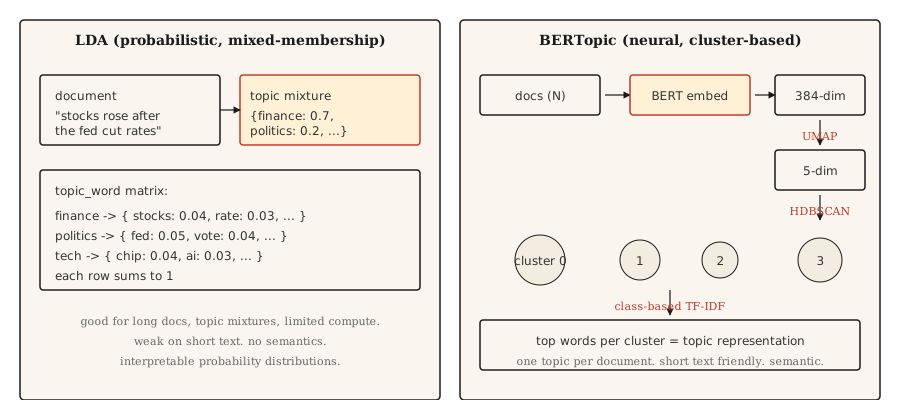
LDA generative story. Each topic is a distribution over words. Each document is a mixture of topics. To generate a word in a document, sample a topic from the document's mixture, then sample a word from that topic's distribution. Inference reverses this: given observed words, infer the topic distribution per document and the word distribution per topic. Collapsed Gibbs sampling or variational Bayes does the math.
Key LDA output:
doc_topic: matrix(n_docs, n_topics), each row sums to 1 (document's topic mixture).topic_word: matrix(n_topics, vocab_size), each row sums to 1 (topic's word distribution).
BERTopic pipeline.
- Encode each document with a sentence transformer (e.g.,
all-MiniLM-L6-v2). 384-dim vectors. - Reduce dimensionality with UMAP to ~5 dimensions. BERT embeddings are too high-dim for clustering.
- Cluster with HDBSCAN. Density-based, produces variable-size clusters and an "outlier" label.
- For each cluster, compute class-based TF-IDF over the cluster's documents to extract top words.
Output is one topic per document (plus a -1 outlier label). Optionally, a soft membership via HDBSCAN's probability vector.
topic-driftBuild It
Step 1: LDA via scikit-learn
from sklearn.feature_extraction.text import CountVectorizer
from sklearn.decomposition import LatentDirichletAllocation
import numpy as np


def fit_lda(documents, n_topics=5, max_features=1000):
    cv = CountVectorizer(
        max_features=max_features,
        stop_words="english",
        min_df=2,
        max_df=0.9,
    )
    X = cv.fit_transform(documents)
    lda = LatentDirichletAllocation(
        n_components=n_topics,
        random_state=42,
        max_iter=50,
        learning_method="online",
    )
    doc_topic = lda.fit_transform(X)
    feature_names = cv.get_feature_names_out()
    return lda, cv, doc_topic, feature_names


def print_top_words(lda, feature_names, n_top=10):
    for idx, topic in enumerate(lda.components_):
        top_idx = np.argsort(-topic)[:n_top]
        words = [feature_names[i] for i in top_idx]
        print(f"topic {idx}: {' '.join(words)}")
Notice: stopwords removed, min_df and max_df filter rare and ubiquitous terms, CountVectorizer (not TfidfVectorizer) because LDA expects raw counts.
Step 2: BERTopic (production)
from bertopic import BERTopic

topic_model = BERTopic(
    embedding_model="sentence-transformers/all-MiniLM-L6-v2",
    min_topic_size=15,
    verbose=True,
)

topics, probs = topic_model.fit_transform(documents)
info = topic_model.get_topic_info()
print(info.head(20))
valid_topics = info[info["Topic"] != -1]["Topic"].tolist()
for topic_id in valid_topics[:5]:
    print(f"topic {topic_id}: {topic_model.get_topic(topic_id)[:10]}")
The filter on Topic != -1 drops BERTopic's outlier bucket (documents HDBSCAN could not cluster). min_topic_size controls HDBSCAN's minimum cluster size; BERTopic's library default is 10. This example sets it to 15 explicitly for the lesson's scale. For corpora over 10,000 documents, increase to 50 or 100.
Step 3: evaluation
Both methods output topic words. The question is whether those words cohere.
- Topic coherence (c_v). Combines NPMI (normalized pointwise mutual information) of top-word pairs over sliding-window contexts, aggregates the scores into topic vectors, and compares those vectors via cosine similarity. Higher is better. Use
gensim.models.CoherenceModelwithcoherence="c_v". - Topic diversity. Fraction of unique words across all topics' top words. Higher is better (topics do not overlap).
- Qualitative inspection. Read the top words of each topic. Do they name a real thing? Human judgment is still the last line of defense.
When to pick which
| Situation | Pick |
|---|---|
| Short text (tweets, reviews, headlines) | BERTopic |
| Long documents with topic mixtures | LDA |
| No GPU / limited compute | LDA or NMF |
| Need document-level multi-topic distributions | LDA |
| LLM integration for topic labeling | BERTopic (direct support) |
| Resource-constrained edge deployment | LDA |
| Max semantic coherence | BERTopic |
The biggest practical consideration is document length. BERT embeddings truncate; LDA counts work on whatever length. For documents longer than the embedding model's context, either chunk + aggregate or use LDA.
Use It
The 2026 stack:
- BERTopic. Default for short text and anything where semantics matter.
gensim.models.LdaModel. Classic LDA for production, mature, battle-tested.sklearn.decomposition.LatentDirichletAllocation. Easy LDA for experiments.- NMF. Non-negative matrix factorization. Fast alternative to LDA, comparable quality on short text.
- Top2Vec. Similar design to BERTopic. Smaller community but good on some benchmarks.
- FASTopic. Newer, faster than BERTopic on very large corpora.
- LLM-based labeling. Run any clustering, then prompt a model to name each cluster.
Ship It
Save as outputs/skill-topic-picker.md:
---
name: topic-picker
description: Pick LDA or BERTopic for a corpus. Specify library, knobs, evaluation.
version: 1.0.0
phase: 5
lesson: 15
tags: [nlp, topic-modeling]
---

Given a corpus description (document count, avg length, domain, language, compute budget), output:

1. Algorithm. LDA / NMF / BERTopic / Top2Vec / FASTopic. One-sentence reason.
2. Configuration. Number of topics: `recommended = max(5, round(sqrt(n_docs)))`, clamped to 200 for corpora under 40,000 docs; permit >200 only when the corpus is genuinely large (>40k) and note the increased compute cost. `min_df` / `max_df` filters and embedding model for neural approaches also belong here.
3. Evaluation. Topic coherence (c_v) via `gensim.models.CoherenceModel`, topic diversity, and a 20-sample human read.
4. Failure mode to probe. For LDA, "junk topics" absorbing stopwords and frequent terms. For BERTopic, the -1 outlier cluster swallowing ambiguous documents.

Refuse BERTopic on documents longer than the embedding model's context window without a chunking strategy. Refuse LDA on very short text (tweets, reviews under 10 tokens) as coherence collapses. Flag any n_topics choice below 5 as likely wrong; flag >200 on corpora under 40k docs as likely over-splitting.
Exercises
- Easy. Fit LDA with 5 topics on the 20 Newsgroups dataset. Print top 10 words per topic. Label each topic by hand. Did the algorithm find the real categories?
- Medium. Fit BERTopic on the same 20 Newsgroups subset. Compare the number of topics found, top words, and qualitative coherence against LDA. Which surfaces the real categories more cleanly?
- Hard. Compute c_v coherence for both LDA and BERTopic on your corpus. Run each with 5, 10, 20, 50 topics. Plot coherence vs topic count. Report which method is more stable across topic counts.
Key Terms
| Term | What people say | What it actually means |
|---|---|---|
| Topic | A thing the corpus is about | A probability distribution over words (LDA) or a cluster of similar documents (BERTopic). |
| Mixed membership | Doc is multiple topics | LDA assigns each document a distribution over all topics. |
| UMAP | Dimensionality reduction | Manifold learning that preserves local structure; used in BERTopic. |
| HDBSCAN | Density clustering | Finds variable-size clusters; produces "noise" label (-1) for outliers. |
| c_v coherence | Topic quality metric | NPMI of top topic words over sliding windows, turned into context vectors and compared with cosine similarity. |
Further Reading
- Blei, Ng, Jordan (2003). Latent Dirichlet Allocation — the LDA paper.
- Grootendorst (2022). BERTopic: Neural topic modeling with a class-based TF-IDF procedure — the BERTopic paper.
- Röder, Both, Hinneburg (2015). Exploring the Space of Topic Coherence Measures — the paper that introduced c_v and friends.
- BERTopic documentation — the production reference. Excellent examples.
Check yourself
Quick quiz
What does LDA assume about each document?
- Each document belongs to exactly one topic
- Documents are sentences
- Each document is a mixture of topics; each topic is a distribution over words
- Documents are independent of topics
Show the answer
C. Each document is a mixture of topics; each topic is a distribution over words LDA's generative story is mixed-membership: each doc has a topic distribution, each topic a word distribution.
What does BERTopic use to form topic clusters?
- Run BM25 followed by k-means
- Encode docs with a sentence transformer, reduce dimensionality with UMAP, then cluster with HDBSCAN
- Train an LSTM end-to-end
- Direct softmax over the vocabulary
Show the answer
B. Encode docs with a sentence transformer, reduce dimensionality with UMAP, then cluster with HDBSCAN BERTopic = embeddings + UMAP + HDBSCAN, with class-based TF-IDF for topic words.
Why does scikit-learn's LDA expect raw counts (CountVectorizer), not TF-IDF?
- LDA cannot handle floats
- LDA's probabilistic model is defined over integer term counts; TF-IDF distorts the underlying distribution
- Memory limits
- TF-IDF is too slow
Show the answer
B. LDA's probabilistic model is defined over integer term counts; TF-IDF distorts the underlying distribution LDA likelihood assumes counts; feeding TF-IDF values violates the model assumption.
What does HDBSCAN's -1 label mean in a BERTopic output?
- Stopword cluster
- An outlier cluster of documents the density-based algorithm could not confidently assign
- A reserved category
- Top topic
Show the answer
B. An outlier cluster of documents the density-based algorithm could not confidently assign HDBSCAN marks unclustered points with -1; in BERTopic these are documents that did not fit any topic.
Which coherence metric is the common default for topic-model evaluation?
- BLEU
- c_v coherence via NPMI over sliding windows of top topic words
- Accuracy
- Perplexity only
Show the answer
B. c_v coherence via NPMI over sliding windows of top topic words c_v coherence (Roder et al., 2015) is the canonical automatic topic-coherence metric.
When is LDA usually a better fit than BERTopic?
- When embeddings are noisy
- When you need a single topic per document
- Long documents where mixed-membership topic distributions are useful and embeddings would truncate input
- On short tweets
Show the answer
C. Long documents where mixed-membership topic distributions are useful and embeddings would truncate input Long documents benefit from LDA's mixed-membership model; BERT encoders truncate inputs.
Why does BERTopic typically win on short text (tweets, headlines)?
- Short text has fewer topics
- It supports more languages
- Semantic similarity in embedding space captures meaning where bag-of-words counts are too sparse
- It is faster
Show the answer
C. Semantic similarity in embedding space captures meaning where bag-of-words counts are too sparse BERT embeddings provide semantic similarity for short text where word-overlap statistics fail.
What is a common LDA failure mode for which you should monitor topics?
- Topics that match labeled categories perfectly
- Topics with too few documents
- Junk topics that absorb stopwords or extremely frequent terms
- Document mixtures that sum to 1
Show the answer
C. Junk topics that absorb stopwords or extremely frequent terms LDA can create junk topics that absorb stopwords; tighter min_df/max_df and stopword filtering mitigate.
Questions people ask
What is the difference between LDA and BERTopic?
LDA treats each document as a mix of topics and each topic as a set of likely words, learned from word counts. BERTopic turns documents into embeddings, clusters similar ones, then names each cluster by its key words. BERTopic often gives more coherent topics on short text.
How many topics should a topic model have?
There is no single right number. Teams try several counts, check coherence scores and read sample documents per topic to see which setting gives distinct, useful themes. BERTopic can also pick a count on its own based on how documents cluster.
Lessons from AI Engineering from Scratch by Rohit Ghumare and contributors, MIT license. Notes for owners by Lozo. License