Chunking Strategies for RAG
Chunking configuration influences retrieval quality as much as the choice of embedding model (Vectara NAACL 2025). Get chunking wrong and no amount of reranking saves you.
Lesson 23 of 29Build~60 minutesPython
Before this: Lesson 14 of Phase 5 (Information Retrieval), lesson 22 of Phase 5 (Embedding Models)
On this page
The Problem
You put a 50-page contract into a RAG system. User asks: "What is the termination clause?" The retriever returns the cover page. Why? Because the model was trained on 512-token chunks and the termination clause sits 20 pages in, split across a page break, with no local keywords tying it to the query.
The fix is not "buy a better embedding model." The fix is chunking. How big? Overlap? Where to split? With surrounding context?
Feb 2026 benchmarks show surprising results:
- Vectara's 2026 study: recursive 512-token chunking beat semantic chunking 69% → 54% accuracy.
- SPLADE + Mistral-8B on Natural Questions: overlap provided zero measurable benefit.
- Context cliff: response quality drops sharply around 2,500 tokens of context.
The "obvious" answer (semantic chunking, 20% overlap, 1000 tokens) is often wrong. This lesson builds intuition for six strategies and tells you when to reach for which.
The Concept
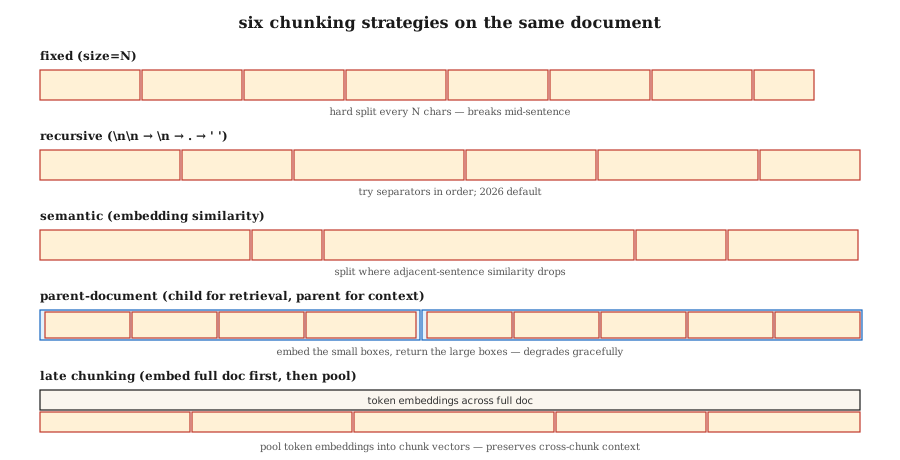
Fixed chunking. Split every N characters or tokens. Simplest baseline. Breaks mid-sentence. Good compression, bad coherence.
Recursive. LangChain's RecursiveCharacterTextSplitter. Try splitting on \n\n first, then \n, then ., then space. Falls back cleanly. The 2026 default.
Semantic. Embed each sentence. Compute cosine similarity between adjacent sentences. Split where similarity drops below a threshold. Preserves topic coherence. Slower; sometimes produces tiny 40-token fragments that hurt retrieval.
Sentence. Split on sentence boundaries. One sentence per chunk or a window of N sentences. Matches semantic chunking up to ~5k tokens at a fraction of the cost.
Parent-document. Store small child chunks for retrieval and the larger parent chunk for context. Retrieve by child; return parent. Degrades gracefully: bad child chunks still return reasonable parents.
Late chunking (2024). Embed the whole document at the token level first, then pool token embeddings into chunk embeddings. Preserves cross-chunk context. Works with long-context embedders (BGE-M3, Jina v3). Higher compute.
Contextual retrieval (Anthropic, 2024). Prepend each chunk with an LLM-generated summary of its position in the document ("This chunk is section 3.2 of the termination clauses..."). 35-50% retrieval improvement in Anthropic's own benchmark. Expensive to index.
The rule that beats every default
Match the chunk size to the query type:
| Query type | Chunk size |
|---|---|
| Factoid ("what is the CEO's name?") | 256-512 tokens |
| Analytical / multi-hop | 512-1024 tokens |
| Whole-section comprehension | 1024-2048 tokens |
NVIDIA's 2026 benchmark. The chunk should be big enough to contain the answer plus local context, small enough that the retriever's top-K returns focus on the answer rather than context noise.
n5-chunk-cutsBuild It
Step 1: fixed and recursive chunking
def chunk_fixed(text, size=512, overlap=0):
    step = size - overlap
    return [text[i:i + size] for i in range(0, len(text), step)]


def chunk_recursive(text, size=512, seps=("\n\n", "\n", ". ", " ")):
    if len(text) <= size:
        return [text]
    for sep in seps:
        if sep not in text:
            continue
        parts = text.split(sep)
        chunks = []
        buf = ""
        for p in parts:
            if len(p) > size:
                if buf:
                    chunks.append(buf)
                    buf = ""
                chunks.extend(chunk_recursive(p, size=size, seps=seps[1:] or (" ",)))
                continue
            candidate = buf + sep + p if buf else p
            if len(candidate) <= size:
                buf = candidate
            else:
                if buf:
                    chunks.append(buf)
                buf = p
        if buf:
            chunks.append(buf)
        return [c for c in chunks if c.strip()]
    return chunk_fixed(text, size)
Step 2: semantic chunking
def chunk_semantic(text, encoder, threshold=0.6, min_chars=200, max_chars=2048):
    sentences = split_sentences(text)
    if not sentences:
        return []
    embs = encoder.encode(sentences, normalize_embeddings=True)
    chunks = [[sentences[0]]]
    for i in range(1, len(sentences)):
        sim = float(embs[i] @ embs[i - 1])
        current_len = sum(len(s) for s in chunks[-1])
        if sim < threshold and current_len >= min_chars:
            chunks.append([sentences[i]])
        else:
            chunks[-1].append(sentences[i])

    result = []
    for group in chunks:
        text_group = " ".join(group)
        if len(text_group) > max_chars:
            result.extend(chunk_recursive(text_group, size=max_chars))
        else:
            result.append(text_group)
    return result
Tune threshold on your domain. Too high → fragments. Too low → one giant chunk.
Step 3: parent-document
def chunk_parent_child(text, parent_size=2048, child_size=256):
    parents = chunk_recursive(text, size=parent_size)
    mapping = []
    for p_idx, parent in enumerate(parents):
        children = chunk_recursive(parent, size=child_size)
        for child in children:
            mapping.append({"child": child, "parent_idx": p_idx, "parent": parent})
    return mapping


def retrieve_parent(child_query, mapping, encoder, top_k=3):
    child_embs = encoder.encode([m["child"] for m in mapping], normalize_embeddings=True)
    q_emb = encoder.encode([child_query], normalize_embeddings=True)[0]
    scores = child_embs @ q_emb
    top = np.argsort(-scores)[:top_k]
    seen, parents = set(), []
    for i in top:
        if mapping[i]["parent_idx"] not in seen:
            parents.append(mapping[i]["parent"])
            seen.add(mapping[i]["parent_idx"])
    return parents
Key insight: dedupe parents. Multiple children can map to the same parent; returning all would waste context.
Step 4: contextual retrieval (Anthropic pattern)
def contextualize_chunks(document, chunks, llm):
    context_prompts = [
        f"""<document>{document}</document>
Here is the chunk to situate: <chunk>{c}</chunk>
Write 50-100 words placing this chunk in the document's context."""
        for c in chunks
    ]
    contexts = llm.batch(context_prompts)
    return [f"{ctx}\n\n{c}" for ctx, c in zip(contexts, chunks)]
Index the contextualized chunks. At query time, retrieval benefits from the extra surrounding signal.
Step 5: evaluate
def recall_at_k(queries, corpus_chunks, encoder, k=5):
    chunk_embs = encoder.encode(corpus_chunks, normalize_embeddings=True)
    hits = 0
    for q_text, gold_idxs in queries:
        q_emb = encoder.encode([q_text], normalize_embeddings=True)[0]
        top = np.argsort(-(chunk_embs @ q_emb))[:k]
        if any(i in gold_idxs for i in top):
            hits += 1
    return hits / len(queries)
Always benchmark. The "best" strategy for your corpus may not match any blog post.
Pitfalls
- Chunking evaluated only on factoid queries. Multi-hop queries reveal very different winners. Use a query-type-stratified eval set.
- Semantic chunking without a minimum size. Produces 40-token fragments that hurt retrieval. Always enforce
min_tokens. - Overlap as cargo cult. 2026 studies find overlap often provides zero benefit and doubles index cost. Measure, do not assume.
- No min/max enforcement. Chunks of 5 tokens or 5000 tokens both break retrieval. Clamp.
- Cross-doc chunking. Never let a chunk span two documents. Always chunk per-doc, then merge.
Use It
The 2026 stack:
| Situation | Strategy |
|---|---|
| First build, unknown corpus | Recursive, 512 tokens, no overlap |
| Factoid QA | Recursive, 256-512 tokens |
| Analytical / multi-hop | Recursive, 512-1024 tokens + parent-document |
| Heavy cross-reference (contracts, papers) | Late chunking or contextual retrieval |
| Conversational / dialog corpus | Turn-level chunks + speaker metadata |
| Short utterances (tweets, reviews) | One document = one chunk |
Start with recursive 512. Measure recall@5 on a 50-query eval set. Tune from there.
Ship It
Save as outputs/skill-chunker.md:
---
name: chunker
description: Pick a chunking strategy, size, and overlap for a given corpus and query distribution.
version: 1.0.0
phase: 5
lesson: 23
tags: [nlp, rag, chunking]
---

Given a corpus (document types, avg length, domain) and query distribution (factoid / analytical / multi-hop), output:

1. Strategy. Recursive / sentence / semantic / parent-document / late / contextual. Reason.
2. Chunk size. Token count. Reason tied to query type.
3. Overlap. Default 0; justify if >0.
4. Min/max enforcement. `min_tokens`, `max_tokens` guards.
5. Evaluation plan. Recall@5 on 50-query stratified eval set (factoid, analytical, multi-hop).

Refuse any chunking strategy without min/max chunk size enforcement. Refuse overlap above 20% without an ablation showing it helps. Flag semantic chunking recommendations without a min-token floor.
Exercises
- Easy. Chunk one 20-page document with fixed(512, 0), recursive(512, 0), and recursive(512, 100). Compare chunk counts and boundary quality.
- Medium. Build a 30-query eval set over 5 documents. Measure recall@5 for recursive, semantic, and parent-document. Which wins? Does it match the blog posts?
- Hard. Implement contextual retrieval. Measure MRR improvement over baseline recursive. Report index cost (LLM calls) vs accuracy gain.
Key Terms
| Term | What people say | What it actually means |
|---|---|---|
| Chunk | A piece of a doc | Sub-document unit that gets embedded, indexed, and retrieved. |
| Overlap | Safety margin | N tokens shared between adjacent chunks; often useless in 2026 benchmarks. |
| Semantic chunking | Smart chunking | Split where adjacent-sentence embedding similarity drops. |
| Parent-document | Two-level retrieval | Retrieve small children, return larger parents. |
| Late chunking | Chunk after embedding | Embed full doc at token level, pool into chunk vectors. |
| Contextual retrieval | Anthropic's trick | LLM-generated summary prepended to each chunk before indexing. |
| Context cliff | 2500-token wall | Quality drop observed around 2.5k context tokens in RAG (Jan 2026). |
Further Reading
- Yepes et al. / LangChain — Recursive Character Splitting docs — the default in production.
- Vectara (2024, NAACL 2025). Chunking configurations analysis — chunking matters as much as embedding choice.
- Jina AI — Late Chunking in Long-Context Embedding Models (2024) — the late chunking paper.
- Anthropic — Contextual Retrieval — 35-50% retrieval improvement with LLM-generated context prefixes.
- NVIDIA 2026 chunk-size benchmark — Premai summary — chunk size by query type.
Check yourself
Quick quiz
Why is chunking strategy as important as the embedding model in RAG?
- Chunking shrinks the model
- Smaller chunks train faster
- Chunking is required by FAISS
- Chunk boundaries determine whether the answer is even retrievable; bad chunks defeat any embedding
Show the answer
D. Chunk boundaries determine whether the answer is even retrievable; bad chunks defeat any embedding Vectara's 2025 study showed chunking quality matches or exceeds embedding-model impact on retrieval quality.
What does LangChain's RecursiveCharacterTextSplitter try in order?
- Try splitting on paragraph breaks, then newlines, then sentence boundaries, then spaces
- Split on token IDs
- Split on whitespace only
- Always split on character N
Show the answer
A. Try splitting on paragraph breaks, then newlines, then sentence boundaries, then spaces Recursive splitting falls back through paragraph -> newline -> sentence -> space to preserve structure.
Why does the parent-document pattern improve answer quality?
- It removes embeddings
- Children give precise retrieval; returning the larger parent block preserves the surrounding context the reader needs
- It avoids tokenization
- It uses fewer GPU cycles
Show the answer
B. Children give precise retrieval; returning the larger parent block preserves the surrounding context the reader needs Retrieve by small child chunks for precision, then expand to the parent for context.
What does Anthropic's 'contextual retrieval' add to each chunk before indexing?
- An LLM-generated 50-100 word summary placing the chunk in the document's overall context
- Random noise
- A POS tag
- A language code
Show the answer
A. An LLM-generated 50-100 word summary placing the chunk in the document's overall context Contextual retrieval prepends an LLM-written situating summary to each chunk; ~35-50% recall gain.
Which 2026 finding contradicts the conventional wisdom about chunk overlap?
- Overlap should be 50%
- Overlap is required for BM25
- Overlap improves contextual retrieval only
- Empirical 2026 benchmarks show overlap often provides zero measurable benefit while doubling index cost
Show the answer
D. Empirical 2026 benchmarks show overlap often provides zero measurable benefit while doubling index cost Newer studies (SPLADE+Mistral on NQ) show chunk overlap rarely helps and inflates index size.
Which chunk size does NVIDIA's 2026 benchmark associate with factoid queries?
- Roughly 256-512 tokens
- 2048-4096 tokens
- 8192 tokens
- 64 tokens
Show the answer
A. Roughly 256-512 tokens Factoid queries benefit from smaller chunks (256-512 tokens) that concentrate the answer signal.
Why is a min-token floor important when using semantic chunking?
- Without a floor, semantic chunking can produce tiny 40-token fragments that hurt retrieval
- Required by BERT
- Floors prevent overlap
- Floors speed up inference
Show the answer
A. Without a floor, semantic chunking can produce tiny 40-token fragments that hurt retrieval Semantic chunkers can over-segment; enforcing a min size prevents low-signal fragments.
What does 'late chunking' do differently from traditional chunking?
- Chunks after retrieval
- Embeds the whole document at the token level first, then pools token embeddings into chunk vectors to preserve cross-chunk context
- Skips chunking entirely
- Uses BM25 instead
Show the answer
B. Embeds the whole document at the token level first, then pools token embeddings into chunk vectors to preserve cross-chunk context Late chunking embeds first and pools second, preserving contextual interactions across chunk boundaries.
Questions people ask
What is the best chunk size for RAG?
There is no universal best size. It depends on your documents, the questions people ask and the embedding model. Teams test a few sizes and overlaps on real questions and measure which one retrieves the right passages most often.
What is semantic chunking?
Semantic chunking splits text where the topic changes rather than at a fixed length. It compares the meaning of neighboring sentences and starts a new chunk when they drift apart. This keeps related ideas together but costs more to compute than fixed-size splits.
Lessons from AI Engineering from Scratch by Rohit Ghumare and contributors, MIT license. Notes for owners by Lozo. License