Dialogue State Tracking
"I want a cheap restaurant in the north... actually make it moderate... and add Italian." Three turns, three state updates. DST keeps the slot-value dict in sync so the booking works.
Lesson 29 of 29Build~75 minutesPython
Before this: Lesson 17 of Phase 5 (Chatbots), lesson 20 of Phase 5 (Structured Outputs)
On this page
The Problem
In a task-oriented dialogue system, the user's goal is encoded as a set of slot-value pairs: {cuisine: italian, area: north, price: moderate}. Every user turn can add, change, or remove a slot. The system must read the whole conversation and output the current state correctly.
Get a single slot wrong and the system books the wrong restaurant, schedules the wrong flight, or charges the wrong card. DST is the hinge between what the user said and what the backend executes.
Why it still matters in 2026 despite LLMs:
- Compliance-sensitive domains (banking, healthcare, airline booking) require deterministic slot values, not free-form generation.
- Tool-use agents still need slot resolution before calling APIs.
- Multi-turn correction is harder than it looks: "actually no, make it Thursday."
The modern pipeline: classical DST concepts + LLM extractors + structured-output guardrails.
The Concept
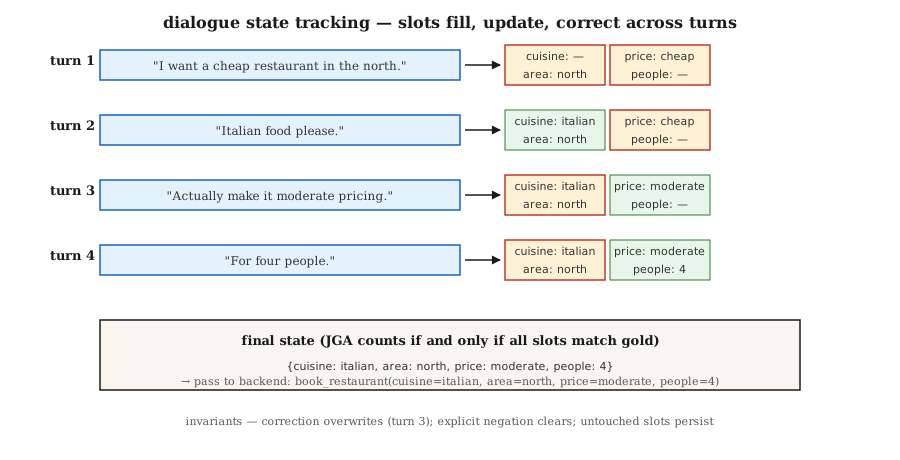
Task structure. A schema defines domains (restaurant, hotel, taxi) and their slots (cuisine, area, price, people). Each slot can be empty, filled with a value from a closed set (price: {cheap, moderate, expensive}), or a free-form value (name: "The Copper Kettle").
Two DST formulations.
- Classification. For each (slot, candidate_value) pair, predict yes/no. Works for closed-vocab slots. Standard pre-2020.
- Generation. Given the dialogue, generate slot values as free text. Works for open-vocab slots. The modern default.
Metric. Joint Goal Accuracy (JGA) — the fraction of turns where every slot is correct. All-or-nothing. MultiWOZ 2.4 leaderboard tops around 83% in 2026.
Architectures.
- Rule-based (slot regex + keyword). Strong baseline for narrow domains. Debuggable.
- TripPy / BERT-DST. Copy-based generation with BERT encoding. Pre-LLM standard.
- LDST (LLaMA + LoRA). Instruction-tuned LLM with domain-slot prompting. Reaches ChatGPT-level quality on MultiWOZ 2.4.
- Ontology-free (2024–26). Skip the schema; generate slot names and values directly. Handles open domains.
- Prompt + structured output (2024–26). LLM with Pydantic schema + constrained decoding. 5 lines of code, production-ready.
The classic failure modes
- Co-reference across turns. "Let's stay with the first option." Needs to resolve which option.
- Over-write vs append. User says "add Italian." Do you replace cuisine or append?
- Implicit confirmations. "OK cool" — did that accept the offered booking?
- Correction. "Actually make it 7 pm." Must update time without clearing other slots.
- Coreference to previous system utterance. "Yes, that one." Which "that"?
n5-slot-trackerBuild It
Step 1: rule-based slot extractor
See code/main.py. Regex + synonym dictionaries cover 70% of canonical utterances in narrow domains:
CUISINE_SYNONYMS = {
    "italian": ["italian", "pasta", "pizza", "italy"],
    "chinese": ["chinese", "chow mein", "noodles"],
}


def extract_cuisine(utterance):
    for canonical, synonyms in CUISINE_SYNONYMS.items():
        if any(syn in utterance.lower() for syn in synonyms):
            return canonical
    return None
Brittle outside the canonical vocabulary. Works for deterministic slot confirmations.
Step 2: state update loop
def update_state(state, utterance):
    new_state = dict(state)
    for slot, extractor in SLOT_EXTRACTORS.items():
        value = extractor(utterance)
        if value is not None:
            new_state[slot] = value
    for slot in NEGATION_CLEARS:
        if is_negated(utterance, slot):
            new_state[slot] = None
    return new_state
Three invariants:
- Never reset a slot the user did not touch.
- Explicit negation ("never mind the cuisine") must clear.
- User correction ("actually...") must overwrite, not append.
Step 3: LLM-driven DST with structured output
from pydantic import BaseModel
from typing import Literal, Optional
import instructor

class RestaurantState(BaseModel):
    cuisine: Optional[Literal["italian", "chinese", "indian", "thai", "any"]] = None
    area: Optional[Literal["north", "south", "east", "west", "center"]] = None
    price: Optional[Literal["cheap", "moderate", "expensive"]] = None
    people: Optional[int] = None
    day: Optional[str] = None


def llm_dst(history, llm):
    prompt = f"""You track the slot values of a restaurant booking across turns.
Dialogue so far:
{render(history)}

Update the state based on the latest user turn. Output only the JSON state."""
    return llm(prompt, response_model=RestaurantState)
Instructor + Pydantic guarantees a valid state object. No regex, no schema mismatches, no hallucinated slots.
Step 4: JGA evaluation
def joint_goal_accuracy(predicted_states, gold_states):
    correct = sum(1 for p, g in zip(predicted_states, gold_states) if p == g)
    return correct / len(predicted_states)
Calibrate: what fraction of turns does the system get ALL slots right? For MultiWOZ 2.4, top 2026 systems: 80-83%. Your in-domain system should exceed that on your narrow vocabulary or the LLM baseline beats you.
Step 5: handling correction
CORRECTION_CUES = {"actually", "no wait", "on second thought", "change that to"}


def is_correction(utterance):
    return any(cue in utterance.lower() for cue in CORRECTION_CUES)
On a detected correction, overwrite the last-updated slot rather than appending. Hard to get right without LLM help. The modern pattern: always let the LLM regenerate the whole state from history rather than incrementally updating — this naturally handles corrections.
Pitfalls
- Full-history regeneration cost. Letting the LLM regenerate state each turn costs $O(n^2)$ total tokens. Cap history or summarize older turns.
- Schema drift. Adding new slots post-hoc breaks old training data. Version your schema.
- Case sensitivity. "Italian" vs "italian" vs "ITALIAN" — normalize everywhere.
- Implicit inheritance. If the user has previously specified "for 4 people," a new request for a different time should not clear people. Always pass the full history.
- Free-form vs closed-set. Names, times, and addresses need free-form slots; cuisines and areas are closed. Mix both in the schema.
Use It
The 2026 stack:
| Situation | Approach |
|---|---|
| Narrow domain (one or two intents) | Rule-based + regex |
| Broad domain, labeled data available | LDST (LLaMA + LoRA on MultiWOZ-style data) |
| Broad domain, no labels, prod-ready | LLM + Instructor + Pydantic schema |
| Spoken / voice | ASR + normalizer + LLM-DST |
| Multi-domain booking flow | Schema-guided LLM with per-domain Pydantic models |
| Compliance-sensitive | Rule-based primary, LLM fallback with confirmation flow |
Ship It
Save as outputs/skill-dst-designer.md:
---
name: dst-designer
description: Design a dialogue state tracker — schema, extractor, update policy, evaluation.
version: 1.0.0
phase: 5
lesson: 29
tags: [nlp, dialogue, task-oriented]
---

Given a use case (domain, languages, vocab openness, compliance needs), output:

1. Schema. Domain list, slots per domain, open vs closed vocabulary per slot.
2. Extractor. Rule-based / seq2seq / LLM-with-Pydantic. Reason.
3. Update policy. Regenerate-whole-state / incremental; correction handling; negation handling.
4. Evaluation. Joint Goal Accuracy on a held-out dialogue set, slot-level precision/recall, confusion on the hardest slot.
5. Confirmation flow. When to explicitly ask the user to confirm (destructive actions, low-confidence extractions).

Refuse LLM-only DST for compliance-sensitive slots without a rule-based secondary check. Refuse any DST that cannot roll back a slot on user correction. Flag schemas without version tags.
Exercises
- Easy. Build the rule-based state tracker in
code/main.pyfor 3 slots (cuisine, area, price). Test on 10 hand-crafted dialogues. Measure JGA. - Medium. Same dataset with Instructor + Pydantic + a small LLM. Compare JGA. Inspect the hardest turns.
- Hard. Implement both and route: rule-based primary, LLM fallback when rule-based emits <2 slots with confidence. Measure the combined JGA and inference cost per turn.
Key Terms
| Term | What people say | What it actually means |
|---|---|---|
| DST | Dialogue state tracking | Maintain the slot-value dict across dialogue turns. |
| Slot | Unit of user intent | Named parameter the backend needs (cuisine, date). |
| Domain | The task area | Restaurant, hotel, taxi — sets of slots. |
| JGA | Joint Goal Accuracy | Fraction of turns where every slot is correct. All-or-nothing. |
| MultiWOZ | The benchmark | Multi-domain WOZ dataset; standard DST evaluation. |
| Ontology-free DST | No schema | Generate slot names and values directly, no fixed list. |
| Correction | "Actually..." | Turn that overwrites a previously-filled slot. |
Further Reading
- Budzianowski et al. (2018). MultiWOZ — A Large-Scale Multi-Domain Wizard-of-Oz — the canonical benchmark.
- Feng et al. (2023). Towards LLM-driven Dialogue State Tracking (LDST) — LLaMA + LoRA instruction tuning for DST.
- Heck et al. (2020). TripPy — A Triple Copy Strategy for Value Independent Neural Dialog State Tracking — the copy-based DST workhorse.
- King, Flanigan (2024). Unsupervised End-to-End Task-Oriented Dialogue with LLMs — EM-based unsupervised TOD.
- MultiWOZ leaderboard — canonical DST results.
Check yourself
Quick quiz
What does dialogue state tracking maintain across turns?
- A free-text history only
- A POS-tagged transcript
- An embedding of the conversation
- A slot-value dictionary representing the user's current goal, updated after every turn
Show the answer
D. A slot-value dictionary representing the user's current goal, updated after every turn DST keeps a structured slot-value map that the backend can act on.
What does Joint Goal Accuracy (JGA) measure?
- Fraction of turns where every slot is exactly correct (all-or-nothing)
- Cosine similarity
- Latency per turn
- Average slot accuracy
Show the answer
A. Fraction of turns where every slot is exactly correct (all-or-nothing) JGA is the strict per-turn match across all slots; per-slot accuracy is more lenient.
Why does regenerating the whole state from history each turn handle user corrections naturally?
- It uses fewer tokens
- It runs on GPU
- It avoids embeddings
- Reading the full history lets the model re-derive the final state including 'actually...' corrections without explicit rollback logic
Show the answer
D. Reading the full history lets the model re-derive the final state including 'actually...' corrections without explicit rollback logic Full-history regeneration absorbs corrections by recomputing the final state from the entire conversation.
Which 2026 pattern gives a guaranteed-valid slot dict in 5 lines of code?
- Hand-written regex
- LLM + Instructor + Pydantic schema with constrained or validated output
- TF-IDF classifier
- BM25 retrieval
Show the answer
B. LLM + Instructor + Pydantic schema with constrained or validated output Pydantic schema + Instructor validates the LLM's state output against the slot ontology automatically.
Why version your DST schema?
- Adding new slots post-hoc invalidates older training data and breaks longitudinal evaluation
- Reduce token count
- Required by JSON
- Speed gains
Show the answer
A. Adding new slots post-hoc invalidates older training data and breaks longitudinal evaluation Unversioned schema changes silently break training data alignment and eval comparability.
Why must DST for compliance-sensitive domains include a rule-based check alongside LLM extraction?
- LLMs are slower
- Rules avoid embeddings
- LLM-only DST can mis-extract destructive parameters (amount, account, date); a rules layer enforces deterministic constraints
- Rules are multilingual
Show the answer
C. LLM-only DST can mis-extract destructive parameters (amount, account, date); a rules layer enforces deterministic constraints Compliance domains require deterministic enforcement; rules catch slot errors that LLMs introduce.
What is the cost concern with regenerating state on every turn via LLM?
- Embedding drift
- More embeddings
- Re-reading the full history each turn yields O(n^2) total token usage; cap or summarize older turns
- Cosine costs
Show the answer
C. Re-reading the full history each turn yields O(n^2) total token usage; cap or summarize older turns Full-history regeneration is quadratic in turns; cap history or use rolling summaries.
Why are explicit confirmation flows required before destructive backend actions?
- Confirmation increases JGA
- Even good DST has nonzero slot-error rates; a deterministic confirmation prevents wrong-account or wrong-amount actions
- Required by tokenizers
- Latency
Show the answer
B. Even good DST has nonzero slot-error rates; a deterministic confirmation prevents wrong-account or wrong-amount actions Destructive actions need user confirmation because DST is never error-free.
Questions people ask
What is dialogue state tracking?
It is the part of a task-focused chatbot that keeps a structured summary of the user's goal so far, usually as slots and values like "date: Friday". After each turn it adds, changes or removes values so the bot always acts on the latest request.
How do chatbots remember what I said earlier in a conversation?
Task bots keep a state record of key details and update it each turn. LLM chatbots usually resend the recent conversation with every request, and some also save summaries or facts to a memory store. Very long chats may still lose early details.
Lessons from AI Engineering from Scratch by Rohit Ghumare and contributors, MIT license. Notes for owners by Lozo. License