Machine Translation
Translation is the task that paid for NLP research for thirty years and keeps paying now.
Lesson 11 of 29Build~75 minutesPython
Before this: Lesson 10 of Phase 5 (Attention Mechanism), lesson 4 of Phase 5 (GloVe, FastText, Subword)
On this page
The Problem
A model reads a sentence in one language and produces a sentence in another. Length varies. Word order varies. Some source words map to multiple target words and vice versa. Idioms refuse one-to-one mapping. "I miss you" in French is "tu me manques" — literally "you are lacking to me." No word-level alignment survives that.
Machine translation is the task that forced NLP to invent encoder-decoders, attention, transformers, and eventually the whole LLM paradigm. Every step forward arrived because translation quality was measurable and the gap between human and machine was stubborn.
This lesson skips the history lesson and teaches the working pipeline of 2026: pretrained multilingual encoder-decoder (NLLB-200 or mBART), subword tokenization, beam search, BLEU and chrF evaluation, and the handful of failure modes that still ship to production uncaught.
The Concept
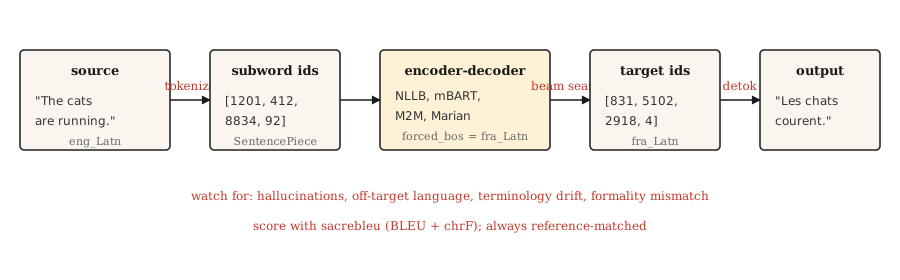
Modern MT is a transformer encoder-decoder trained on parallel text. The encoder reads the source in its language's tokenization. The decoder generates the target, one subword at a time, using the encoder's output via cross-attention (lesson 10). Decoding uses beam search to avoid the greedy-decoding trap. The output is detokenized, detruecased, and scored against a reference.
Three operational choices drive real-world MT quality.
- Tokenizer. SentencePiece BPE trained on a mixed-language corpus. Shared vocabulary across languages is what enables zero-shot pairs in NLLB.
- Model size. NLLB-200 distilled 600M fits on a laptop. NLLB-200 3.3B is the published production default. 54.5B is the research ceiling.
- Decoding. Beam width 4-5 for general content. Length penalty to avoid too-short output. Constrained decoding when you need terminology consistency.
seq2seq-alignmentBuild It
Step 1: a pretrained MT call
from transformers import AutoTokenizer, AutoModelForSeq2SeqLM

model_id = "facebook/nllb-200-distilled-600M"
tok = AutoTokenizer.from_pretrained(model_id, src_lang="eng_Latn")
model = AutoModelForSeq2SeqLM.from_pretrained(model_id)

src = "The cats are running."
inputs = tok(src, return_tensors="pt")

out = model.generate(
    **inputs,
    forced_bos_token_id=tok.convert_tokens_to_ids("fra_Latn"),
    num_beams=5,
    length_penalty=1.0,
    max_new_tokens=64,
)
print(tok.batch_decode(out, skip_special_tokens=True)[0])
Les chats courent.Three things matter here. src_lang tells the tokenizer which script and segmentation to apply. forced_bos_token_id tells the decoder which language to generate. Both are NLLB-specific tricks; mBART and M2M-100 use their own conventions and they are not interchangeable.
Step 2: BLEU and chrF
BLEU measures n-gram overlap between output and reference. Four reference n-gram sizes (1-4), geometric mean of precisions, brevity penalty for too-short output. The score is in [0, 100]. Commonly used. Frustrating to interpret: 30 BLEU is "usable"; 40 is "good"; 50 is "exceptional"; differences under 1 BLEU are noise.
chrF measures character-level F-score. More sensitive to morphologically rich languages where BLEU undercounts matches. Often reported alongside BLEU.
import sacrebleu

hypotheses = ["Les chats courent."]
references = [["Les chats courent."]]

bleu = sacrebleu.corpus_bleu(hypotheses, references)
chrf = sacrebleu.corpus_chrf(hypotheses, references)
print(f"BLEU: {bleu.score:.1f}  chrF: {chrf.score:.1f}")
Always use sacrebleu. It normalizes tokenization so scores are comparable across papers. Rolling your own BLEU computation is how misleading benchmarks happen.
The three-tier evaluation hierarchy (2026)
Modern MT evaluation uses three complementary metric families. Ship with at least two.
- Heuristic (BLEU, chrF). Fast, reference-based, interpretable, insensitive to paraphrase. Use for legacy comparison and regression detection.
- Learned (COMET, BLEURT, BERTScore). Neural models trained on human judgment; compare semantic similarity of translation to source and reference. COMET has the highest association with MT research since 2023 and is the 2026 production default where quality matters.
- LLM-as-judge (reference-free). Prompt a large model to score translations on fluency, adequacy, tone, cultural appropriateness. GPT-4-as-judge matches human agreement ~80% of the time when the rubric is well designed. Use for open-ended content where no reference exists.
Practical 2026 stack: sacrebleu for BLEU and chrF, unbabel-comet for COMET, and a prompted LLM for the final human-facing signal. Calibrate every metric against 50-100 human-labeled examples before trusting it on production data.
Reference-free metrics (COMET-QE, BLEURT-QE, LLM-as-judge) let you evaluate translations without a reference, which matters for long-tail language pairs where reference translations do not exist.
Step 3: what breaks in production
The working pipeline above will translate fluently 80% of the time and silently fail the remaining 20%. Named failure modes:
- Hallucination. Model invents content that was not in the source. Common in unfamiliar domain vocabulary. Symptom: output is fluent but claims facts the source did not state. Mitigation: constrained decoding on domain terms, human review on regulated content, monitoring for output much longer than input.
- Off-target generation. Model translates into the wrong language. NLLB is surprisingly prone to this on rare language pairs. Mitigation: verify
forced_bos_token_idand always decode with a language-ID model check on output. - Terminology drift. "Sign up" becomes "s'inscrire" in doc 1 and "créer un compte" in doc 2. For UI text and user-facing strings, consistency matters more than raw quality. Mitigation: glossary-constrained decoding or post-edit dictionary.
- Formality mismatch. French "tu" vs "vous", Japanese politeness levels. The model picks whichever form was more common in training. For customer-facing content this is usually wrong. Mitigation: prompt prefix with a formality token if the model supports it, or fine-tune a small model on formal-only corpora.
- Length explosion on short input. Very short input sentences often produce overlong translations because the length penalty falls off a cliff below ~5 source tokens. Mitigation: hard max-length cap proportional to source length.
Step 4: fine-tuning for a domain
Pretrained models are generalists. Legal, medical, or game-dialog translation benefits measurably from fine-tuning on domain parallel data. The recipe is not exotic:
from transformers import Trainer, TrainingArguments
from datasets import Dataset

pairs = [
    {"src": "The defendant pleaded guilty.", "tgt": "L'accusé a plaidé coupable."},
]

ds = Dataset.from_list(pairs)


def preprocess(ex):
    return tok(
        ex["src"],
        text_target=ex["tgt"],
        truncation=True,
        max_length=128,
        padding="max_length",
    )


ds = ds.map(preprocess, remove_columns=["src", "tgt"])

args = TrainingArguments(output_dir="out", per_device_train_batch_size=4, num_train_epochs=3, learning_rate=3e-5)
Trainer(model=model, args=args, train_dataset=ds).train()
A few thousand high-quality parallel examples beats a few hundred thousand noisy web-scraped ones. Quality of training data is the single largest production lever.
Use It
The 2026 production stack for MT:
| Use case | Recommended starting point |
|---|---|
| Any-to-any, 200 languages | facebook/nllb-200-distilled-600M (laptop) or nllb-200-3.3B (production) |
| English-centric, high quality, 50 languages | facebook/mbart-large-50-many-to-many-mmt |
| Short runs, cheap inference, English-French/German/Spanish | Helsinki-NLP / Marian models |
| Latency-critical browser-side | ONNX-quantized Marian (~50 MB) |
| Maximum quality, willing to pay | GPT-4 / Claude / Gemini with translation prompts |
LLMs now outperform specialized MT models on several language pairs as of 2026, particularly on idiomatic content and long context. The tradeoff is per-token cost and latency. Pick an LLM when context length, stylistic consistency, or domain adaptation via prompting matters more than throughput.
Ship It
Save as outputs/skill-mt-evaluator.md:
---
name: mt-evaluator
description: Evaluate a machine translation output for shipping.
version: 1.0.0
phase: 5
lesson: 11
tags: [nlp, translation, evaluation]
---

Given a source text and a candidate translation, output:

1. Automatic score estimate. BLEU and chrF ranges you would expect. State whether a reference is available.
2. Five-point human-verifiable check list: (a) content preservation (no hallucinations), (b) correct language, (c) register / formality match, (d) terminology consistency with glossary if provided, (e) no truncation or length explosion.
3. One domain-specific issue to probe. E.g., for legal: named entities and statute citations. For medical: drug names and dosages. For UI: placeholder variables `{name}`.
4. Confidence flag. "Ship" / "Ship with review" / "Do not ship". Tie to the severity of issues found in step 2.

Refuse to ship a translation without a language-ID check on output. Refuse to evaluate without a reference unless the user explicitly opts in to reference-free scoring (COMET-QE, BLEURT-QE). Flag any content over 1000 tokens as likely needing chunked translation.
Exercises
- Easy. Translate a 5-sentence English paragraph to French and back to English using
nllb-200-distilled-600M. Measure how close the round-trip is to the original. You should see semantic preservation with word-choice drift. - Medium. Implement a language-ID check on translation outputs using
fasttext lid.176orlangdetect. Integrate into the MT call so off-target generations are caught before returning. - Hard. Fine-tune
nllb-200-distilled-600Mon a 5,000-pair domain corpus of your choice. Measure BLEU on a held-out set before and after fine-tuning. Report which kinds of sentences improved and which regressed.
Key Terms
| Term | What people say | What it actually means |
|---|---|---|
| BLEU | Translation score | N-gram precision with brevity penalty. [0, 100]. |
| chrF | Character F-score | Character-level F-score. More sensitive for morphologically rich languages. |
| NMT | Neural MT | Transformer encoder-decoder trained on parallel text. The 2017+ default. |
| NLLB | No Language Left Behind | Meta's 200-language MT model family. |
| Constrained decoding | Controlled output | Force specific tokens or n-grams to appear / not appear in the output. |
| Hallucination | Invented content | Model output that is not supported by the source. |
Further Reading
- Costa-jussà et al. (2022). No Language Left Behind: Scaling Human-Centered Machine Translation — the NLLB paper.
- Post (2018). A Call for Clarity in Reporting BLEU Scores — why
sacrebleuis the only correct way to report BLEU. - Popović (2015). chrF: character n-gram F-score for automatic MT evaluation — the chrF paper.
- Hugging Face MT guide — practical fine-tuning walkthrough.
Check yourself
Quick quiz
What does BLEU measure?
- N-gram precision (typically 1-4) between hypothesis and reference, with a brevity penalty
- Embedding cosine similarity
- Language identification accuracy
- Character-level F-score
Show the answer
A. N-gram precision (typically 1-4) between hypothesis and reference, with a brevity penalty BLEU is the geometric mean of 1-4-gram precision against references, plus a brevity penalty.
Why use sacrebleu instead of rolling your own BLEU?
- It runs on GPU
- It is more accurate
- It normalizes tokenization so scores are comparable across papers and runs
- It supports streaming
Show the answer
C. It normalizes tokenization so scores are comparable across papers and runs sacrebleu freezes tokenization, removing a common source of incomparable BLEU numbers.
Which NLLB-specific setting controls the target language during decoding?
- src_lang
- forced_bos_token_id set to the target language code's token id
- num_beams
- length_penalty
Show the answer
B. forced_bos_token_id set to the target language code's token id NLLB forces the first decoded token to a target-language code via forced_bos_token_id.
Which metric family is the 2026 default for production MT quality where labeled data exists?
- Token edit distance
- Latency
- BLEU alone
- Learned metrics such as COMET (and BERTScore/BLEURT) trained on human judgment
Show the answer
D. Learned metrics such as COMET (and BERTScore/BLEURT) trained on human judgment Learned metrics like COMET correlate more strongly with human judgment than BLEU/chrF alone.
When does chrF tend to be more informative than BLEU?
- For morphologically rich languages where character-level matches catch inflectional variants BLEU misses
- When using beam search
- On very short sentences
- Whenever a reference exists
Show the answer
A. For morphologically rich languages where character-level matches catch inflectional variants BLEU misses Character F-score captures partial morphological matches that word-level BLEU undercounts.
What is off-target generation in multilingual MT?
- Output that drops named entities
- The model decodes into the wrong target language (e.g. NLLB outputting Spanish when French was requested)
- Output that is too short
- Output that misses punctuation
Show the answer
B. The model decodes into the wrong target language (e.g. NLLB outputting Spanish when French was requested) Off-target generation is common on rare language pairs; a post-translation language-ID check catches it.
Why does fine-tuning on a few thousand high-quality domain pairs often beat much larger noisy web data?
- Quality and domain match dominate volume; noisy parallel data introduces drift and hallucination
- Smaller datasets train faster
- Web data is illegal to use
- Larger data overflows GPU memory
Show the answer
A. Quality and domain match dominate volume; noisy parallel data introduces drift and hallucination Clean domain-aligned pairs are the largest production lever; noisy data degrades adaptation.
When is an LLM (e.g. GPT-4) likely to outperform a specialized MT model in 2026?
- Latency-critical browser translation
- Idiomatic content, long context, stylistic adaptation via prompting, or content requiring tone control
- Highest throughput batch translation
- Small-language pairs with millions of parallel sentences
Show the answer
B. Idiomatic content, long context, stylistic adaptation via prompting, or content requiring tone control LLMs win on idiomatic, long-context, or style-controlled translation; specialized MT wins on throughput and latency.
Questions people ask
What is a BLEU score in machine translation?
BLEU compares a machine translation to one or more human translations by counting matching word sequences. Higher means more overlap. It is quick and cheap, but it misses meaning and fluency, so newer metrics and human review are used alongside it.
Is AI translation good enough for business use?
For everyday emails, support replies and internal reading it is usually good. For contracts, regulated text, marketing slogans and anything where a mistake is costly, have a fluent person review the output before it goes out.
Lessons from AI Engineering from Scratch by Rohit Ghumare and contributors, MIT license. Notes for owners by Lozo. License