Subword Tokenization — BPE, WordPiece, Unigram, SentencePiece
Word tokenizers choke on unseen words. Character tokenizers blow up sequence length. Subword tokenizers split the difference. Every modern LLM ships on one.
Lesson 19 of 29Learn~60 minutesPython
Before this: Lesson 1 of Phase 5 (Text Processing), lesson 4 of Phase 5 (GloVe / FastText / Subword)
On this page
The Problem
Your vocabulary has 50,000 words. A user types "untokenizable". Your tokenizer returns [UNK]. The model now has no signal about the word. Worse: the 90th-percentile document in your corpus has 40 rare words, which means 40 bits of dropped information per document.
Subword tokenization solves this. Common words stay single tokens. Rare words decompose into meaningful pieces: untokenizable → un, token, izable. Training data covers everything because any string is ultimately a sequence of bytes.
Every frontier LLM in 2026 ships on one of three algorithms (BPE, Unigram, WordPiece), wrapped in one of three libraries (tiktoken, SentencePiece, HF Tokenizers). You cannot ship a language model without picking one.
The Concept
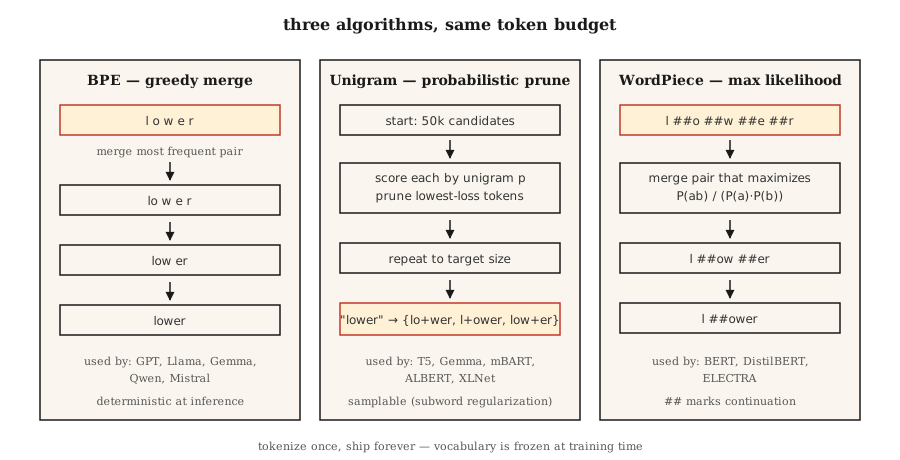
BPE (Byte-Pair Encoding). Start with a character-level vocabulary. Count every adjacent pair. Merge the most frequent pair into a new token. Repeat until you hit the target vocabulary size. Dominant algorithm: GPT-2/3/4, Llama, Gemma, Qwen2, Mistral.
Byte-level BPE. Same algorithm but over raw bytes (256 base tokens) instead of Unicode characters. Guarantees zero [UNK] tokens — any byte sequence encodes. GPT-2 uses 50,257 tokens (256 bytes + 50,000 merges + 1 special).
Unigram. Start with a huge vocabulary. Assign each token a unigram probability. Iteratively prune tokens whose removal least increases the corpus log-likelihood. Probabilistic at inference: can sample tokenizations (useful for data augmentation via subword regularization). Used by T5, mBART, ALBERT, XLNet, Gemma.
WordPiece. Merge pairs that maximize likelihood of the training corpus rather than raw frequency. Used by BERT, DistilBERT, ELECTRA.
SentencePiece vs tiktoken. SentencePiece is the library that trains vocabularies (BPE or Unigram) directly on raw Unicode text, encoding whitespace as ▁. tiktoken is OpenAI's fast encoder against pre-built vocabularies; it does not train.
Rule of thumb:
- Training a new vocabulary: SentencePiece (multilingual, no pre-tokenization) or HF Tokenizers.
- Fast inference against GPT vocab: tiktoken (cl100k_base, o200k_base).
- Both: HF Tokenizers — one library, training + serving.
bpe-mergeBuild It
Step 1: BPE from scratch
See code/main.py. The loop:
def train_bpe(corpus, num_merges):
    vocab = {tuple(word) + ("</w>",): count for word, count in corpus.items()}
    merges = []
    for _ in range(num_merges):
        pairs = Counter()
        for symbols, freq in vocab.items():
            for a, b in zip(symbols, symbols[1:]):
                pairs[(a, b)] += freq
        if not pairs:
            break
        best = pairs.most_common(1)[0][0]
        merges.append(best)
        vocab = apply_merge(vocab, best)
    return merges
Three facts the algorithm encodes. </w> marks word end so "low" (suffix) and "lower" (prefix) stay distinct. Frequency weighting makes high-frequency pairs win early. The merge list is ordered — inference applies merges in training order.
Step 2: encode with the learned merges
def encode_bpe(word, merges):
    symbols = list(word) + ["</w>"]
    for a, b in merges:
        i = 0
        while i < len(symbols) - 1:
            if symbols[i] == a and symbols[i + 1] == b:
                symbols = symbols[:i] + [a + b] + symbols[i + 2:]
            else:
                i += 1
    return symbols
Naive $O(n \cdot \lvert \text{merges} \rvert)$. Production implementations (tiktoken, HF Tokenizers) use merge-rank lookup with priority queues and run in near-linear time.
Step 3: SentencePiece in practice
import sentencepiece as spm

spm.SentencePieceTrainer.train(
    input="corpus.txt",
    model_prefix="my_tokenizer",
    vocab_size=8000,
    model_type="bpe",          # or "unigram"
    character_coverage=0.9995, # lower for CJK (e.g. 0.9995 for English, 0.995 for Japanese)
    normalization_rule_name="nmt_nfkc",
)

sp = spm.SentencePieceProcessor(model_file="my_tokenizer.model")
print(sp.encode("untokenizable", out_type=str))
# ['▁un', 'token', 'izable']
Notice: no pre-tokenization required, space encoded as ▁, character_coverage controls how aggressively rare characters are preserved vs mapped to <unk>.
Step 4: tiktoken for OpenAI-compatible vocabs
import tiktoken
enc = tiktoken.get_encoding("o200k_base")
print(enc.encode("untokenizable"))        # [127340, 101028]
print(len(enc.encode("Hello, world!")))   # 4
Encoding-only. Fast (Rust backend). Exact match with GPT-4/5 tokenization for byte-counting, cost estimation, context-window budgeting.
Pitfalls that still ship in 2026
- Tokenizer drift. Training on vocab A, deploying against vocab B. Token IDs differ; model outputs garbage. Check
tokenizer.jsonhash in CI. - Whitespace ambiguity. BPE "hello" vs " hello" produce different tokens. Always specify
add_special_tokensandadd_prefix_spaceexplicitly. - Multilingual undertraining. English-heavy corpora produce vocabularies that split non-Latin scripts into 5-10x more tokens. Same prompt costs 5-10x more in Japanese/Arabic on GPT-3.5. o200k_base partially fixed this.
- Emoji splits. A single emoji can take 5 tokens. Checkpoint emoji handling when budgeting context.
Use It
The 2026 stack:
| Situation | Pick |
|---|---|
| Training a monolingual model from scratch | HF Tokenizers (BPE) |
| Training a multilingual model | SentencePiece (Unigram, character_coverage=0.9995) |
| Serving an OpenAI-compatible API | tiktoken (o200k_base for GPT-4+) |
| Domain-specific vocab (code, math, protein) | Train custom BPE on domain corpus, merge with base vocab |
| Edge inference, small model | Unigram (smaller vocabularies work better) |
Vocabulary size is a scaling decision, not a constant. Rough heuristic: 32k for <1B params, 50-100k for 1-10B, 200k+ for multilingual/frontier.
Ship It
Save as outputs/skill-bpe-vs-wordpiece.md:
---
name: tokenizer-picker
description: Pick tokenizer algorithm, vocab size, library for a given corpus and deployment target.
version: 1.0.0
phase: 5
lesson: 19
tags: [nlp, tokenization]
---

Given a corpus (size, languages, domain) and deployment target (training from scratch / fine-tuning / API-compatible inference), output:

1. Algorithm. BPE, Unigram, or WordPiece. One-sentence reason.
2. Library. SentencePiece, HF Tokenizers, or tiktoken. Reason.
3. Vocab size. Rounded to nearest 1k. Reason tied to model size and language coverage.
4. Coverage settings. `character_coverage`, `byte_fallback`, special-token list.
5. Validation plan. Average tokens-per-word on held-out set, OOV rate, compression ratio, round-trip decode equality.

Refuse to train a character-coverage <0.995 tokenizer on corpora with rare-script content. Refuse to ship a vocab without a frozen `tokenizer.json` hash check in CI. Flag any monolingual tokenizer under 16k vocab as likely under-spec.
Exercises
- Easy. Train a 500-merge BPE on
code/main.py's tiny corpus. Encode three held-out words. How many produced exactly 1 token vs >1 token? - Medium. Compare token counts on 100 English Wikipedia sentences between
cl100k_base,o200k_base, and a SentencePiece BPE you train with vocab=32k. Report the compression ratio of each. - Hard. Train the same corpus with BPE, Unigram, and WordPiece. Measure downstream accuracy when using each on a small sentiment classifier. Does the choice move the needle by more than 1 point F1?
Key Terms
| Term | What people say | What it actually means |
|---|---|---|
| BPE | Byte-Pair Encoding | Greedy merge of most-frequent character pairs until target vocab size hit. |
| Byte-level BPE | No unknown tokens ever | BPE over raw 256 bytes; GPT-2 / Llama use this. |
| Unigram | Probabilistic tokenizer | Prunes from a large candidate set using log-likelihood; used by T5, Gemma. |
| SentencePiece | The whitespace one | Library that trains BPE/Unigram on raw text; space encoded as ▁. |
| tiktoken | The fast one | OpenAI's Rust-backed BPE encoder for pre-built vocabs. No training. |
| Merge list | The magic numbers | Ordered list of (a, b) → ab merges; inference applies in order. |
| Character coverage | How rare is too rare? | Fraction of characters in training corpus the tokenizer must cover; ~0.9995 typical. |
Further Reading
- Sennrich, Haddow, Birch (2015). Neural Machine Translation of Rare Words with Subword Units — the BPE paper.
- Kudo (2018). Subword Regularization with Unigram Language Model — the Unigram paper.
- Kudo, Richardson (2018). SentencePiece: A simple and language independent subword tokenizer — the library.
- Hugging Face — Summary of the tokenizers — concise reference.
- OpenAI tiktoken repo — cookbook + encoding list.
Check yourself
Quick quiz
What does subword tokenization buy you over word-level vocabularies?
- Faster training
- Smaller models
- Better embeddings
- Rare words decompose into known subword pieces, eliminating OOV while keeping vocabulary bounded
Show the answer
D. Rare words decompose into known subword pieces, eliminating OOV while keeping vocabulary bounded Subword tokens cover any input by decomposition, removing the OOV problem of word-level vocab.
Why does GPT-2 use byte-level BPE rather than character-level BPE?
- Required by transformers
- A 256-byte base vocabulary covers any UTF-8 input, guaranteeing no [UNK] tokens
- Bytes are smaller
- Byte BPE skips merges
Show the answer
B. A 256-byte base vocabulary covers any UTF-8 input, guaranteeing no [UNK] tokens Byte-level BPE starts from 256 bytes so every input encodes; nothing is OOV.
How does the Unigram tokenizer build its vocabulary?
- Greedy frequent-pair merging
- Random sampling
- Start from a large candidate set, iteratively prune tokens whose removal least hurts corpus log-likelihood
- Greedy IDF weighting
Show the answer
C. Start from a large candidate set, iteratively prune tokens whose removal least hurts corpus log-likelihood Unigram fits a unigram LM and iteratively removes the least useful tokens to reach target vocab size.
What distinguishes WordPiece's merge criterion from BPE's?
- WordPiece uses bytes
- WordPiece skips merges
- WordPiece is unsupervised
- WordPiece merges pairs that maximize training-corpus likelihood, while BPE merges the most frequent pair
Show the answer
D. WordPiece merges pairs that maximize training-corpus likelihood, while BPE merges the most frequent pair WordPiece picks merges by likelihood; BPE picks by raw frequency.
Which tool trains a tokenizer directly on raw multilingual Unicode text?
- spaCy
- tiktoken
- tokenizers-lite
- SentencePiece (encodes whitespace as a special marker and trains BPE or Unigram)
Show the answer
D. SentencePiece (encodes whitespace as a special marker and trains BPE or Unigram) SentencePiece trains BPE/Unigram on raw text without pre-tokenization; tiktoken only encodes.
Why must production CI hash-check the deployed tokenizer.json?
- Tokenizer drift produces different token IDs from those the model was trained on, silently corrupting outputs
- To compress storage
- It reduces vocabulary size
- Required by Hugging Face
Show the answer
A. Tokenizer drift produces different token IDs from those the model was trained on, silently corrupting outputs Even small tokenizer changes shift IDs; a hash check catches drift before it reaches users.
What is a common reason a single emoji takes many tokens?
- Emojis are stop characters
- Emojis are reserved
- Multi-codepoint emojis encode into multiple UTF-8 bytes; without dedicated tokens each byte is its own subword
- Emojis are stored as floats
Show the answer
C. Multi-codepoint emojis encode into multiple UTF-8 bytes; without dedicated tokens each byte is its own subword Composite emojis encode as several bytes; byte-level tokenizers may use multiple tokens per glyph.
What heuristic guides vocabulary size for a new monolingual transformer?
- Match training corpus size
- Roughly 32k for models under 1B parameters; 50-100k for 1-10B; 200k+ for multilingual or frontier models
- Always 1M
- Always 8000
Show the answer
B. Roughly 32k for models under 1B parameters; 50-100k for 1-10B; 200k+ for multilingual or frontier models Vocab size scales with model and language coverage; these are rough community defaults.
Questions people ask
What is a token in ChatGPT or Claude?
A token is a chunk of text the model reads or writes, often a common word, part of a word or a punctuation mark. Pricing and context limits are counted in tokens. In English, a token averages a bit less than one word, but it varies by language and content.
What is byte pair encoding?
Byte pair encoding builds a vocabulary by starting from single characters or bytes and repeatedly merging the most frequent adjacent pair into a new token. After many merges, common words become one token and rare words split into a few known pieces.
Lessons from AI Engineering from Scratch by Rohit Ghumare and contributors, MIT license. Notes for owners by Lozo. License