Vision Transformers (ViT)
An image is a grid of patches. A sentence is a grid of tokens. The same transformer eats both.
Lesson 9 of 16Build~45 minutesPython
Before this: Lesson 5 of Phase 7 (Full Transformer), lesson 3 of Phase 4 (CNNs), lesson 14 of Phase 4 (Vision Transformers intro)
On this page
The Problem
Before 2020, computer vision meant convolutions. Every SOTA on ImageNet, COCO, and detection benchmarks used a CNN backbone. Transformers were for language.
Dosovitskiy et al. (2020) — "An Image is Worth 16x16 Words" — showed you can drop the convolutions entirely. Slice an image into fixed-size patches, linearly project each patch into an embedding, feed the sequence to a vanilla transformer encoder. At sufficient scale (ImageNet-21k pretraining or bigger), ViT matches or beats ResNet-based models.
ViT was the start of a broader pattern in 2026: one architecture, many modalities. Whisper tokenizes audio. ViT tokenizes images. Action tokens for robotics. Pixel tokens for video. The transformer doesn't care — feed it a sequence and it learns.
By 2026, ViT and its descendants (DeiT, Swin, DINOv2, ViT-22B, SAM 3) own most of vision. CNNs still win on edge devices and latency-sensitive tasks. Everything else has a ViT somewhere in the stack.
The Concept
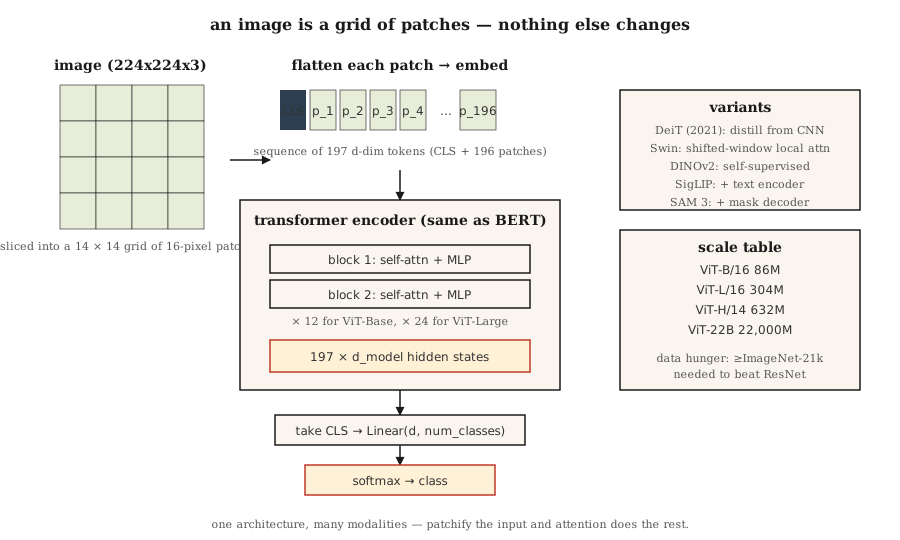
Step 1 — patchify
Split a H × W × C image into an N × (P·P·C) sequence of flat patches. Typical setup: 224 × 224 image, 16 × 16 patches → 196 patches of 768 values each.
image (224, 224, 3) → 14 × 14 grid of 16x16x3 patches → 196 vectors of length 768Patch size is the lever. Smaller patches = more tokens, better resolution, quadratic attention cost. Larger patches = coarser, cheaper.
Step 2 — linear embedding
A single learned matrix projects each flat patch to d_model. Equivalent to a convolution of kernel size P and stride P. In PyTorch this is literally nn.Conv2d(C, d_model, kernel_size=P, stride=P) — a 2-line implementation.
Step 3 — prepend [CLS] token, add positional embeddings
- Prepend a learnable
[CLS]token. Its final hidden state is the image representation used for classification. - Add learnable positional embeddings (ViT-original) or sinusoidal 2D (later variants).
- In 2024+ RoPE extended to 2D for position, sometimes without explicit embeddings.
Step 4 — standard transformer encoder
Stack L blocks of LayerNorm → Self-Attention → + → LayerNorm → MLP → +. Identical to BERT. No vision-specific layers. This is the pedagogical punchline of the paper.
Step 5 — head
For classification: take [CLS] hidden state → linear → softmax. For DINOv2 or SAM, discard [CLS], use the patch embeddings directly.
Variants that mattered
| Model | Year | Change |
|---|---|---|
| ViT | 2020 | The original. Fixed patch size, full global attention. |
| DeiT | 2021 | Distillation; trainable on ImageNet-1k only. |
| Swin | 2021 | Hierarchical with shifted windows. Fixed sub-quadratic cost. |
| DINOv2 | 2023 | Self-supervised (no labels). Best general vision features. |
| ViT-22B | 2023 | 22B params; scaling laws apply. |
| SigLIP | 2023 | ViT + language pair, sigmoid contrastive loss. |
| SAM 3 | 2025 | Segment anything; ViT-Large + promptable mask decoder. |
Why it took a while
ViT needs a lot of data to match CNNs because it has none of the CNN inductive biases (translation invariance, locality). Without >100M labeled images or strong self-supervised pretraining, CNNs still win at matched compute. DeiT fixed this in 2021 with distillation tricks; DINOv2 fixed it permanently in 2023 with self-supervision.
n5-patch-streamBuild It
See code/main.py. Pure-stdlib patchify + linear embedding + sanity checks. No training — ViT at any realistic scale needs PyTorch and hours of GPU time.
Step 1: fake image
A 24 × 24 RGB image as a list of rows of (R, G, B) tuples. We use 6×6 patches → 16 patches, 108-d embedding vector each.
Step 2: patchify
def patchify(image, P):
    H = len(image)
    W = len(image[0])
    patches = []
    for i in range(0, H, P):
        for j in range(0, W, P):
            patch = []
            for di in range(P):
                for dj in range(P):
                    patch.extend(image[i + di][j + dj])
            patches.append(patch)
    return patches
Raster order: row-major across the grid. Every ViT uses this ordering.
Step 3: linear embed
Multiply each flat patch by a random (patch_flat_size, d_model) matrix. Verify output shape is (N_patches + 1, d_model) after prepending [CLS].
Step 4: count parameters for a realistic ViT
Print the param count for ViT-Base: 12 layers, 12 heads, d=768, patch=16. Compare to ResNet-50 (~25M). ViT-Base lands at ~86M. ViT-Large ~307M. ViT-Huge ~632M.
Use It
from transformers import ViTImageProcessor, ViTModel
import torch
from PIL import Image

processor = ViTImageProcessor.from_pretrained("google/vit-base-patch16-224-in21k")
model = ViTModel.from_pretrained("google/vit-base-patch16-224-in21k")

img = Image.open("cat.jpg")
inputs = processor(img, return_tensors="pt")
out = model(**inputs).last_hidden_state   # (1, 197, 768): [CLS] + 196 patches
cls_emb = out[:, 0]                       # image representation
DINOv2 embeddings are the 2026 default for image features. Freeze the backbone, train a tiny head. Works for classification, retrieval, detection, captioning. Meta's DINOv2 checkpoints outperform CLIP on every non-text vision task.
Patch-size picking. Small models use 16×16 (ViT-B/16). Dense prediction (segmentation) uses 8×8 or 14×14 (SAM, DINOv2). Very large models use 14×14.
Ship It
See outputs/skill-vit-configurator.md. The skill picks a ViT variant and patch size for a new vision task given dataset size, resolution, and compute budget.
Exercises
- Easy. Run
code/main.py. Verify the number of patches equals(H/P) * (W/P)and the flat patch dimension equalsP*P*C. - Medium. Implement 2D sinusoidal positional embeddings — two independent sinusoidal codes for
rowandcolof each patch, concatenated. Feed them into a tiny PyTorch ViT and compare accuracy vs learnable positional embeddings on CIFAR-10. - Hard. Build a 3-layer ViT (PyTorch), train on 1,000 MNIST images with 4×4 patches. Measure test accuracy. Now add DINOv2 pretraining on the same 1,000 images (simplified: just train the encoder to predict patch embeddings from masked patches). Does accuracy improve?
Key Terms
| Term | What people say | What it actually means |
|---|---|---|
| Patch | "The vision-transformer token" | Flat vector of pixel values for a P × P × C region of the image. |
| Patchify | "Chop + flatten" | Slice image into non-overlapping patches, flatten each to a vector. |
[CLS] token |
"The image summary" | Prepended learnable token; its final embedding is the image representation. |
| Inductive bias | "What the model assumes" | ViT has fewer priors than CNNs; needs more data to make up the gap. |
| DINOv2 | "Self-supervised ViT" | Trained without labels using image augmentation + momentum teacher. Best general image features in 2026. |
| SigLIP | "CLIP's successor" | ViT + text encoder trained with sigmoid contrastive loss; better than CLIP on matched compute. |
| Swin | "Windowed ViT" | Hierarchical ViT with local attention + shifted windows; sub-quadratic. |
| Register tokens | "2023 trick" | A few extra learnable tokens that soak up attention sinks; improves DINOv2 features. |
Further Reading
- Dosovitskiy et al. (2020). An Image is Worth 16x16 Words: Transformers for Image Recognition at Scale — the ViT paper.
- Touvron et al. (2021). Training data-efficient image transformers & distillation through attention — DeiT.
- Liu et al. (2021). Swin Transformer: Hierarchical Vision Transformer using Shifted Windows — Swin.
- Oquab et al. (2023). DINOv2: Learning Robust Visual Features without Supervision — DINOv2.
- Darcet et al. (2023). Vision Transformers Need Registers — the register-token fix for DINOv2.
Questions people ask
How does a vision transformer work?
It splits an image into fixed-size patches, flattens each patch into a vector and adds position information. These patch vectors go through a standard transformer encoder. A special token or pooled output is then used to classify the image or feed other tasks.
Are vision transformers better than CNNs?
With large training sets, vision transformers often match or beat CNNs. With small datasets, CNNs can do better because they have built-in assumptions about images. Many modern systems mix both ideas, and the best choice depends on data size and hardware.
Lessons from AI Engineering from Scratch by Rohit Ghumare and contributors, MIT license. Notes for owners by Lozo. License