BERT — Masked Language Modeling
GPT predicts the next word. BERT predicts a missing word. One sentence of difference — and half a decade of everything embedding-shaped.
Lesson 6 of 16Build~45 minutesPython
Before this: Lesson 5 of Phase 7 (Full Transformer), lesson 2 of Phase 5 (Text Representation)
On this page
The Problem
In 2018 every NLP task — sentiment, NER, QA, entailment — trained its own model from scratch on its own labeled data. There was no pre-trained "understand English" checkpoint you could fine-tune. ELMo (2018) showed you could pre-train contextual embeddings with a bidirectional LSTM; it helped but did not generalize.
BERT (Devlin et al. 2018) asked: what if we took a transformer encoder, trained it on every sentence on the internet, and forced it to predict missing words from context on both sides? Then you fine-tune one head on your downstream task. Parameter efficiency was a revelation.
The result: within 18 months BERT and its variants (RoBERTa, ALBERT, ELECTRA) dominated every NLP leaderboard that existed. By 2020 every search engine, content moderation pipeline, and semantic-search system on earth had a BERT inside.
In 2026 encoder-only models are still the right tool for classification, retrieval, and structured extraction — they run 5–10× faster per token than decoders and their embeddings are the backbone of every modern retrieval stack. ModernBERT (Dec 2024) pushed the architecture to 8K context with Flash Attention + RoPE + GeGLU.
The Concept
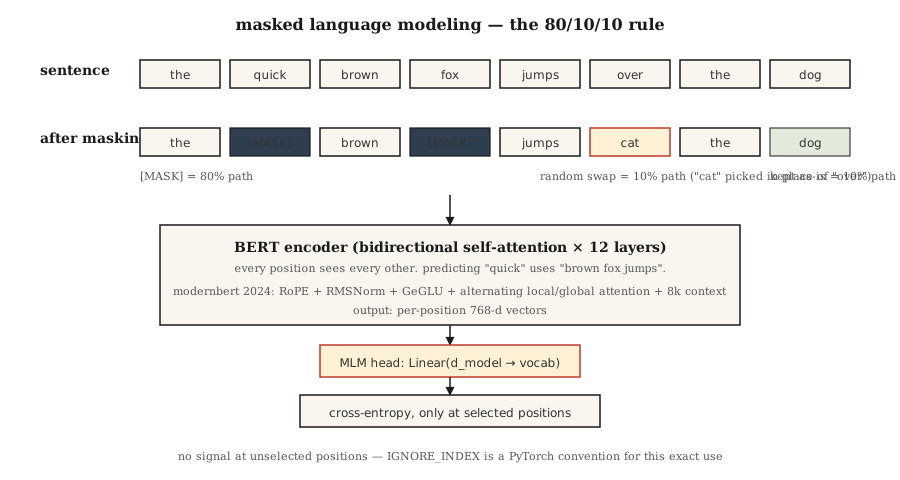
The training signal
Take a sentence: the quick brown fox jumps over the lazy dog.
Mask 15% of tokens randomly:
input:  the [MASK] brown fox jumps [MASK] the lazy dog
target: the  quick brown fox jumps  over  the lazy dog
Train the model to predict the original tokens at masked positions. Because the encoder is bidirectional, predicting [MASK] at position 1 can use brown fox jumps at positions 2+. That is the thing GPT cannot do.
The BERT mask rules
Of the 15% of tokens selected for prediction:
- 80% are replaced with
[MASK]. - 10% are replaced with a random token.
- 10% are left unchanged.
Why not always [MASK]? Because [MASK] never appears at inference time. Training the model to expect [MASK] at 100% of masked positions would create a distribution shift between pretraining and fine-tuning. The 10% random + 10% unchanged keeps the model honest.
Next Sentence Prediction (NSP) — and why it was dropped
Original BERT also trained on NSP: given two sentences A and B, predict if B follows A. RoBERTa (2019) ablated it and showed NSP hurt, not helped. Modern encoders skip it.
What changed in 2026: ModernBERT
The 2024 ModernBERT paper rebuilt the block with 2026 primitives:
| Component | Original BERT (2018) | ModernBERT (2024) |
|---|---|---|
| Positional | Learned absolute | RoPE |
| Activation | GELU | GeGLU |
| Normalization | LayerNorm | Pre-norm RMSNorm |
| Attention | Full dense | Alternating local (128) + global |
| Context length | 512 | 8192 |
| Tokenizer | WordPiece | BPE |
And unlike the 2018 stack, it is Flash-Attention-native. Inference is 2–3× faster at sequence length 8K than DeBERTa-v3 with better GLUE scores.
Use cases that still pick an encoder in 2026
| Task | Why encoder beats decoder |
|---|---|
| Retrieval / semantic search embeddings | Bidirectional context = better embedding quality per token |
| Classification (sentiment, intent, toxicity) | One forward pass; no generation overhead |
| NER / token labeling | Per-position output, natively bidirectional |
| Zero-shot entailment (NLI) | Classifier head on top of encoder |
| Reranker for RAG | Cross-encoder scoring, 10x faster than LLM rerankers |
transformer-residualBuild It
Step 1: masking logic
See code/main.py. The function create_mlm_batch takes a list of token IDs, a vocab size, and a mask probability. Returns input IDs (with masks applied) and labels (only at masked positions, -100 elsewhere — PyTorch's ignore index convention).
def create_mlm_batch(tokens, vocab_size, mask_prob=0.15, rng=None):
    input_ids = list(tokens)
    labels = [-100] * len(tokens)
    for i, t in enumerate(tokens):
        if rng.random() < mask_prob:
            labels[i] = t
            r = rng.random()
            if r < 0.8:
                input_ids[i] = MASK_ID
            elif r < 0.9:
                input_ids[i] = rng.randrange(vocab_size)
            # else: keep original
    return input_ids, labels
Step 2: run MLM prediction on a tiny corpus
Train a 2-layer encoder + MLM head on a vocabulary of 20 words, 200 sentences. No gradient — we do forward-pass sanity checks. Full training needs PyTorch.
Step 3: compare mask types
Show how the three-way rule keeps the model usable without [MASK]. Predict on an unmasked sentence and on a masked sentence. Both should produce reasonable token distributions because the model saw both patterns in training.
Step 4: fine-tune head
Replace the MLM head with a classification head on a toy sentiment dataset. Only the head trains; the encoder is frozen. This is the pattern every BERT application follows.
Use It
from transformers import AutoModel, AutoTokenizer

tok = AutoTokenizer.from_pretrained("answerdotai/ModernBERT-base")
model = AutoModel.from_pretrained("answerdotai/ModernBERT-base")

text = "Attention is all you need."
inputs = tok(text, return_tensors="pt")
out = model(**inputs).last_hidden_state   # (1, N, 768)
Embedding models are fine-tuned BERT. sentence-transformers models like all-MiniLM-L6-v2 are BERTs trained with contrastive loss. The encoder is the same. The loss changed.
Cross-encoder rerankers are also fine-tuned BERT. Pair-classification on [CLS] query [SEP] doc [SEP]. The bidirectional attention between query and doc is exactly what gives cross-encoders their quality edge over biencoders.
When not to pick BERT in 2026. Anything generative. The encoder has no sensible way to autoregressively produce tokens. Also: anything under 1B params where a small decoder can match quality with more flexibility (Phi-3-Mini, Qwen2-1.5B).
Ship It
See outputs/skill-bert-finetuner.md. The skill scopes a BERT fine-tune (backbone choice, head spec, data, eval, stopping) for a new classification or extraction task.
Exercises
- Easy. Run
code/main.pyand print the mask distribution across 10,000 tokens. Confirm ~15% are selected, and of those ~80% become[MASK]. - Medium. Implement whole-word masking: if a word is tokenized into subwords, mask all subwords together or none. Measure whether this improves MLM accuracy on a 500-sentence corpus.
- Hard. Train a tiny (2-layer, d=64) BERT on 10,000 sentences from a public dataset. Fine-tune the
[CLS]token for SST-2 sentiment. Compare against a decoder-only baseline at matched params — which wins?
Key Terms
| Term | What people say | What it actually means |
|---|---|---|
| MLM | "Masked language modeling" | Training signal: randomly replace 15% of tokens with [MASK], predict the originals. |
| Bidirectional | "Looks both ways" | Encoder attention has no causal mask — every position sees every other position. |
[CLS] |
"The pooler token" | A special token prepended to every sequence; its final embedding is used as the sentence-level representation. |
[SEP] |
"Segment separator" | Separates paired sequences (e.g. query/doc, sentence A/B). |
| NSP | "Next sentence prediction" | BERT's second pretraining task; shown to be useless in RoBERTa, dropped after 2019. |
| Fine-tuning | "Adapt to a task" | Keep the encoder mostly frozen; train a small head on top for the downstream task. |
| Cross-encoder | "A reranker" | A BERT that takes both query and doc as input, outputs a relevance score. |
| ModernBERT | "2024 refresh" | Encoder rebuilt with RoPE, RMSNorm, GeGLU, alternating local/global attention, 8K context. |
Further Reading
- Devlin et al. (2018). BERT: Pre-training of Deep Bidirectional Transformers for Language Understanding — original paper.
- Liu et al. (2019). RoBERTa: A Robustly Optimized BERT Pretraining Approach — how to train BERT right; kills NSP.
- Clark et al. (2020). ELECTRA: Pre-training Text Encoders as Discriminators Rather Than Generators — replaced-token detection beats MLM at matched compute.
- Warner et al. (2024). Smarter, Better, Faster, Longer: A Modern Bidirectional Encoder — ModernBERT paper.
- HuggingFace
modeling_bert.py— canonical encoder reference.
Questions people ask
What is the difference between BERT and GPT?
BERT reads a whole sentence in both directions and is trained to fill in hidden words, so it is good at understanding and classifying text. GPT reads left to right and is trained to predict the next word, so it is good at generating text.
Is BERT still used today?
Yes. BERT and its successors are widely used for classification, named entity recognition, search reranking and embeddings. They are small and fast compared to chat models, so they suit high-volume tasks where cost and speed matter.
Lessons from AI Engineering from Scratch by Rohit Ghumare and contributors, MIT license. Notes for owners by Lozo. License