Build a Transformer from Scratch — The Capstone
Thirteen lessons. One model. No shortcuts.
Lesson 14 of 16Build~120 minutesPython
Before this: Lesson 1 of Phase 7 through 13. Don't skip.
On this page
The Problem
You've read every paper. You've implemented attention, multi-head splits, positional encodings, encoder and decoder blocks, BERT and GPT losses, MoE, KV cache. Now make them work together on a real task.
The capstone: train a small decoder-only transformer end-to-end on a character-level language modeling task. It reads Shakespeare. It generates new Shakespeare. It is small enough to train on a laptop in under 10 minutes. It is correct enough that swapping in a bigger dataset and longer training gets you a real LM.
This is the "nanoGPT" of the course. It is not original — Karpathy's 2023 nanoGPT tutorial is the reference implementation every student writes at least once. We lift the shape and retool it around what we've covered.
The Concept
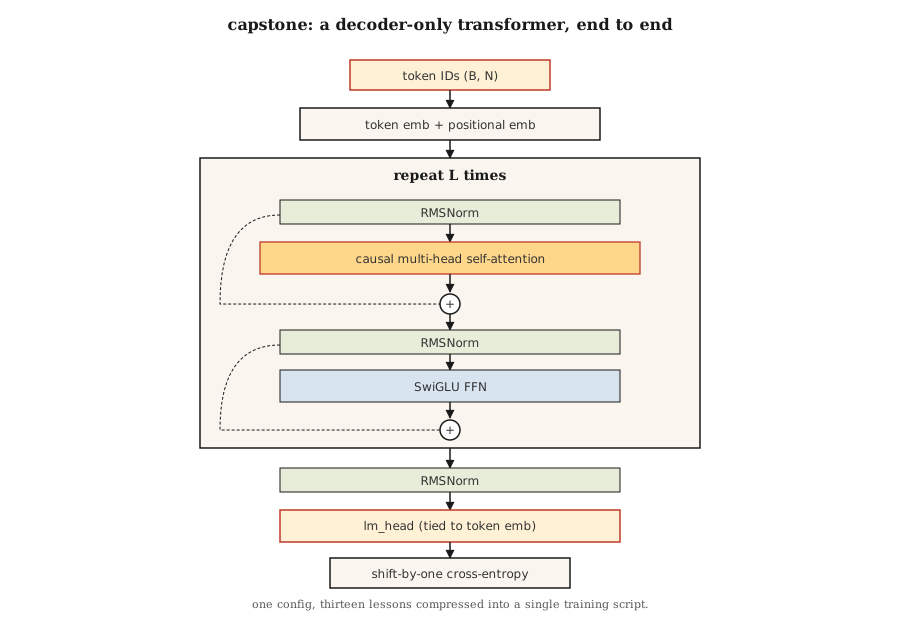
The architecture, annotated:
input tokens (B, N)
   │
   ▼
token embedding + positional embedding  ◀── Lesson 04 (RoPE option)
   │
   ▼
┌──── block × L ────────────────────┐
│  RMSNorm                          │  ◀── Lesson 05
│  MultiHeadAttention (causal)      │  ◀── Lesson 03 + 07 (causal mask)
│  residual                         │
│  RMSNorm                          │
│  SwiGLU FFN                       │  ◀── Lesson 05
│  residual                         │
└────────────────────────────────── ┘
   │
   ▼
final RMSNorm
   │
   ▼
lm_head (tied to token embedding)
   │
   ▼
logits (B, N, V)
   │
   ▼
shift-by-one cross-entropy            ◀── Lesson 07
What we ship
GPTConfig— one place to configure all hyperparameters.MultiHeadAttention— causal, batched, with optional Flash-style pathway (PyTorch'sscaled_dot_product_attention).SwiGLUFFN— modern FFN.Block— pre-norm, residual-wrapped attention + FFN.GPT— embeddings, stacked blocks, LM head, generate().- Training loop with AdamW, cosine LR, gradient clipping.
- Char-level tokenizer on Shakespeare text.
What we don't ship
- RoPE — implemented conceptually in Lesson 04. Here we use learned positional embeddings for simplicity. The exercises ask you to swap in RoPE.
- KV cache during generation — each generation step recomputes attention over the full prefix. Slower but simpler. The exercises ask you to add a KV cache.
- Flash Attention — PyTorch 2.0+ auto-dispatches if the inputs match; we use
F.scaled_dot_product_attention. - MoE — single FFN per block. You saw MoE in Lesson 11.
Target metrics
On a Mac M2 laptop, a 4-layer, 4-head, d_model=128 GPT trained for 2,000 steps on tinyshakespeare.txt:
- Training loss converges from ~4.2 (random) to ~1.5 in about 6 minutes.
- Sampled output looks Shakespeare-shaped: archaic words, line breaks, proper names like "ROMEO:" emerge.
- Val loss (held-out final 10% of text) tracks training loss closely; no overfitting at this size/budget.
n5-block-stackBuild It
This lesson uses PyTorch. Install torch (CPU build is fine). See code/main.py. The script handles:
- Downloading
tinyshakespeare.txtif missing (or reading a local copy). - Byte-level char tokenizer.
- Train/val split at 90/10.
- Training loop with bf16 autocast on supported hardware.
- Sampling after training completes.
Step 1: data
text = open("tinyshakespeare.txt").read()
chars = sorted(set(text))
stoi = {c: i for i, c in enumerate(chars)}
itos = {i: c for c, i in stoi.items()}
encode = lambda s: [stoi[c] for c in s]
decode = lambda xs: "".join(itos[x] for x in xs)
65 unique characters. Tiny vocabulary. Fits a 4-byte vocab_size. No BPE, no tokenizer drama.
Step 2: model
See code/main.py. The block is textbook from Lesson 05 — pre-norm, RMSNorm, SwiGLU, causal MHA. Parameter count for 4/4/128: ~800K.
Step 3: training loop
Get a random batch of length-256 token windows. Forward. Shift-by-one cross-entropy. Backward. AdamW step. Log. Repeat.
for step in range(max_steps):
    x, y = get_batch("train")
    logits = model(x)
    loss = F.cross_entropy(logits.view(-1, vocab_size), y.view(-1))
    loss.backward()
    torch.nn.utils.clip_grad_norm_(model.parameters(), 1.0)
    opt.step()
    opt.zero_grad()
Step 4: sample
Given a prompt, repeatedly forward, sample from top-p logits, append, and continue. Stop after 500 tokens.
Step 5: read the output
After 2,000 steps:
ROMEO:
Away and mild will not thy friend, that thou shalt wit:
The chief that well shame and hath been his friends,
...
Not Shakespeare. But Shakespeare-shaped. A clear win for ~800K parameters and 6 minutes on a laptop.
Use It
This capstone is a reference architecture. Three extensions to ship it to something real:
- Swap the tokenizer. Use BPE (e.g.
tiktoken.get_encoding("cl100k_base")). Vocab size jumps from 65 to ~50,000. Model capacity needs to scale up to compensate. - Train on a bigger corpus. Use
OpenWebTextorfineweb-edu(HuggingFace). 10B tokens on a single A100 takes ~24 hours for a 125M-param GPT. - Add RoPE + KV cache + Flash Attention. The exercises below walk you through each.
This ends up as a 125M-parameter GPT that generates fluent English. Not a frontier model. But the same code path — just bigger — is what Karpathy, EleutherAI, and the Allen Institute use to train research checkpoints in 2026.
Ship It
See outputs/skill-transformer-review.md. The skill reviews a transformer-from-scratch implementation for correctness across all 13 prior lessons.
Exercises
- Easy. Run
code/main.py. Verify your trained model's final-step validation loss is under 2.0. Changemax_stepsfrom 2,000 to 5,000 — does val loss keep improving? - Medium. Replace learned positional embeddings with RoPE. Apply the rotation to Q and K inside
MultiHeadAttention. Train and verify val loss is at least as low. - Medium. Implement a KV cache in the sampling loop. Generate 500 tokens with and without cache. Wall-clock should improve by 5–20× on a laptop.
- Hard. Add a second head to the model that predicts the next-plus-one token (MTP — Multi-Token Prediction from DeepSeek-V3). Train jointly. Does it help?
- Hard. Replace the single FFN per block with a 4-expert MoE. Router + top-2 routing. See how val loss changes at matched active parameters.
Key Terms
| Term | What people say | What it actually means |
|---|---|---|
| nanoGPT | "Karpathy's tutorial repo" | Minimal decoder-only transformer training code, ~300 LOC; the canonical reference. |
| tinyshakespeare | "The standard toy corpus" | ~1.1 MB of text; every character-LM tutorial since 2015 uses it. |
| Tied embeddings | "Share input/output matrix" | LM head weight = transpose of token embedding matrix; saves parameters, improves quality. |
| bf16 autocast | "Training precision trick" | Run forward/back in bf16, keep optimizer state in fp32; standard since 2021. |
| Gradient clipping | "Stops spikes" | Cap global grad norm at 1.0; prevents training blowups. |
| Cosine LR schedule | "The 2020+ default" | LR ramps up linearly (warmup) then decays cosine-shaped to 10% of peak. |
| MFU | "Model FLOP Utilization" | Achieved FLOPs / theoretical peak; 40% dense, 30% MoE is strong in 2026. |
| Val loss | "Held-out loss" | Cross-entropy on data the model never saw; overfit detector. |
Further Reading
- The Annotated Transformer (Harvard NLP) — the classic annotated implementation.
Questions people ask
Can you build a transformer from scratch in Python?
Yes. A small transformer can be written in a few hundred lines of Python using PyTorch or even plain NumPy. It will not match commercial models, but training one on a small text set is a common way to learn how every part works.
How long does it take to train a small transformer?
A tiny character-level model on a small text file can train in minutes to a few hours on a single GPU or even a laptop. Time grows quickly with model size, data size and context length, so large models need clusters of GPUs.
Lessons from AI Engineering from Scratch by Rohit Ghumare and contributors, MIT license. Notes for owners by Lozo. License