Mixture of Experts (MoE)
A dense 70B transformer activates every parameter for every token. A 671B MoE activates only 37B per token and beats it on every benchmark. Sparsity is the most important scaling idea of the decade.
Lesson 11 of 16Build~45 minutesPython
Before this: Lesson 5 of Phase 7 (Full Transformer), lesson 7 of Phase 7 (GPT)
On this page
The Problem
A dense transformer's FLOPs at inference equal its parameter count (times 2 for forward pass). Scale up a dense model and every token pays the full bill. By 2024 the frontier was hitting a compute wall: to be meaningfully smarter, you needed exponentially more FLOPs per token.
Mixture of Experts breaks this link. Replace each FFN with $E$ independent experts + a router that picks $k$ experts per token. Total parameters = $E \times \text{FFN size}$. Active parameters per token = $k \times \text{FFN size}$. Typical 2026 configuration: $E=256$, $k=8$. Storage scales with $E$, compute scales with $k$.
The 2026 frontier is almost entirely MoE: DeepSeek-V3 (671B total / 37B active), Mixtral 8×22B, Qwen2.5-MoE, Llama 4, Kimi K2, gpt-oss. On Artificial Analysis's independent leaderboard, the top 10 open-source models are all MoE.
The Concept
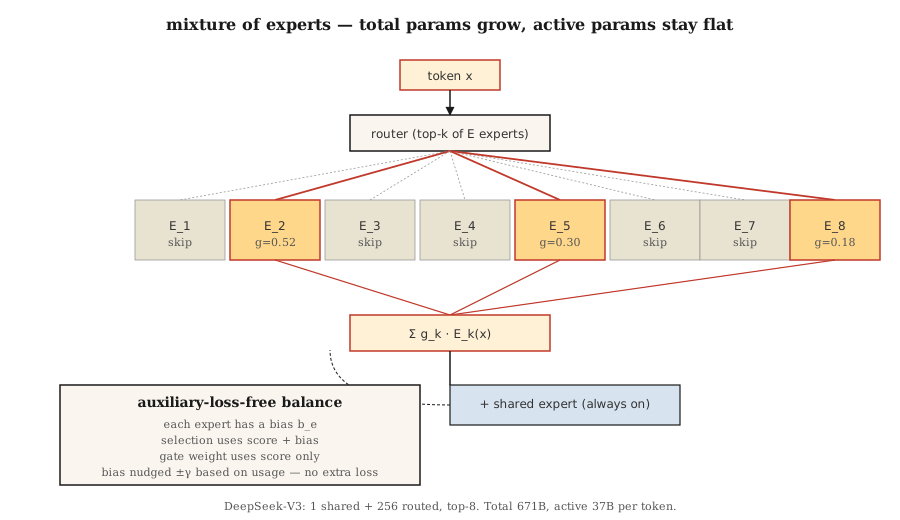
The FFN swap
Dense transformer block:
h = x + attn(norm(x))
h = h + FFN(norm(h))
MoE block:
h = x + attn(norm(x))
scores = router(norm(h))              # (N_tokens, E)
top_k = argmax_k(scores)              # pick k of E per token
h = h + sum_{e in top_k}(
        gate(scores[e]) * Expert_e(norm(h))
    )
Every expert is an independent FFN (typically SwiGLU). The router is a single linear layer. Each token picks its own k experts and gets a gated mixture of their outputs.
The load-balancing problem
If the router puts 90% of tokens through expert 3, the other experts starve. Three fixes have been tried:
- Auxiliary load-balancing loss (Switch Transformer, Mixtral). Add a penalty proportional to the variance in expert usage. Works, but adds a hyperparameter and a second gradient signal.
- Expert capacity + token dropping (early Switch). Each expert processes at most $C \times N/E$ tokens; overflow tokens skip the layer. Hurts quality.
- Auxiliary-loss-free balancing (DeepSeek-V3). Add a learned per-expert bias that shifts the router's top-k selection. Bias is updated outside the training loss. No penalty on the main objective. 2024's big unlock.
DeepSeek-V3's approach: after each training step, for every expert, check if its usage is above or below the target. Nudge the bias by ±γ. Selection uses scores + bias. Expert probabilities used for gating are the raw scores unchanged. Decouples routing from expression.
Shared experts
DeepSeek-V2/V3 also split experts into shared and routed. Every token passes through all shared experts. Routed experts are picked via top-k. Shared experts capture common knowledge; routed experts specialize. V3 runs 1 shared expert plus top-8 of 256 routed.
Fine-grained experts
Classic MoE (GShard, Switch): each expert is as wide as a full FFN. E is small (8–64), k is small (1–2).
Modern fine-grained MoE (DeepSeek-V3, Qwen-MoE): each expert is narrower (1/8 FFN size). $E$ is large (256+), $k$ is larger (8+). Same total parameters, but combinations scale much faster. $\binom{256}{8} \approx 400$ trillion possible "experts" per token. Quality goes up, latency stays flat.
The cost profile
Per token, per layer:
| Config | Active params / token | Total params |
|---|---|---|
| Mixtral 8×22B | ~39B | 141B |
| Llama 3 70B (dense) | 70B | 70B |
| DeepSeek-V3 | 37B | 671B |
| Kimi K2 (MoE) | ~32B | 1T |
DeepSeek-V3 beats Llama 3 70B (dense) on almost every benchmark while doing fewer active FLOPs per token. More parameters = more knowledge. More active FLOPs = more compute per token. MoE decouples them.
The catch: memory
All experts live on GPU regardless of which ones fire. A 671B model needs ~1.3 TB of VRAM for fp16 weights. Frontier MoE deployment requires expert parallelism — shard experts across GPUs, route tokens across the network. Latency is dominated by the all-to-all communication, not the matmul.
expert-routingBuild It
See code/main.py. A compact MoE layer in pure stdlib with:
n_experts=8SwiGLU-ish experts (one linear each, for illustration)- top-k=2 routing
- softmax-normalized gating weights
- auxiliary-loss-free balancing via per-expert bias
Step 1: the router
def route(hidden, W_router, top_k, bias):
    scores = [sum(h * w for h, w in zip(hidden, W_router[e])) for e in range(len(W_router))]
    biased = [s + b for s, b in zip(scores, bias)]
    top_idx = sorted(range(len(biased)), key=lambda i: -biased[i])[:top_k]
    # softmax over ORIGINAL scores of the chosen experts
    chosen = [scores[i] for i in top_idx]
    m = max(chosen)
    exps = [math.exp(c - m) for c in chosen]
    s = sum(exps)
    gates = [e / s for e in exps]
    return top_idx, gates
Bias affects selection, not gate weight. That is the DeepSeek-V3 trick — bias corrects load imbalance without steering the model's predictions.
Step 2: run 100 tokens through the router
Track which experts fire how often. Without the bias, usage is skewed. With a bias update loop (-γ for over-used experts, +γ for under-used), usage converges to a uniform distribution over a few iterations.
Step 3: param count comparison
Print the "dense equivalent" of an MoE config. DeepSeek-V3-shaped: 256 routed + 1 shared, 8 active, d_model=7168. The total parameter count is eye-watering. The active count is a seventh of a dense Llama 3 70B.
Use It
HuggingFace loading:
from transformers import AutoModelForCausalLM, AutoTokenizer
model = AutoModelForCausalLM.from_pretrained("mistralai/Mixtral-8x22B-v0.1")
2026 production inference: vLLM supports MoE routing natively. SGLang has the fastest expert-parallel path. Both automatically handle top-k selection and expert parallelism.
When to pick MoE:
- You want frontier quality at lower inference cost per token.
- You have the VRAM / expert-parallel infrastructure.
- Your workload is token-heavy (chat, code) not context-heavy (long docs).
When NOT to pick MoE:
- Edge deployment — you pay full storage for any active FLOP.
- Latency-critical single-user serving — expert routing adds overhead.
- Small models (<7B) — MoE's quality advantage only appears above a compute threshold (~6B active params).
Ship It
See outputs/skill-moe-configurator.md. The skill picks E, k, and shared-expert layout for a new MoE given parameter budget, training tokens, and deployment target.
Exercises
- Easy. Run
code/main.py. Watch how the auxiliary-loss-free bias update evens out expert usage over 50 iterations. - Medium. Replace the learned router with a hash-based router (deterministic, no learning). Compare quality and balance. Why is the learned router better?
- Hard. Implement GRPO-style "rollout-matched routing" (DeepSeek-V3.2 trick): log which experts fire during inference, force the same routing during gradient computation. Measure the effect on a toy policy-gradient setup.
Key Terms
| Term | What people say | What it actually means |
|---|---|---|
| Expert | "One FFN among many" | An independent feed-forward network; parameters dedicated to a sparse slice of the FFN computation. |
| Router | "The gate" | A tiny linear layer that scores each token against each expert; top-k selection. |
| Top-k routing | "k active experts per token" | Each token's FFN computation goes through exactly k experts, weighted by gate. |
| Auxiliary loss | "Load-balance penalty" | Extra loss term that penalizes skewed expert usage. |
| Auxiliary-loss-free | "DeepSeek-V3's trick" | Balance via per-expert bias on the router's selection only; no extra gradient. |
| Shared expert | "Always on" | Extra expert through which every token passes; captures common knowledge. |
| Expert parallelism | "Shard by expert" | Distribute different experts to different GPUs; route tokens across the network. |
| Sparsity | "Active params < total params" | The ratio $k \times \text{expert size} / (E \times \text{expert size})$; 37/671 ≈ 5.5% for DeepSeek-V3. |
Further Reading
- Shazeer et al. (2017). Outrageously Large Neural Networks: The Sparsely-Gated Mixture-of-Experts Layer — the idea.
- Fedus, Zoph, Shazeer (2022). Switch Transformer: Scaling to Trillion Parameter Models with Simple and Efficient Sparsity — Switch, the classic MoE.
- Jiang et al. (2024). Mixtral of Experts — Mixtral 8×7B.
- DeepSeek-AI (2024). DeepSeek-V3 Technical Report — MLA + auxiliary-loss-free MoE + MTP.
- Wang et al. (2024). Auxiliary-Loss-Free Load Balancing Strategy for Mixture-of-Experts — the bias-based balancing paper.
- Dai et al. (2024). DeepSeekMoE: Towards Ultimate Expert Specialization in Mixture-of-Experts Language Models — the fine-grained + shared-expert split this lesson's router uses.
- Kim et al. (2022). DeepSpeed-MoE: Advancing Mixture-of-Experts Inference and Training — original shared-expert paper.
Questions people ask
What is a mixture of experts model?
It is a model where some layers contain many parallel feed-forward networks called experts. A small router sends each token to only a few experts. The model has a huge total size, but each token uses only a small part of it, which cuts compute per token.
Is a mixture of experts model cheaper to run?
Per token it needs less compute than a dense model of the same total size, so it can be faster and cheaper to serve. But all experts must still sit in memory, so it needs a lot of GPU memory, and routing adds some complexity.
Lessons from AI Engineering from Scratch by Rohit Ghumare and contributors, MIT license. Notes for owners by Lozo. License