Tokenized Dataset with Sliding Window
A pretraining run is a function from token ids to gradients. This lesson builds the conveyor that feeds the ids in.
Lesson 29 of 85Build~90 minutesPython
Before this: Phase 04 lessons, Phase 07 transformer lessons, Lesson 30 of this phase
On this page
Learning Objectives
- Convert a raw corpus into a stream of token ids by calling the tokenizer once.
- Slice the id stream into fixed-length windows with a configurable overlap stride.
- Build a PyTorch Dataset that returns input and target tensors for next-token prediction.
- Wrap the dataset in a DataLoader with a deterministic shuffle seeded per epoch.
- Reason about the trade-off between stride, redundancy, and effective dataset size.
cap-sliding-windowThe frame
A pretraining run reads one batch of token ids at a time and updates the model. The shape of each batch is fixed by the training contract. For a causal language model, the batch holds (B, T) input ids and (B, T) target ids where the target is the input shifted left by one. The job of the data pipeline is to produce that contract on demand, in a deterministic and reproducible way, from a corpus that may be several gigabytes of raw text.
This lesson builds the pipeline. The tokenizer from the previous lesson turns text into a long flat list of ids. A sliding window slices that list into training examples. A custom Dataset exposes the examples as tensors. A DataLoader batches them and shuffles them with a known seed.
The shape contract
A causal LM consumes ids of shape (B, T) where B is the batch size and T is the context length. The target at position t is the input at position t+1. That means every training example covers T+1 raw ids. The window stride controls how much overlap exists between consecutive examples.


The slicer never overlaps with the boundary of the corpus. If the last window does not have enough ids to fill T+1 positions, the slicer drops it. Padding the tail with <|pad|> is also a valid choice but it complicates the loss mask. For this lesson we drop.
Why a sliding window
A pretraining corpus is one long stream of ids. If the model only saw non-overlapping windows, every training example would teach it the same T boundaries. Adjusting the stride moves those boundaries around so the model sees more diverse predict-next-token tasks.
A stride of T produces non-overlapping windows. A stride of T // 2 produces fifty-percent overlap and doubles the effective dataset. A stride of 1 produces maximum overlap and increases the dataset by a factor of T. The cost is more compute per epoch. The benefit is more boundary diversity. Most pretraining runs use a stride equal to the context length because the corpus is already much larger than the model can finish in one epoch, so the boundary diversity argument is weaker.
The Dataset class
A PyTorch Dataset has two required methods. __len__ returns the number of examples. __getitem__ returns one example as a pair of tensors. Our Dataset stores the encoded id stream and the stride. Indexing into it computes the start of the window on the fly so the memory cost is one copy of the id stream regardless of how many examples the stride produces.
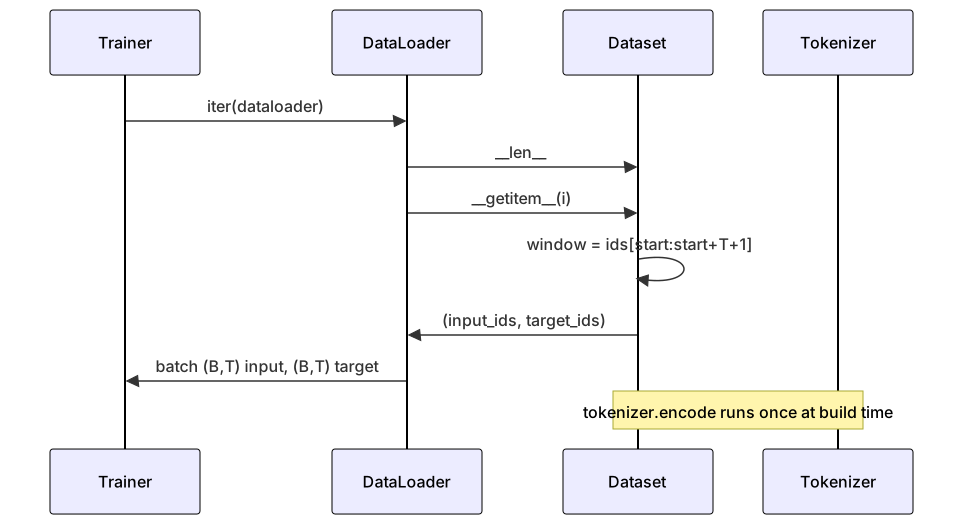
The shift-by-one happens inside __getitem__. The Dataset returns (input, target) where input = window[:-1] and target = window[1:]. Both are PyTorch long tensors. The training loop treats them as ground truth.
Deterministic shuffle
A DataLoader with shuffle=True reads from a PyTorch random generator. By passing an explicit torch.Generator seeded per epoch, we get the same shuffle every time the run is restarted. That property matters when you want to compare two runs that differ only in a single hyperparameter. Without a seed, two runs see the data in different orders and the loss curves diverge for reasons unrelated to the change.
The seed contract in this lesson is simple. epoch_seed = base_seed + epoch_index. The base seed is passed at construction. The epoch index is incremented by the trainer at the top of each epoch. A re-run with the same base seed always sees the same order in every epoch.
Batch sampler
The default sampler in PyTorch picks indices uniformly at random with replacement disabled. That is what we want for pretraining. For finetuning on a small dataset the contract is the same. The DataLoader assembles a batch by calling __getitem__ B times and stacking the results. Because every example is the same length by construction, no padding logic is needed.
The lesson keeps num_workers=0 for simplicity. In a production run the workers parallelize the __getitem__ calls. With our pipeline that is mostly a no-op because the work is just a slice of an in-memory tensor, but the same Dataset API supports workers cleanly.
Counting examples
For an id stream of length N, a context length T, and a stride S, the number of examples is max(0, 1 + (N - (T + 1)) // S). The lesson exposes that calculation as a static method on the Dataset so the trainer can compute total steps per epoch without iterating.
What this lesson does not do
It does not stream from disk. The corpus is encoded fully in memory and held as a single tensor. For a corpus of a few million ids that is well under a hundred megabytes and is the right shape for the lesson. Disk streaming is a separate concern that plugs in by replacing the storage but keeps the Dataset contract.
It does not handle multiple documents. The corpus is treated as one continuous id stream. The next-document boundary is encoded by inserting <|endoftext|> ids when the corpus is built from multiple documents. The model learns to predict around the boundary.
How to read the code
main.py defines two classes and one helper. SlidingWindowDataset is the PyTorch Dataset. make_dataloader returns a configured DataLoader with a seeded generator. _encode_corpus_to_ids is the one-shot tokenizer call. The demo at the bottom builds a small tokenizer in-process, encodes a built-in corpus, constructs the dataset and dataloader, prints one batch, and asserts the shape contract. The tests in code/tests/test_dataset.py pin the window count formula, the shift-by-one property, the deterministic shuffle, and the stride trade-off.
Run the demo. Then change the context length from 16 to 32 and watch how the number of examples per epoch falls. That number is your steps-per-epoch budget.
Check yourself
Quick quiz
What is the shape contract for a causal LM training batch?
- (B, T) input ids and (B, T) target ids where target is the input shifted left by one
- (B, V) one-hot vectors over the vocabulary
- (B, T, T) attention masks with the input ids on the diagonal
- (B, 2) input id and label pairs
Show the answer
A. (B, T) input ids and (B, T) target ids where target is the input shifted left by one Causal LM training reads (B, T) input ids and predicts the same shape of target ids, where target[t] = input[t+1].
How many windows of length T+1 fit in an id stream of length N with stride S?
- max(0, 1 + (N - (T + 1)) // S)
- N - T - S
- (N - T) * S
- N // (T + 1)
Show the answer
A. max(0, 1 + (N - (T + 1)) // S) The first window starts at 0. Subsequent windows start at multiples of S. The last window must still cover T+1 ids.
What effect does halving the stride have on the dataset?
- It halves the number of training examples per epoch
- It removes overlap between consecutive windows
- It roughly doubles the number of training examples per epoch
- It has no effect because windows never overlap
Show the answer
C. It roughly doubles the number of training examples per epoch A smaller stride produces more overlapping windows, increasing the example count and the boundary diversity at the cost of more compute per epoch.
Why pass an explicit torch.Generator to the DataLoader?
- It makes the shuffle deterministic across runs with the same seed
- It removes the need for batch padding
- It enables multi-GPU training
- It speeds up data loading
Show the answer
A. It makes the shuffle deterministic across runs with the same seed A seeded generator reproduces the same shuffle. Reruns with the same seed see batches in the same order, which is required for fair hyperparameter comparison.
Why does the dataset return (input[:-1], input[1:]) from each window of size T+1?
- It throws away one id to save memory
- It removes a special token from the input
- It is a quirk of PyTorch tensor indexing
- It implements the shift-by-one target so the loss measures next-token prediction
Show the answer
D. It implements the shift-by-one target so the loss measures next-token prediction The target at position t is the input at position t+1. Slicing the window into [:-1] and [1:] expresses that contract.
Why does the lesson drop incomplete trailing windows rather than padding them?
- Dropping keeps every example the same length so no loss mask is needed
- Dropped data is recovered by the next epoch
- Padding would change the vocabulary size
- Padded tokens are not supported by the model
Show the answer
A. Dropping keeps every example the same length so no loss mask is needed All examples are exactly T tokens long by construction, so the batch is a clean rectangular tensor and the loss applies uniformly without a mask.
Questions people ask
How is text prepared for training a language model?
The text is tokenized into ids, joined into one long stream and cut into fixed-length chunks. For each chunk, the target is the same sequence shifted by one token, so the model learns to predict each next token.
What is a sliding window in language model training?
It is a way to cut a long token stream into many training samples. A window of fixed length moves along the stream by a set step. Overlap gives more samples and context, while a step equal to the window length avoids repeats.
Lessons from AI Engineering from Scratch by Rohit Ghumare and contributors, MIT license. Notes for owners by Lozo. License