Multi-Head Self-Attention
One linear projection, three views, H parallel heads, one mask. The attention block as the model actually uses it.
Lesson 31 of 85Build~90 minutesPython
Before this: Phase 04 lessons, Phase 07 transformer lessons, Lessons 30 through 32 of this phase
On this page
Learning Objectives
- Implement a batched Query/Key/Value projection as a single linear layer split into H heads.
- Compute scaled dot-product attention with the correct normalization and dtype handling.
- Apply a causal mask that prevents a position from attending to future positions.
- Inspect per-head attention weights for a fixed input and reason about what each head looks at.
- Train a small attention block on a toy task and watch the loss fall as the heads specialize.
cap-multihead-attentionThe frame
Attention is the function that lets a token's representation pull information from other tokens in the same sequence. Self-attention means queries, keys, and values are all derived from the same input. Multi-head means the projection is split into H parallel attention problems whose outputs are concatenated and projected back.
The efficient implementation pattern is one linear layer that projects from D to 3 * D and gets sliced into three views, then reshaped into H heads of size D // H each. The matmul, softmax, and weighted sum happen as batched tensor operations so the heads run in parallel on the accelerator.
This lesson builds that block. It also adds the causal mask so the same code works as the attention layer in a decoder-only language model. The next lesson stacks the block into a full transformer and the lesson after trains it.
The shape contract
The input is (B, T, D). The output is (B, T, D). The mask is (T, T) or broadcastable to it. Inside the block the intermediate tensors have shape (B, H, T, d_head) where d_head = D // H. The constraint is D % H == 0.


The two linear layers (the QKV projection and the output projection) are the only parameters in the block. The mask, the softmax, the matmuls, and the reshapes are all parameter-free.
The QKV split
The naive implementation has three separate linear layers, one each for Q, K, and V. The efficient one has a single layer that outputs 3 * D features and splits the result. The two are mathematically equivalent because three separate matrix multiplications by (D, D) weights are exactly one matrix multiplication by a (3D, D) weight stacked from them.
The efficient version is faster because the accelerator launches one matmul instead of three. It is also easier to initialize because the three sub-matrices live in the same parameter tensor and can be initialized together.
The head reshape
After the split, each of Q, K, V is (B, T, D). To turn that into H parallel attention problems, we reshape to (B, T, H, d_head) and transpose to (B, H, T, d_head). The head dimension now sits next to the batch dimension so PyTorch treats the per-head attention as a batched operation across B * H independent instances.
The d_head dimension stays last so the score matmul Q @ K.transpose(-2, -1) contracts it. The result is (B, H, T, T) per-head attention scores.
Scaling
The scores get divided by sqrt(d_head) before softmax. Without that scaling, dot products grow as d_head grows and push the softmax into a regime where one entry has almost all the mass and the others are vanishingly small. The gradients in that regime are tiny and learning stalls. Dividing by sqrt(d_head) keeps the variance of the scores roughly constant across head sizes.
The causal mask
A decoder-only language model can only condition on the past when predicting the next token. The mask enforces that. Concretely, before the softmax, every entry above the diagonal of the (T, T) score matrix gets replaced by negative infinity. After softmax those positions get weight zero.
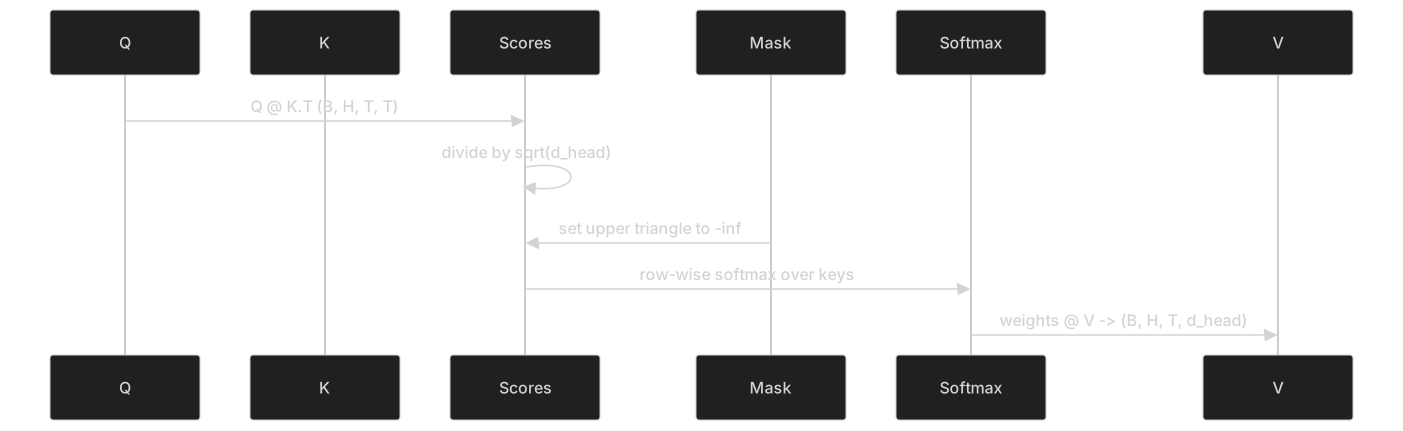
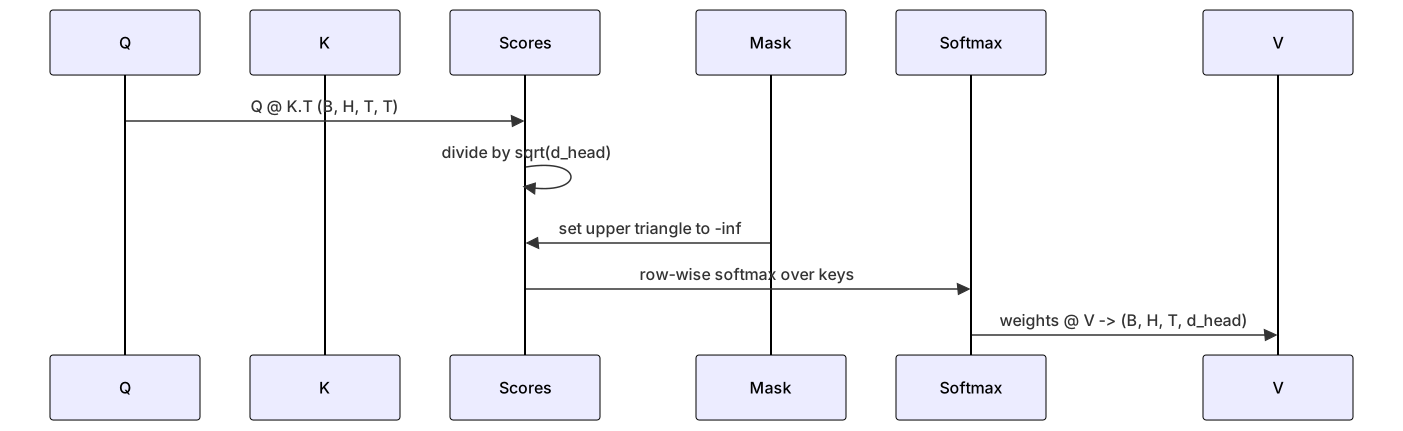
We register the mask as a buffer at construction so it lives on the same device as the model and is not part of the gradient graph. The mask covers the maximum context length the block will ever see. At forward time we slice the top-left (T, T) corner.
The output projection
After per-head context vectors (B, H, T, d_head), we transpose back to (B, T, H, d_head), reshape to (B, T, D), and apply a final (D, D) linear projection. The output projection lets the model mix the heads. Without it, the H heads would only ever recombine through later layers and the block would be artificially constrained.
Attention weight inspection
The lesson exposes a return_weights=True flag on the forward pass. When set, the block returns the per-head attention weights of shape (B, H, T, T) alongside the output. The demo prints a heatmap of one head's weights on a short input so you can see the causal-triangle structure and the per-position focus.
In a trained model, different heads learn different patterns. Some heads attend to the immediately previous token. Some heads attend to the start of the sequence. Some heads spread attention almost uniformly. The inspection hook is the entry point for that interpretability work.
The training demo
The demo at the bottom of main.py wires the attention block to a tiny LM head and trains the whole thing on a repeat task. Each row of the input is a single random id replicated across the context. The target is the input shifted by one, so the model must learn that the next token is the same as the previous token. The loss is cross-entropy. With H=4, D=32, T=12, and a vocabulary of 64, the loss falls from random (around log(64) ~ 4.16) down to well under 1.0 over three epochs on CPU.
The point of the demo is not to train a useful model. The point is to confirm the gradients flow through every piece of the block and the heads learn something on a problem where the answer is obvious.
What this lesson does not do
It does not add a feed-forward block. The transformer layer in a real model is attention followed by a two-layer MLP with a residual connection and layer norm around each. The next lesson adds those.
It does not implement rotary or AliBi positional encoding. Both apply at the QKV projection step in the same block, but they are a separate teaching unit. The block as built here is compatible with either by transforming Q and K before the matmul.
It does not implement KV cache for inference. Caching keys and values across forward passes is the optimization that makes autoregressive decoding fast. It changes the shape contract on the K and V tensors but not on Q. It belongs in the inference lesson.
How to read the code
main.py defines MultiHeadSelfAttention. The class holds two linear layers and a registered mask buffer. The forward pass projects, reshapes, scores, masks, softmaxes, weights, reshapes, and projects again. The demo at the bottom builds a small model that wraps the attention with token and positional embeddings and an LM head, trains it on a copy task for three epochs, and prints the loss curve and a per-head attention heatmap. The tests in code/tests/test_attention.py pin the shape contract, the causality property, the softmax property, the head-split property, and the gradient flow.
Run the demo. Then increase n_heads from 4 to 8 (keeping d_model=32, so d_head=4) and watch the heatmap change.
Check yourself
Quick quiz
Why does an efficient self-attention block use a single linear layer that outputs 3*D features?
- It is mathematically equivalent to three Linear(D, D) layers and runs as one matmul
- It reduces the model parameter count
- It enforces weight sharing between Q, K, and V
- It avoids the need for a causal mask
Show the answer
A. It is mathematically equivalent to three Linear(D, D) layers and runs as one matmul Stacking three (D, D) projection matrices into one (3D, D) matrix produces the same outputs, but the forward pass is a single accelerator-friendly matmul.
What is the relationship between d_model, n_heads, and d_head?
- d_head = d_model * n_heads
- d_head = d_model + n_heads
- d_head is independent of d_model
- d_head = d_model // n_heads and d_model must be divisible by n_heads
Show the answer
D. d_head = d_model // n_heads and d_model must be divisible by n_heads The block splits d_model evenly across heads. The constraint d_model % n_heads == 0 is enforced at construction.
What value goes into the scaling factor of scaled dot-product attention?
- sqrt(d_head)
- sqrt(n_heads)
- sqrt(d_model)
- sqrt(seq_len)
Show the answer
A. sqrt(d_head) Scores are divided by sqrt(d_head), the head dimension that the matmul contracts. This keeps the variance of the scores bounded as d_head grows.
How does the causal mask enforce that position t cannot attend to position t+1?
- By multiplying the keys at future positions by zero
- By setting score entries above the diagonal to negative infinity before softmax
- By removing future tokens from the input
- By using a different attention head for the future
Show the answer
B. By setting score entries above the diagonal to negative infinity before softmax Setting future entries to -inf forces softmax to give them weight zero. Past and present positions retain a valid weight distribution.
Why does the block end with a Linear(D, D) output projection after merging heads?
- To allow the model to mix information across heads
- To match the model's vocabulary size
- To normalize the activations to mean zero
- It is required for autograd to track gradients
Show the answer
A. To allow the model to mix information across heads Without the output projection, head outputs would only ever combine in later layers. The projection gives the block one place to mix heads in the same step.
What does an attention-weight matrix of shape (B, H, T, T) tell you?
- Which key positions each query position attends to, per head, per batch element
- The cosine similarity between query and value vectors
- The output logits for the next token
- How many parameters each head has
Show the answer
A. Which key positions each query position attends to, per head, per batch element Row t of the per-head matrix is the distribution over key positions used by query position t. Inspecting it shows where each head looks.
Questions people ask
What is self-attention in simple terms?
Each token creates a query, a key and a value. It compares its query with every other token's key to get weights, then mixes their values using those weights. The result lets each word take in information from the words that matter most to it.
Why do transformers use multiple attention heads?
Each head can focus on a different kind of relationship, such as grammar, nearby words or long-range references. Running several heads in parallel and combining them gives the model a richer view than one head alone, at a similar compute cost.
Lessons from AI Engineering from Scratch by Rohit Ghumare and contributors, MIT license. Notes for owners by Lozo. License