Critic Loop
A critic that returns "looks good" the first time is broken. A critic that always returns "needs work" is broken. The interesting critic is the one that converges, and you have to engineer convergence.
Lesson 53 of 85Build~90 minutesPython
Before this: Lessons 48 to 51 of Phase 19
On this page
Learning Objectives
- Score a paper draft across five fixed dimensions: clarity, novelty, evidence, methodology, related-work.
- Apply each round's critique as a structured revision diff rather than a freeform rewrite.
- Detect convergence by comparing scores across rounds; stop on plateau, target met, or budget exhausted.
- Cap rounds with a max-iteration budget so a non-converging critic does not run forever.
- Emit a per-round trace so the dashboard or the next stage can render the score trajectory.
ch-critic-convergeWhy five fixed dimensions
A freeform critic is a model that returns a paragraph of suggestions. The next round's revision treats the paragraph as ambient context. Whether the rewrite addresses the criticism is unverifiable because the criticism never had structure.
Five dimensions give the harness a contract.


The score is a vector. The harness watches each dimension across rounds. A revision that raises clarity but tanks evidence is a regression on evidence, and the convergence check sees it. A model-only critic cannot offer that guarantee.
The Critique shape


Every suggestion carries the dimension it improves, the section it targets, and an edit instruction the reviser can apply. The reviser is also a callable. The lesson ships a deterministic reviser that interprets the edit instruction as an append-to-section operation. A model-driven reviser would interpret the same field as a prompt. The contract does not change.
Convergence rules, in order
The critic loop terminates when any one of three conditions fires.


The target is the strictest case: every one of the five dimensions (clarity, novelty, evidence, methodology, related_work) must hit >= target_score (default 8.0) before the loop returns success. A high mean with one weak dimension is not enough. Plateau detection compares the current round's mean to the previous round's mean. If the improvement is below plateau_epsilon (default 0.1) for two consecutive rounds, the loop exits with plateau. The budget is a hard cap on rounds (default 5) and exits with budget.
The order matters. Target wins over plateau wins over budget. If round three hits the target on the same iteration that would also trigger a plateau, the result is target, not plateau.
Why plateau detection runs over two rounds
A one-round plateau is noise. A real critic returns a slightly different score each iteration even on a fixed draft, because deterministic scoring still depends on which suggestions were applied and in what order. Requiring two consecutive plateau rounds filters that noise out. If the harness reports a plateau, the draft has genuinely stopped improving.
The deterministic critic in this lesson
The lesson does not call a model. The shipped critic is a callable that scores a draft based on three signals: average section body length (clarity), figure count and citation count (evidence), and an originality_tag field on the paper metadata (novelty). The reviser knows how to push each score upward.
clarity      grows when the average section body length increases
novelty      grows when originality_tag is set to "high"
evidence     grows when a section's figure_refs is non-empty
methodology  grows when a section titled "Method" exists with body
related-work grows when a section titled "Related Work" exists with body
The reviser interprets each suggestion as a targeted append. After round one, the harness can observe the score going up. The tests use this property to assert the loop reduces the gap.
The full loop contract
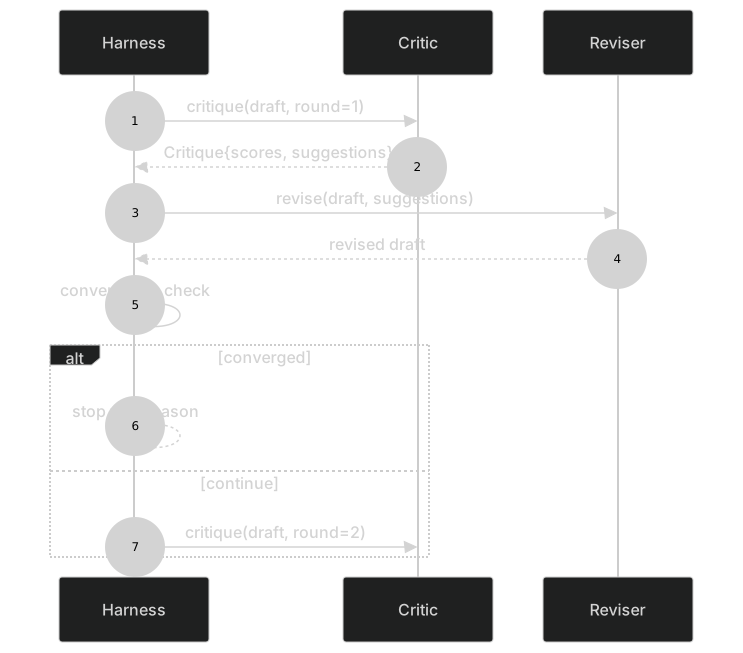
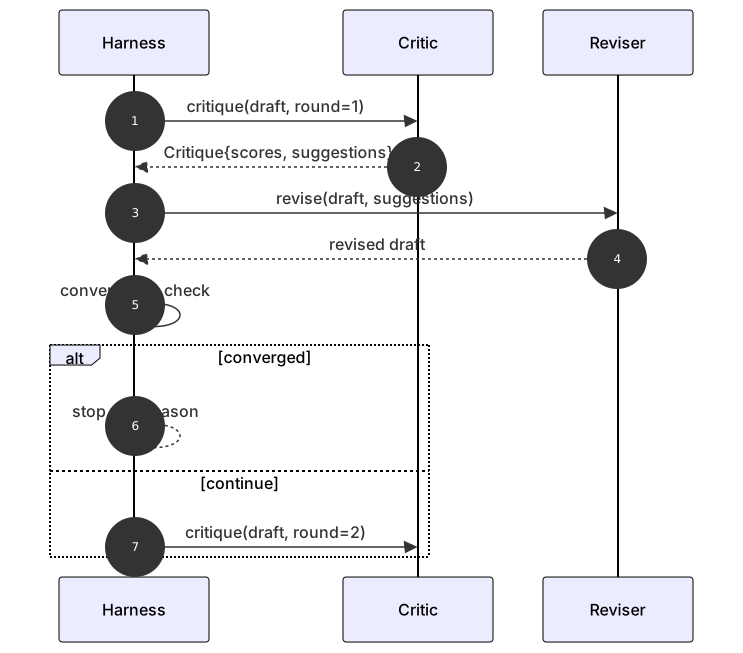
The harness owns the round counter, the trace, and the convergence check. The critic owns the score. The reviser owns the diff. None of the three touches the others' state.
The Trace output
Every round emits one trace event with the round number, the score vector, the suggestion count, and the convergence verdict. The full trace is returned alongside the final draft. A downstream dashboard can render the score-per-round chart. The next lesson, the iteration scheduler, reads the trace to decide whether the branch is worth keeping.
Budgets that protect against bad critics
A critic that produces suggestions that never improve the score will lock the loop into the max-iteration ceiling. The trace makes that visible: five rounds, scores flat, verdict budget. The user reads that as a critic bug, not a draft bug. The alternative, surfacing only the final draft, hides the diagnosis. Trace-first design surfaces it.
How to read the code
code/main.py defines Critique, Suggestion, Critic protocol, Reviser protocol, CriticLoop, and a make_deterministic_critic_pair factory that returns the deterministic critic and a matching reviser. A minimal Paper shape is included so the lesson stands alone.
code/tests/test_critic_loop.py covers: monotone improvement after round one, target convergence on a tuned draft, plateau detection after two flat rounds, budget exhaustion when no suggestion improves, suggestion application by the reviser, and trace shape.
Going further
Two extensions a real implementation will want. First, dimension weights: a paper for a workshop weights novelty higher than methodology; a journal weights the inverse. The convergence check becomes a weighted mean. Second, paired critics: one critic scores, a second critic adjudicates the suggestions before the reviser sees them. Both add value, both compose on the same Critique shape.
The bet is the score vector. Once the critique is structured, every other improvement, convergence rule, dashboard, paired critic, drops in without changing the loop.
Check yourself
Quick quiz
Why does the critic score across five fixed dimensions instead of returning a freeform paragraph?
- Because models cannot generate paragraphs reliably
- Because the reviser only accepts JSON
- Because LaTeX requires a score field
- Because a fixed vector lets the harness detect per-dimension regressions across rounds
Show the answer
D. Because a fixed vector lets the harness detect per-dimension regressions across rounds A fixed dimension vector turns critique into structured data the harness can compare across rounds. Freeform criticism is unverifiable; vectors make regressions visible.
In what order does the loop check stop conditions at the end of a round?
- Plateau, then target, then budget
- Budget, then plateau, then target
- Whichever fires first by random tie-break
- Target, then plateau, then budget
Show the answer
D. Target, then plateau, then budget Target met wins (the work is done). Then plateau (no more progress is achievable). Then budget (hard cap). The order makes the result deterministic when more than one condition could fire.
Why does plateau detection require two consecutive flat rounds rather than one?
- Because the model returns nondeterministic scores
- Because deterministic scoring still has noise per round; one flat round is not enough signal
- Because the dataclass requires a list
- Because the dashboard expects two points
Show the answer
B. Because deterministic scoring still has noise per round; one flat round is not enough signal Even a deterministic scorer's output changes round to round depending on which suggestions were applied. Requiring two flat rounds filters that noise.
What does the reviser receive as input each round?
- The raw LaTeX source
- A model-generated paragraph
- The full Critique object including scores
- The paper and the list of Suggestion records
Show the answer
D. The paper and the list of Suggestion records Reviser.__call__ takes (paper, suggestions). Each Suggestion carries a dimension, target section, and an edit instruction. The reviser does not see scores. That separation lets either side be swapped without touching the other.
What does the trace contain for each round?
- Just the final paper draft
- Only the convergence verdict
- The model prompt and completion
- Round number, score vector, mean, suggestions applied, verdict
Show the answer
D. Round number, score vector, mean, suggestions applied, verdict The trace is the per-round event log. Dashboards render it as a score-over-time chart; the next stage reads it to decide whether the branch is worth keeping.
A critic that keeps emitting suggestions that never improve any score will produce which terminal verdict?
- converged, because suggestions were applied
- target, because the budget hides the bug
- plateau or budget, because the harness will catch the lack of progress
- An exception, because the loop crashes
Show the answer
C. plateau or budget, because the harness will catch the lack of progress Either plateau (two flat rounds) or budget (hard cap) fires. Both verdicts surface the bug. The loop never silently succeeds.
Questions people ask
What is a critic loop in AI agents?
One model writes a draft and another, or the same model with a different prompt, critiques it. The writer revises based on the feedback, and the loop repeats until the critic is satisfied or a round limit is hit.
How do you stop an AI critique loop from running forever?
Set a maximum number of rounds, require the critic to give specific, scored feedback, and stop when scores stop improving. A critic that always passes or always fails is broken and should be fixed before trusting the loop.
Lessons from AI Engineering from Scratch by Rohit Ghumare and contributors, MIT license. Notes for owners by Lozo. License